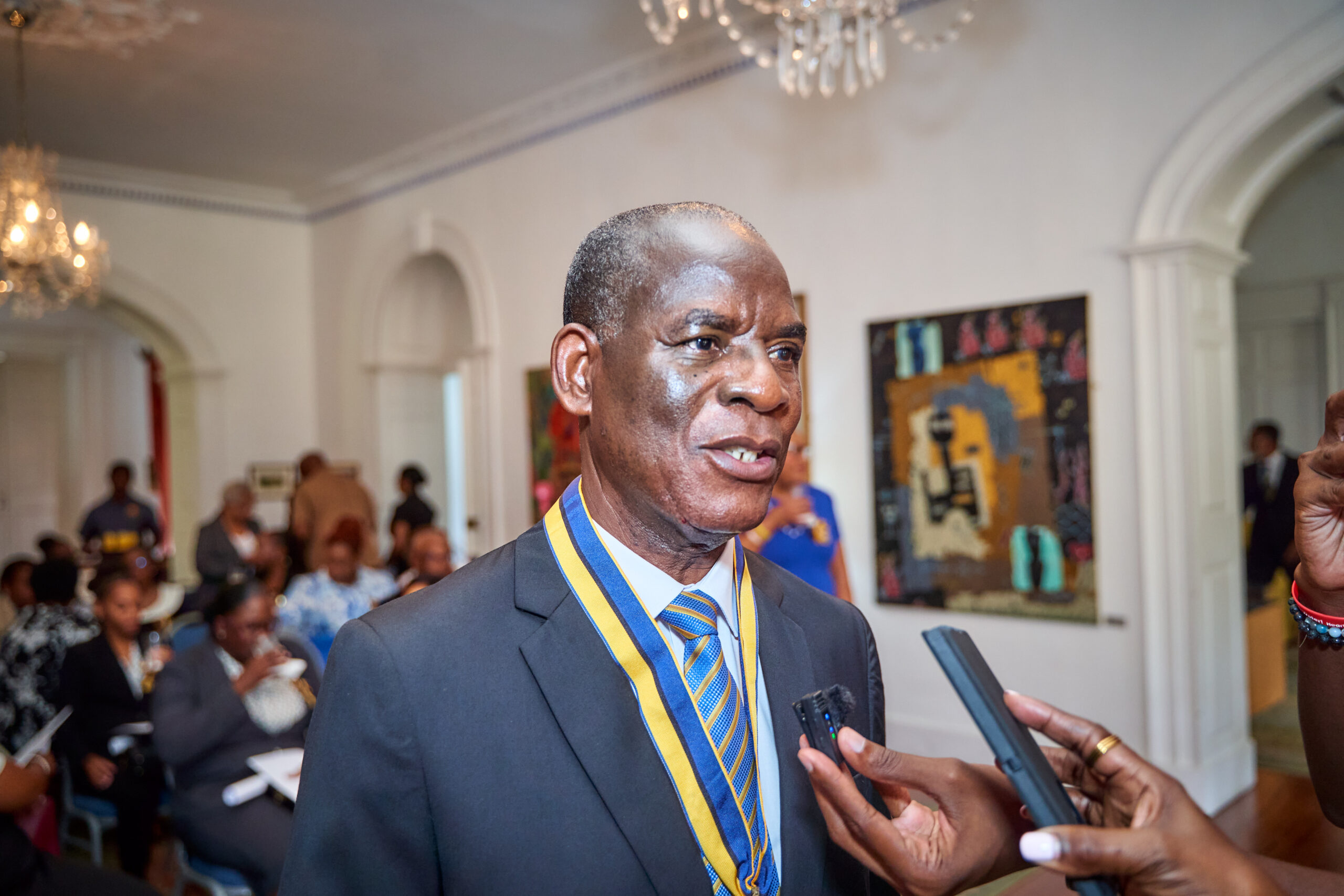
On Wednesday, as Barbados honored the team that steered the country off two major global anti-money laundering risk lists, Senate President Reginald Farley delivered a stark warning: the island nation has just over a year to prove its ongoing compliance with tightened international anti-money laundering and counter-terrorist financing standards, or it could be pushed back onto harmful grey and blacklists.
Farley was a core member of the working group that secured Barbados’ removal from the Financial Action Task Force (FATF) grey list and the European Union’s blacklist of high-risk financial jurisdictions, a milestone achieved earlier this year after more than seven years of sweeping regulatory reform. During a national honours ceremony at State House recognizing the efforts of the FATF Action Plan Implementation Team and the International Business Unit Economic Substance Team, he laid out the strict timeline for the upcoming compliance assessment.
“Between now and June next year, we essentially have to prove to the international financial community that we have a system which is compliant with the new arrangements,” Farley told reporters on Wednesday. The delisting achieved earlier this year was the end result of a years-long reform process launched after a 2016–2017 mutual evaluation identified critical gaps in Barbados’ regulatory framework. At that time, FATF issued a formal action plan with binding deadlines for the country to address its deficiencies, a process that dominated the work of financial regulators and government officials for nearly a decade.
Though Barbados has retained its off-list status to date, Farley confirmed that a high-stakes re-evaluation is scheduled for June 2027. Over the coming months, Barbados will first submit a series of detailed written reports to international assessors, before a review team travels to the island for what Farley called the “final test.” During the on-site visit, assessors will interview stakeholders across the private sector, national law enforcement agencies, and top financial regulators. Their mandate: verify that Barbados’ domestic laws, regulatory frameworks, and enforcement mechanisms are robust enough to counter money laundering, block terrorist financing, and stop the proliferation of weapons of mass destruction.
“As a member of the international community, one of the requirements is that all countries must show they are not even unwittingly being used as a funnel for money to fund terrorist activity or the spread of weapons of mass destruction,” Farley explained. Against a backdrop of stricter global standards for the fifth round of FATF evaluations, the Senate President stressed that Barbados cannot afford to ease its reform efforts. “We have a responsibility to redouble our efforts to ensure that under the new tightened rules of this next fifth round, we do not find ourselves on any negative listing,” he said.
Back in February of this year, when Barbados secured its delisting, Finance Minister Ryan Straughn called the achievement a major breakthrough after more than seven years of relentless work. He emphasized that the milestone clears the way for Barbados to position itself as a leading, fully compliant international investment hub aligned with all global tax and regulatory standards. “Over the last seven and a half years, the government has worked to address every issue highlighted on the EU black list, working alongside FATF and the OECD,” Straughn said at the time. “We did this because the reputation of Barbados required a complete overhaul, to demonstrate that we are a well-run jurisdiction.”
Leading regional economists echoed that optimism when the delisting was announced. Dr. Don Marshall, director and senior research fellow at the Sir Arthur Lewis Institute of Social and Economic Studies (SALISES), framed the removal from the lists as a transformative boost to Barbados’ national brand. He noted that the economic benefits of the improved reputation would be felt almost immediately, helping to stabilize existing international businesses operating on the island and attract new foreign direct investment.
For the upcoming assessment, Farley has reaffirmed Barbados’ commitment to meeting all global requirements, pledging that the government will allocate the necessary financial and technical resources, and pass any new legislation needed to preserve international confidence in the country’s financial sector. He also outlined the coordinated governance structure that guides Barbados’ anti-money laundering (AML) efforts: overall responsibility falls to the Office of the Attorney General through the national AML Authority, which works in close coordination with law enforcement, customs, the Barbados Revenue Authority, the Central Bank of Barbados, and the Financial Services Commission via a formal AML Network that holds regular coordination meetings.
“We do have governance structures in place, a coherent strategy, and a national action plan mapping where we are and what we need to deliver to meet our goals by the end of this process in June 2027,” Farley said.