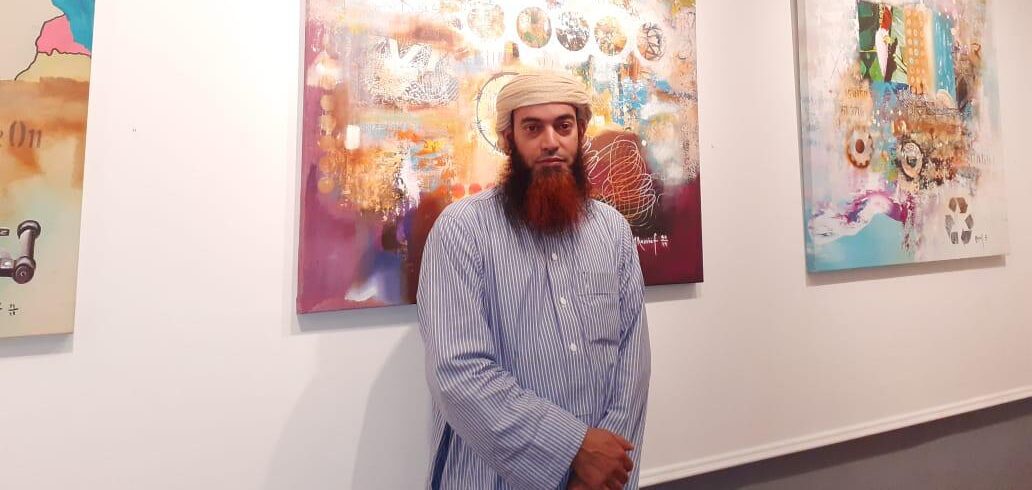
For internationally recognized Dominican-born artist Jean-Claude Elias Nassief, better known by his professional name Ilyas Nassief, art has always been a mirror that reflects the full arc of a life shaped by movement, learning, and rediscovery. This month, he prepares to open his most personal exhibition to date, titled *The Return Series*, a collection of works rooted in themes of cross-border migration, collective and personal memory, evolving cultural identity, and the quiet joy of returning to one’s creative roots after a long journey away from the canvas.
Nassief’s artistic path began in his home country of Dominica, where he was born in June 1968. He pursued formal artistic training in the United States, cutting his teeth in printmaking at Miami Dade Community College before completing his fine arts degree at the prestigious Maryland Institute College of Art. Over the decades, his work has earned global acclaim and widespread recognition across multiple creative fields: in 1995, he took home first prize in the highly regarded Lime Calendar Cover Design competition, and his art has graced the covers and pages of prominent publications including *Miambiance* magazine, *France-Antilles* newspaper, and *Domnitjen Magazine*. His work has been featured in international exhibitions spanning from Vienna’s Art Exchange to the Cezanne Center in Saudi Arabia, CARIFESTA 2019 in Trinidad and Tobago, and the Gallery of Caribbean Art in Barbados, alongside solo and group shows across the Caribbean with titles like *Repetition*, *Glimpses of Contrast and Sameness*, and *All Must Go*.
A defining chapter of Nassief’s creative journey came between 2000 and 2012, when he stepped back from full-time painting to explore other passions, most notably the academic study of Arabic language. Even as painting receded to the background of his life, it never fully left his creative identity, and when he returned to the canvas, he brought with him a new depth of perspective shaped by his years living abroad. After 25 years residing in Saudi Arabia — a period he describes as deeply enriching both culturally and intellectually — Nassief made the decision to relocate back to his native Dominica. The journey home was far from simple: bureaucratic red tape and complex logistical hurdles turned a planned move into a years-long struggle, with barriers that finally fell only in December 2025.
Even after arriving home, limitations shaped the earliest works of what would become *The Return Series*: restricted access to professional art supplies left Nassief working with just three core pigments, a constraint that ultimately shaped the stripped-down, intentional aesthetic of his new pieces. That raw, focused approach aligns with the artistic philosophy Nassief has cultivated over his entire career, rooted in his foundational training in printmaking. His signature style blends classic print techniques including woodcutting and stenciling, balancing abstract non-figurative imagery with recognizable, relatable visual elements. Contrast, he says, has been a core theme of his work since he first began creating art: contrast between bold and muted hues, between organic and geometric shapes, between rough and smooth textures.
“My art is based on a vision that goes beyond geographical limitations to embrace traditions that are universal and varied, much like the variety in all aspects of the world which surrounds us,” Nassief explained in his artist statement for the upcoming show.
*The Return Series* brings together both earlier works created during Nassief’s time abroad and new pieces completed after his return to Dominica, revealing the recurring symbols, forms, and themes that have threaded through his entire creative practice. Rather than seeing a sharp divide between works created in different places and times, Nassief notes that core motifs often reemerge and are reimagined across new bodies of work, creating a cohesive creative language unique to his practice. This continuity, he argues, is inherent to all art: “art, in reality, is an expression of thought, directed by inspiration and what one sees as relevant or important.”
A recurring symbolic throughline in the exhibition is the use of Madras fabric, a textile deeply tied to Dominican and broader Caribbean cultural identity. For Nassief, the fabric carries layered meaning that perfectly encapsulates his interest in cross-cultural connection. The textile takes its name from Chennai, India — where it has long been produced — and the word itself traces back to the Arabic term *madrasah*, meaning “place of learning.” This layered history, with connections to South Asia, the Arab world, and the Caribbean, embodies the interconnectedness that is central to his work.
Unlike the direct observational tradition that defines much of European art, Nassief’s practice draws heavily on intuitive and abstract approaches rooted in Eastern and indigenous artistic traditions, aligning more closely with his personal creative perspective. Rejecting narrow definitions of art tied to national or geographic boundaries, he instead leans into the universal threads that connect creative practices across the globe, even as his own personal experiences and roots inevitably find their way into his work.
As audiences prepare to engage with *The Return Series*, Nassief says he has no fixed expectations for how viewers should interpret his work. Instead, he hopes each person will find their own personal connection and inspiration in the canvases, a outcome that he considers the ultimate goal of any creative work.