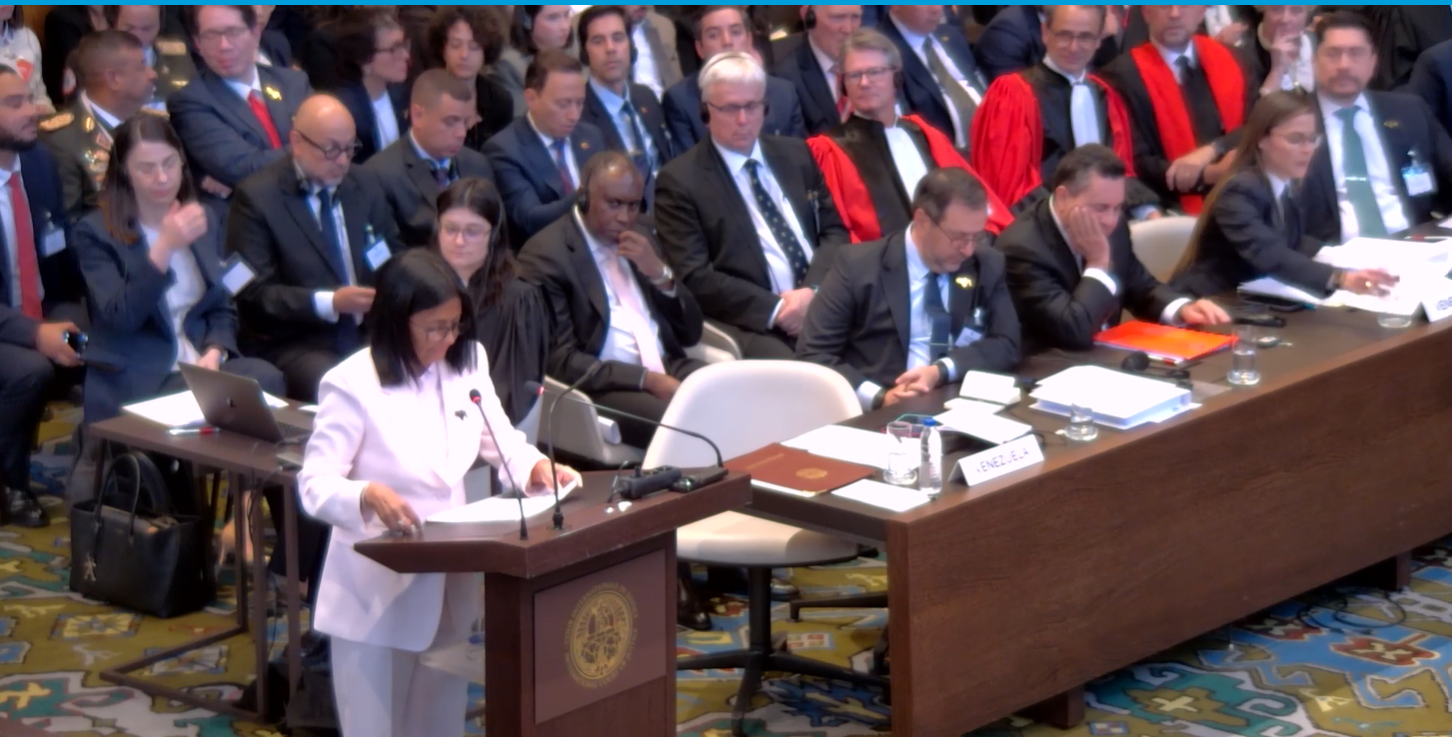
On Monday, 11 May 2026, Venezuela’s interim President Delcy Rodriguez delivered closing oral arguments before the United Nations’ highest judicial body, the International Court of Justice (ICJ), and issued a clear statement that Caracas will reject any ICJ judgment that upholds the validity of the 1899 Arbitral Tribunal Award, which established the current border between Venezuela and Guyana over the resource-rich Essequibo Region.
Rodriguez emphasized that Venezuela’s refusal to recognize ICJ jurisdiction over the decades-long territorial dispute extends to all possible outcomes of the current proceedings. “Even if the Court were to declare the 1899 award invalid, Venezuela would be unable to comply with such a ruling, as it would undermine the 1966 Geneva Agreement and core principles of international law,” she stated. “It follows very clearly that there is no legal basis for recognizing any decision resulting from this process, whatever that decision may be.”
The interim president reaffirmed Venezuela’s long-held position that the 1966 Geneva Agreement, signed by Venezuela, the United Kingdom, and British Guiana ahead of Guyana’s independence, remains the only internationally valid framework for resolving the border dispute. She warned that any ICJ judgment on the controversy will not deliver a mutually acceptable definitive resolution, and will instead deepen divisions between the two South American nations.
“Any ruling by this court will only push both sides to entrench themselves further in their opposing positions, moving us further away from the practical, mutually satisfactory settlement both parties committed to reaching when we signed the Geneva Agreement in 1966,” Rodriguez explained.
Instead of ICJ adjudication, Rodriguez proposed an alternative path aligned with the peaceful goals of the 1966 accord: a high-level bilateral negotiation mediated by key regional stakeholders. She argued that this approach would be far more productive and effective than judicial proceedings in reaching a lasting resolution that works for both nations.
Rodriguez also pushed back against claims that a ruling in Guyana’s favor would resolve the dispute permanently, noting that such an outcome would not end Venezuela’s territorial claims and would only return the conflict to the long-standing impasse the Geneva Agreement was designed to address.
She further accused Guyana of abandoning the Geneva accord and acting in bad faith starting in 2015, when large oil reserves were discovered offshore of the Essequibo Region. Since that discovery, Rodriguez said, Guyana has deliberately sought to evade its obligations under the 1966 agreement by turning to the ICJ for a binding ruling.
Outlining Venezuela’s historical claim to the territory, Rodriguez argued that irrefutable evidence confirms Essequibo has been part of Venezuela’s sovereign territory since the formation of the Captaincy General of Venezuela by the Spanish crown in 1777, which included the province of Essequibo as an official administrative unit. This administrative boundary, she said, forms the territorial foundation of the independent Republic of Venezuela declared in 1811, and every Venezuelan constitution since independence has explicitly enshrined Guayana Esequiba as Venezuelan territory. She added that the United Kingdom formally recognized Colombia’s eastern border as reaching Guayana Esequiba in 1825, meaning the UK never held legitimate legal title to the territory — a right that also cannot be claimed by its successor state Guyana today.
“Beginning in 1840, after discovering immense gold reserves in the territory, the British Crown designed a deliberate strategy to seize and plunder the region, and now Guyana seeks to artificially forge a false legal title to the land through these misleading proceedings,” Rodriguez said.
The interim president also condemned Guyana’s request that the ICJ order Venezuela to remove all references to Essequibo from national maps, remove it from history education, and eliminate national symbols that reference the territory — measures she described as an attempt to erase Venezuelan claims to the region. “The aim is to erase the memory of a people in order to nullify their future,” she said. “Annihilating history will never, never legitimise dispossession.”
To counter Guyana’s argument that neither Spain nor Venezuela ever exercised effective control over any part of the Essequibo Region, Rodriguez presented newly submitted Venezuelan maps showing Spanish administrative control extended inland as far as the Pomeroon River within Essequibo.
Guyana has maintained consistently that the 1899 Arbitral Tribunal, the treaty that established it, and its final boundary award are all fully legal and valid. It also rejects Venezuela’s claims, based on a posthumous memorandum from former arbitrator Mallet Prevost, that the tribunal’s president, Friedrich Martens, engaged in manipulative backroom dealing to sway tribunal members toward a ruling that favored British interests.
Notably, Rodriguez avoided the harsh anti-American rhetoric that defined the previous administration of former President Nicolas Maduro, who often accused the U.S. government, U.S. Southern Command, and ExxonMobil of colluding with Guyana to seize Venezuelan territory. Following Maduro’s removal from office in a U.S.-backed military operation, bilateral relations between Washington and Caracas have improved significantly under Rodriguez’s interim government: U.S. sanctions on Venezuelan oil exports have been lifted, relevant domestic laws have been amended to align with bilateral cooperation, and major American oil companies have already begun returning to operate in Venezuela.