By May 11, widespread flooding has crippled parts of Paramaribo, Wanica and Saramacca in Suriname, leaving local farmers facing catastrophic, imminent losses as decades of mismanagement and flawed policy decisions have left the region’s critical Saramaccakanaal drainage system unable to handle extreme rainfall.
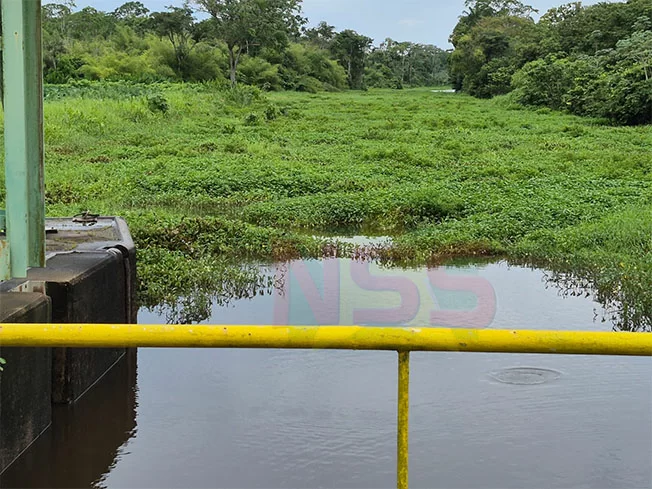
The 25-kilometer Saramaccakanaal serves as the primary drainage artery for the low-lying coastal region, connecting the Suriname River to the Saramacca River and carrying excess water away from residential areas, infrastructure and thousands of hectares of agricultural land. Just two years after a major cleanup, the canal and its feeder canals are already choked with overgrown vegetation and illegally dumped waste, cutting their capacity dramatically. When paired with record high water levels in the Saramacca River driven by intense inland rainfall, the entire system has ground to a halt.
The key sluice gate at Uitkijk/Creola, which relies on gravity to drain water from the canal into the river, cannot operate even at low tide. For the gate to function, the river’s water level must sit lower than the canal’s, but persistent heavy rainfall has left the two levels nearly identical, eliminating the elevation difference needed to move excess water out. A small, existing pumping station only serves a fraction of the Uitkijk polder, leaving the vast majority of the region with no active water removal. Feeder canals that are supposed to channel runoff into the main Saramaccakanaal are entirely overgrown, trapping water on roads, residential plots and farmland, with water levels showing almost no sign of dropping days after the worst rain passed.
For local farmers, the situation has already devolved into a humanitarian and economic disaster. Entire crop plantations are submerged, and growers warn that most plants will rot and become a total loss within 24 hours if water is not drained immediately. Many farmers have carried outstanding loans to plant their seasonal crops, and widespread losses threaten numerous small and mid-sized operations with bankruptcy. Frustrations run high: farmers say they have warned successive national governments about the decaying drainage infrastructure, blocked canals, and insufficient capacity for decades, but their warnings have gone unanswered. “Successive governments have left farmers to fend for themselves,” many growers said bitterly.
Technical experts and local politicians confirm that the current crisis is rooted in long-standing structural failures and bad decision-making on a major World Bank-funded drainage rehabilitation project. The $35 million project was supposed to upgrade the Saramaccakanaal system, but lawmaker and large-scale Saramacca farmer Mahinder Jogi, from the ruling VHP party, says planners ignored critical technical advice to install two large capacity pumping stations – one at Uitkijk on the Saramaccakanaal and one at the Suriname River end.
Jogi explains that the Creola sluice was never designed to serve as the primary outlet for flood water; it was originally built to support shipping and provide water to agricultural areas during dry seasons. Without large pumping stations, the system cannot actively push water out into the river when the water levels are aligned, leaving the region completely vulnerable during extreme rain events. Jogi also alleged that project leaders ignored expert input to prioritize contracts that benefited a small group of insiders, failing to deliver the functional flood protection the region was promised.
Independent engineering experts agree with this assessment. Ravi Patandin, an engineer with leading Surinamese engineering firm Ilaco, told reporters that the existing gravity-based system is already at its absolute limit during periods of extreme rainfall, which are becoming more frequent and intense due to climate change. Patandin noted that gravity drainage is only possible for a few short hours around low tide, and when river levels remain elevated even at low tide, no drainage can occur at all. He added that small pumping stations would make no meaningful difference in a crisis of this scale; to properly protect the region, pumping installations with a capacity of 20 to 30 cubic meters of water per second are required, matching the large-scale system that already protects the Wakay area in Nickerie.
Ongoing rehabilitation work on five sluice gates and one navigation lock at the Suriname River end of the canal is not scheduled for completion until August or September 2026, meaning no relief can come from that project for months. The work, which launched in 2024, has been slowed by lengthy procurement, design, manufacturing and shipping processes for replacement parts, and one sluice is already completely out of service, worsening the current backlog. Workers are keeping as many existing drainage points operational as possible in the interim, but the capacity remains far too low to handle the current flood volume. Even when the rehabilitation is complete, it will only restore roughly 60 percent of the canal’s drainage capacity, and the problem will remain unresolved until the large pumping stations are added at Uitkijk and other critical points.
Beyond infrastructure investment, experts say chronic under-maintenance and public non-compliance have made the crisis far worse. Even after the 2024 cleanup, the canal and feeder trenches have become choked with overgrown vegetation, and large volumes of household and construction waste are illegally dumped into the waterway, further blocking flow. Patandin emphasized that regular, consistent maintenance is non-negotiable to keep the system functional, and that local communities must also take responsibility to stop dumping waste into drainage channels.
As climate change increases the frequency of intense, short-duration rain events, Suriname’s flat coastal region will remain extremely vulnerable to repeated catastrophic flooding unless the government implements long-term structural fixes. Experts warn that temporary patchwork measures will no longer be enough to protect communities and the critical agricultural sector: without expanded pumping capacity, fully functional sluices, and consistent long-term maintenance, flooding events will only grow more severe with each passing rainy season. Right now, losses are mounting by the day as floodwaters remain stagnant across thousands of hectares, leaving farmers waiting for a rescue that experts warn will not come for months.