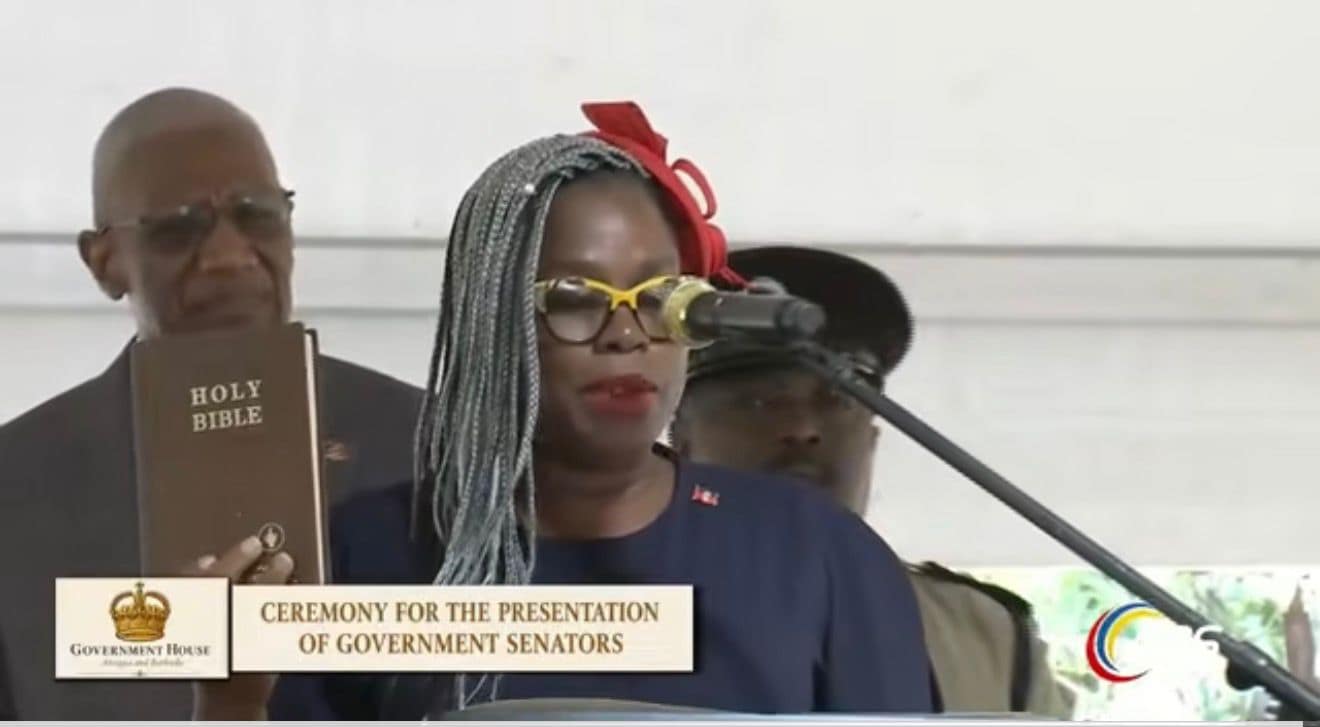
As Alincia Williams-Grant prepares to step into her fourth consecutive term as President of the Senate of Antigua and Barbuda, the veteran lawmaker has laid out a clear policy agenda focused on boosting public civic literacy, strengthening parliamentary autonomy, and advancing gender representation in national politics.
Williams-Grant spoke publicly about her goals shortly after Friday’s swearing-in ceremony held at Government House, where she described her reappointment to one of the nation’s top legislative roles as a deeply meaningful and humbling milestone. “It’s emotional and it’s an honor,” she told reporters. “Public service is a daily calling, and you must always approach this office with humility and gratitude.”
First appointed to the role after the Antigua and Barbuda Labour Party won national office in 2014, Williams-Grant acknowledged that this incoming term will bring a fresh set of unprecedented challenges, but she said she is ready to take them on. “This is my fourth term in this position, and it has been a tremendous responsibility over the years,” she noted. “I’m looking forward to the challenges that come with this new dispensation.”
Turning to the topic of gender representation in the upper chamber, Williams-Grant shared that while four women were newly appointed to the Senate this term, she had hoped to see a greater number of female legislators seated. She pointed out that the current figure actually represents a small step backward; when the administration first took office in 2014, the Senate boasted a higher share of female representatives. Even so, she praised the Gaston Browne-led administration for its ongoing commitment to lifting women into leadership positions across all levels of government. “We’re very happy that there has been a continued commitment by the Gaston Browne administration to empower women in every way possible, at every level possible,” she said.
Williams-Grant also took time during her remarks to pay tribute to former senator Mary-Claire Hurst, who she described as a foundational mentor and inspiration for women across Antigua and Barbuda’s public sphere. “Her motto has always been mentoring and empowering others — young people, women,” Williams-Grant said. “In this moment, we must honor that legacy; because of her work, so many of us are able to stand here today.”
On a positive note, Williams-Grant highlighted a notable shift in youth engagement over the past decade: she has observed a sharp increase in interest from young women seeking to enter public life, with many now reaching out to ask how they can pursue a senate appointment. This growing enthusiasm stands in stark contrast to the widespread political apathy among young people that marked the early days of the current administration in 2014, when many young people distanced themselves entirely from political processes, she noted.
Addressing the internal operations of the Senate, Williams-Grant emphasized that the upper house serves a critical function as the final legislative review body, requiring rigorous standards and careful attention to the details of proposed policy before it reaches the public. “We are the most civilized chamber,” she said with a laugh. “We are very particular about the work that we do because we are the review body — we are the last stop before legislation affects the public.”
To support incoming first-time senators, Williams-Grant revealed she has already reached out to regional and international parliamentary partners to organize specialized training programs, designed to help new legislators understand their constitutional roles and responsibilities thoroughly. “We want to make sure that they understand the role from day one,” she explained.
A core priority for Williams-Grant this term will be closing the persistent gap in public understanding of how parliament functions. She argued that many Antigua and Barbuda residents still fail to distinguish the legislative branch of government from the executive, a lack of clarity that erodes public respect for the legislature’s independent mandate. “I think too often in this country, persons do not appreciate the legislative function,” she said. “There’s no deference given to the legislature separate from the executive. It’s confusing, and people don’t understand the separation.”
To address this, Williams-Grant aims to launch targeted civic education initiatives this term to boost public awareness of the legislature’s independent role, while also strengthening the institution’s structural capacity. Beyond public education, she is also pushing for greater formal autonomy for parliament, arguing that the legislative branch should operate with the same level of independent authority already granted to the judiciary and executive branches. Williams-Grant disclosed that she first discussed the need for these changes with the late prominent parliamentarian Sir Gerald Watt, and revealed that targeted structural reforms could be introduced during the new term. “You will be seeing some changes… more in terms of tightening up how we function as a legislative arm of government, in line with our constitutional mandate,” she said.
She credited ongoing youth outreach programs and civic engagement efforts for the growing interest in parliamentary participation among young people, especially young women. Working to dismantle outdated stereotypes about political life, Williams-Grant noted that “Politics, political life, parliament is not just for the ordinary boring person.” She praised the growing visibility and advocacy of younger senators and civic leaders for making public service feel more accessible and appealing to a new generation of Antiguans and Barbudans.