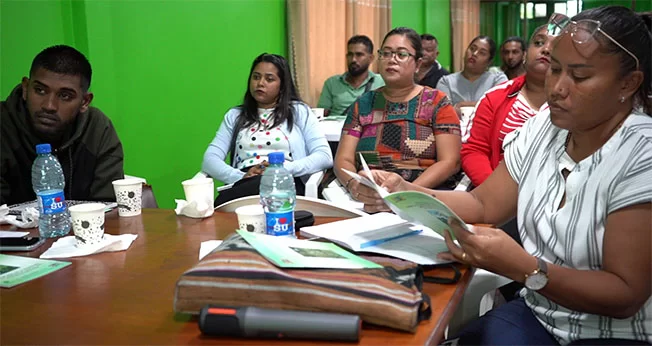
Growing consumer demand for citrus fruits has pushed Suriname’s Ministry of Agriculture, Livestock and Fisheries (LVV) to strengthen regional agricultural support offices and launch a targeted capacity-building initiative aimed at upgrading the country’s citrus sector. The new Citrus Cultivation Training, launched as part of the IDB-funded ‘Strengthening of Citrus Production in Suriname’ project and implemented by the Fruit Tree Research Department (VBO), comes as persistent import dependence for oranges and orange juice highlights gaps in local output despite years of distributed citrus sapling sales.
LVV Minister Mike Noersalim emphasized that the training program aligns with the ministry’s core goals: raising citrus output, improving fruit quality, and building a more sustainable local citrus industry. Unlike many short agricultural workshops, this comprehensive program runs between 12 and 18 months, matching the full growth cycle required to cultivate market-ready citrus saplings from seed. “When we successfully grow a sufficient supply of healthy saplings, we can make them available for sale to the public,” Noersalim explained, noting that while thousands of saplings have been sold in recent years, the impact on overall local production has not matched rising consumer demand. Today, Suriname still relies heavily on imported oranges and processed orange juice to meet domestic consumption needs.
Many participants in the program are already small-scale citrus growers who have chosen to upskill to address evolving industry challenges. Noersalim pointed out that emerging crop diseases, invasive pests, and the growing impacts of climate change have created an urgent need for updated growing knowledge. “It is very encouraging that existing small-scale producers are proactively seeking out new information and techniques to adapt to these changes,” the minister added. The high turnout for the training also underscores the strong level of interest across Suriname’s agricultural community in expanding citrus production.
Acting Director of the Directorate of Agricultural Research, Marketing and Processing Rayen Toekoen confirmed that citrus is a strategically important crop in Suriname, valued for both large-scale commercial production and small-scale household cultivation. However, the sector currently faces a range of persistent barriers, including low overall productivity, frequent disease and pest outbreaks, and limited adoption of modern, climate-adapted cultivation techniques. The training program is designed to directly address these gaps by delivering both practical skills and evidence-based technical knowledge to participating farmers and agricultural extension officers.
The curriculum combines structured classroom learning with hands-on field training to ensure participants gain actionable skills. Theoretical modules cover topics including citrus variety identification, climate-adapted cultivation methods, and proven strategies to boost output. Practical sessions allow trainees to apply new techniques directly in growing fields, with guided practice in pruning, crop maintenance, pest and disease identification, and soil nutrient management. By equipping local producers with updated skills, LVV aims to grow domestic citrus output, reduce long-term import dependence, and build a more resilient, sustainable citrus sector for Suriname.