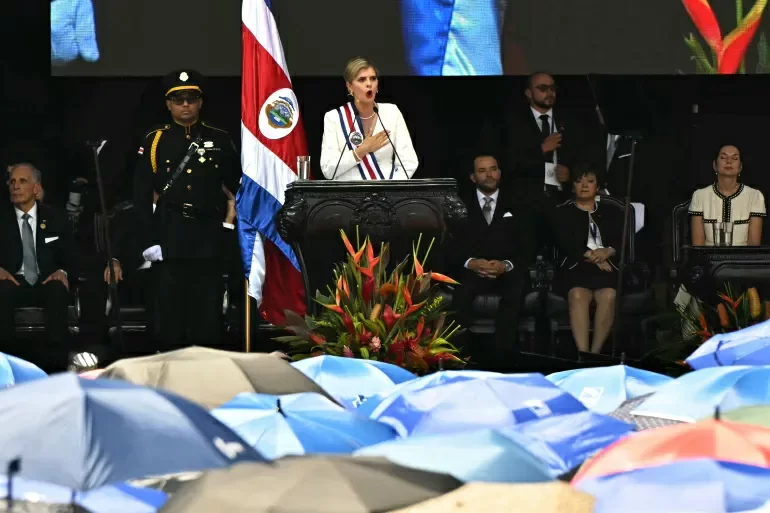
On May 9, 2026, Laura Fernandez, a 39-year-old center-right political leader, took the oath of office as Costa Rica’s new president during an inauguration ceremony held at San José’s National Stadium, marking a new chapter for the Central American nation already navigating rising security challenges and shifting regional geopolitics.
Fernandez’s Sovereign People’s Party (PPSO) secured an absolute majority in the 57-seat national parliament, claiming 31 seats – a governing advantage that clears the way for her administration to advance its full legislative agenda without relying on opposition support. She first claimed victory in the country’s February 1 presidential election, a hotly contested race that saw her defeat competitors to succeed outgoing president Rodrigo Chaves, a well-documented ally of former U.S. President Donald Trump. In a surprising arrangement that preserves Chaves’ influence in national governance, the former leader will remain in the new cabinet as Minister of the Presidency and Finance, granting him continued significant sway over policy making.
To underscore her administration’s commitment to deepening the strategic partnership between Costa Rica and the United States, Fernandez appointed new vice president Douglas Soto to serve concurrently as Costa Rica’s ambassador to Washington. The inauguration was attended by high-profile international guests that highlighted the new government’s geopolitical priorities: Kristi Noem, U.S. Special Envoy and leader of Trump’s ‘Shield of the Americas’ initiative, and Isaac Herzog, President of Israel, were both in attendance. Their presence drew attention to shifting regional alignment amid ongoing global tensions stemming from the Gaza conflict.
At the top of Fernandez’s policy priority list is addressing the steady rise in criminal activity that has shaken Costa Rica’s long-held reputation as one of Central America’s most stable nations. The country has increasingly become a key transit route for drug smugglers moving contraband north to the United States, fueling a surge in gang-related violence and organized crime. In response, Fernandez has announced sweeping, ambitious reforms to the country’s justice system and national security legislation, naming Gerald Campos as the new Minister of Public Security to lead the crackdown. ‘We are waging a merciless war on organized crime,’ Fernandez stated in her inaugural address, laying out her hardline stance on security.
Her administration’s approach to security closely echoes the controversial model adopted by neighboring El Salvador. Costa Rica is currently constructing a new maximum-security prison modeled after El Salvador’s mega-sized CECOT prison facility, which gained global attention for its mass incarceration of alleged gang members. The country is also a signatory to the controversial ‘third country agreements’ with the United States, a policy that allows the U.S. to deport migrants with no legal connection to Costa Rica to be detained and resettled in the country. Last year, hundreds of Venezuelan migrants deported from the U.S. were held in CECOT without due process, drawing widespread condemnation from global watchdogs. Human rights organizations have repeatedly criticized these agreements, warning that they expose deported migrants to severe risk of inhumane living conditions and human rights abuses.
With her party’s unchallenged majority in parliament, political analysts note that Fernandez faces few procedural barriers to pushing through her full proposed reform agenda, setting the stage for major shifts in both Costa Rica’s domestic security policy and its foreign relations in the coming years.