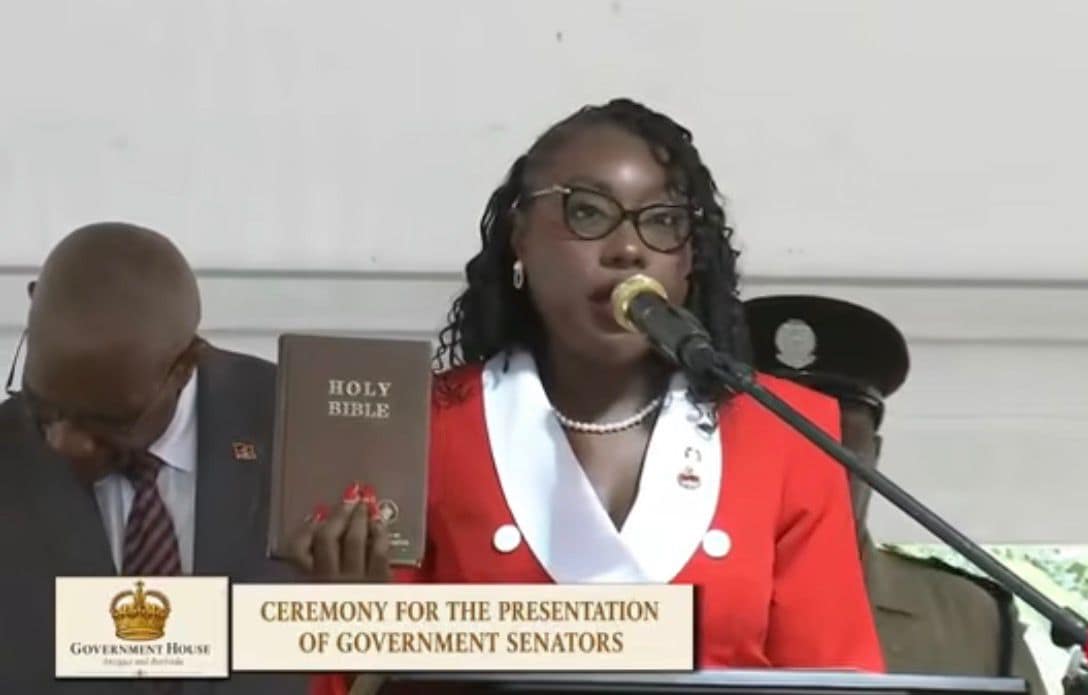
Following her formal swearing-in ceremony at Government House this Friday, newly appointed Senator Angelica O’Donoghue has stepped into her role in the Upper House of Antigua and Barbuda’s Parliament with a clear, people-centered policy agenda. The newest government senator, one of 10 ruling party appointees taking office after the April 30 general election that triggered a full reconstitution of the national legislature, called her appointment an emotionally meaningful and deeply gratifying milestone, crediting Prime Minister Gaston Browne for his mentorship and steady confidence throughout her career.
“I consider myself truly blessed,” O’Donoghue shared in her first public remarks after taking office. “My path to this chamber has been one of constant growth. After moving back to Antigua, I had the opportunity to work closely with Prime Minister Browne, and his unwavering trust and commitment to helping me build the skills and capacity to serve has brought me to where I am today.”
Drawing on her professional background in communications and public storytelling, O’Donoghue identified legislative transparency as her top priority in the Senate. She argued that complex legislative language often creates unnecessary barriers between lawmakers and the general public, leaving many citizens disconnected from the policy process that shapes their daily lives.
“As a professional communicator, my core goal is to make sure that every resident of Antigua and Barbuda can clearly understand and engage with the bills and amendments we consider here,” she explained. “Too often, critical policy information gets lost in jargon. Many legislative texts are dense, inaccessible, and hard for ordinary people to digest. I want to change that.”
O’Donoghue emphasized that closing this information gap is key to fostering greater public participation in national development. When citizens understand how proposed laws will impact their communities, they can contribute more meaningfully to the country’s growth, she said. “Whatever I bring before this chamber, the first priority will be making sure the public knows exactly what is at stake,” she added.
Beyond improving legislative outreach, O’Donoghue outlined four key policy areas she plans to champion during her tenure: reparations for historical injustices, expanded youth development initiatives, full gender parity in political representation, and broader social justice reform. As a longstanding reparations advocate, she confirmed that she will elevate conversations around historical and reparatory justice ahead of the upcoming Commonwealth Heads of Government Meeting, scheduled for later this year.
She also celebrated the growing number of women serving in Antigua and Barbuda’s Parliament, crediting the Browne administration for making gender parity a central governing priority. “Gender parity has been a core mandate of Prime Minister Browne’s government from the start,” she noted. “It has long been top of his agenda to ensure that every community’s voice is fairly represented in both houses of the legislature.”
Increased female representation, O’Donoghue argued, directly translates to more inclusive legislation that serves the needs of all members of society. For too long, proposed laws have often failed to center the interests of women, children, and marginalized vulnerable groups, she explained. “When more women take seats in the Upper House, the bills we draft and pass will reflect the needs of everyone in this country, not just a select few,” she said.