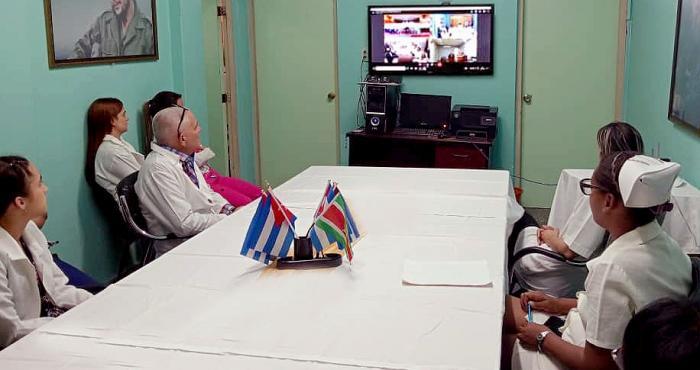
Just 30 days after integrating into Cuba’s National Virtual Hospital network, the Pepe Portilla Pediatric Hospital in western Cuba’s Pinar del Río has already emerged as a testament to how digital healthcare innovation can overcome longstanding systemic and geographic barriers to high-quality medical treatment. What was once a standard institutional meeting room has been reimagined as a digital hub connecting local clinicians to top specialists across the island, outfitted with a simple setup of a webcam, large display screen, and internet-connected computer.
This transformation is already changing outcomes for rare, complex pediatric cases that local providers rarely encounter in their practice. Dr. Jesús Lazo Cabrera, a clinician at the facility, recently leveraged the network to secure consensus for a six-month-old infant named Liam Valdés Morejón, who was born with congenital global emphysema — an extremely rare condition that affects just one in 20,000 to 30,000 births. With roughly 5,000 annual births across Pinar del Río, local clinicians may only see one case every five to six years, leaving them without frequent hands-on experience managing post-surgical complications. After Liam’s post-operative progress failed to match standard medical guidance, the team turned to the National Virtual Hospital for support.
Through the platform, Lazo Cabrera and his team shared real-time imaging, full patient histories, and clinical notes with leading pediatric specialists at Havana’s prestigious Juan Manuel Márquez Pediatric Hospital and other leading Cuban institutions, replicating the experience of having out-of-province experts in the exam room. The collaboration allowed the local team to align their treatment approach with national best practices and adopt a customized new care plan that Liam is currently following, with a formal re-evaluation scheduled in four weeks. Today, six months after his birth, the infant continues to make steady positive progress — a concrete outcome that demonstrates the network’s life-changing impact.
Dr. Mayte Cabrera Hernández, general director of Pepe Portilla Pediatric Hospital, explained that the National Virtual Hospital offers far more than just second-opinion consultations. The platform supports a full suite of telehealth services, including remote patient monitoring, remote diagnostic analysis, continuing medical education for local clinicians, and cross-institutional case consultations. For a country facing persistent fuel shortages that complicate long-distance patient transfers, the digital network addresses two critical challenges at once: it cuts unnecessary healthcare costs and eliminates the inherent medical risks of moving vulnerable pediatric patients hundreds of kilometers for specialist input. Even when transportation is available, Cabrera Hernández notes, avoiding travel reduces stress and risk for young patients and their families, while delivering the same standard of care available in Cuba’s capital.
In its first full month connected to the network, Pepe Portilla has already completed three remote specialist consultations, with the case of Liam standing as the clearest example of the model’s potential. For seasoned clinicians like Lazo Cabrera, the network fills a longstanding gap in care: even clinicians with decades of experience can encounter unique cases that other centers have more experience managing, and the platform unifies care standards across the entire country. “This gives us security in our procedures,” Lazo Cabrera explained, “because we can confirm our approach matches what top teams across Cuba use, and we can give families confidence that their child is receiving the same treatment they would get anywhere in the country.”
Pepe Portilla is not the only Pinar del Río facility participating in the program: the province’s Abel Santamaría Cuadrado General Teaching Hospital has also joined the national network, which aims to standardize care, share specialized medical knowledge, and close geographic gaps in access to care across Cuba, powered by digital health innovation. As Liam’s steady recovery shows, the initiative is already delivering on that promise, uniting clinicians across the island in a shared mission to protect patient health and save lives.