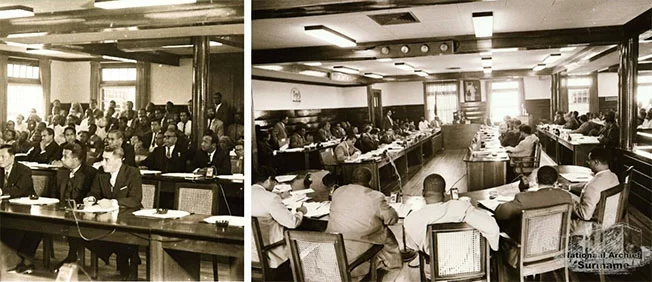
On May 8, Suriname marks a major historical milestone: 160 years of institutional popular representation. This occasion is rightly a source of national pride, but it also demands unflinching reflection. Beyond the formal ceremonies and celebratory speeches planned for Wednesday’s extraordinary public parliamentary session, a pressing, uncomfortable question lingers: Who truly represents the Surinamese people in 2026?
The trajectory of Suriname’s representative institution stretches back to the colonial-era Koloniale Staten established in 1866. After decolonization, it evolved into the Staten van Suriname, then the parliament of the independent Republic of Suriname, and today it exists as the National Assembly. Across all these iterations, the core mission has remained unchanged: to serve as a body that amplifies the public voice, oversees executive power, and guides the nation’s development. The 160th anniversary, therefore, is a natural moment to ask a fundamental question: How much of this original mission has been realized, and how much has slipped out of reach?
Today, what too often plays out in the National Assembly is not the pure practice of popular representation, but a perpetual political battlefield where governing coalitions and opposition factions hold one another in a constant stalemate. The governing bloc acts largely as an extension of the executive branch, and partisan loyalty consistently outweighs the broader public interest. Public parliamentary debates have devolved little more than scripted political theater, where positions are predictable before any representative takes the floor.
Recent years have only reinforced this grim picture. Political intrigue has become commonplace, with lawmakers frequently crossing the floor between factions. Backroom deals are rarely explained to the public, even as their impacts ripple across society. These trends have not strengthened public trust in representative institutions—they have eroded it dramatically. It is true that the assembly continues to formally function: laws are still passed, sessions are still held. But legislation itself is no achievement if it fails to improve the daily lives of ordinary Surinamese citizens. The question remains unanswered: How does this formal policymaking translate to tangible change beyond the walls of the parliamentary building?
For years, the most pressing daily concerns of Surinamese society have remained unaddressed: affordable public housing, accessible public healthcare, quality education, and reliable social services. These are not abstract policy talking points—they are concrete, urgent worries for working people. And it is on these issues that the public ultimately judges the performance of its representative body.
Equally fundamental is the National Assembly’s core oversight mandate. In theory, the body is the highest institution tasked with checking executive power. But in practice, the effectiveness of that oversight is increasingly open to question. Has the assembly truly forced the executive branch to deliver full transparency? Has it meaningfully improved governance across the country? Or has this critical role been weakened by the pressure of partisan loyalty and pre-negotiated coalition agreements?
For all these reasons, the 160th anniversary of popular representation is not an occasion for unbroken celebration and nostalgic pride alone. It is a moment to openly acknowledge what needs to improve—even what needs fundamental change. Reform begins with the standards we set for people entering parliament. It is past time to have a more serious conversation about the profile of effective representatives, moving beyond basic eligibility requirements to focus on core qualifications and accountability. A representative should be more than a partisan candidate or a party loyalist; they must demonstrate proven commitment to public service, broad life experience in civil society, strong general knowledge, and at minimum a solid educational background.
Even after candidates take office, the work of improving representation does not end. Every new cohort of parliamentarians should complete mandatory, structured training as a core part of their duties. Training in public administration, media engagement, and issue-specific preparation for sectoral committees is not an unnecessary luxury—it is a fundamental requirement. Without targeted knowledge and preparation, parliamentary oversight will always remain superficial, and legislation will always be vulnerable to gaps and misalignment with public needs.
Beyond individual qualifications, it is also time to re-examine the institutional structure of the National Assembly itself. Important steps toward modernization were already taken during the tenure of former speaker Jennifer Simons, and that progress must be continued. One critical question to consider: Should the speaker of the National Assembly be an independent figure, selected from a pool of candidates put forward by all contesting parties? This would be a figure who stands above partisan politics, meets strict standards of authority, expertise, and governing experience. Such a reform could significantly strengthen the quality of parliamentary leadership and the overall performance of the body as a collective political institution.
A parliament that only acts on partisan reflex quickly loses its meaning. A representative body that is out of touch with the concerns of the people it serves loses its legitimacy. That is why this 160th anniversary is less a celebration and more a critical wake-up call. The occasion is not just an opportunity to reflect on what popular representation has been over 160 years—it is a challenge to reclaim the original promise of the institution: to be the true voice of the Surinamese people, not the voice of parties and coalitions.