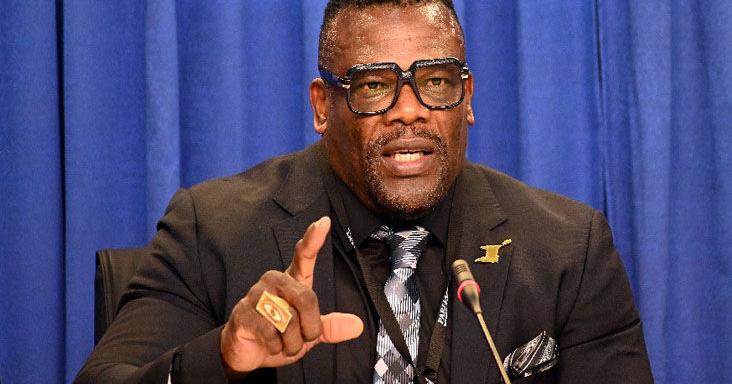
In the wake of a shocking triple homicide in Belmont that claimed the life of a two-year-old boy and triggered opposition demands for his ousting, Homeland Security Minister Roger Alexander has pushed back firmly against calls for his removal, vowing to fulfill his mandate to tackle the nation’s deepening gang-related crime crisis.
Speaking in a phone interview with the Express on Thursday, Alexander gave a public guarantee that all individuals linked to the recent killings would face full legal consequences, while appealing directly to community members to share intelligence with local law enforcement to help crack down on criminal activity.
The minister launched a counterattack on the opposition People’s National Movement (PNM), the party that led the country for a decade before the current United National Congress Government took office one year ago. Alexander argued that the same figures now demanding his resignation are the same officials who allowed gang activity and organized crime to spread unchecked across the country over ten years in power. He called the PNM’s calls for his removal deeply ironic, noting that gangs grew in influence and territorial control during the party’s tenure.
Alexander also pointed to the opposition’s recent decision to block the Zones of Special Operations (ZOSO) Bill, a piece of legislation he said would have enabled targeted, direct intervention in high-crime communities that the opposition claims to represent. He accused opposition lawmakers of abandoning the very constituents who voted them into office, saying, “They have the audacity to speak about who should go and who shouldn’t go. They should have gone ten years ago. They left this problem for us.”
While the minister acknowledged that the current administration and law enforcement agencies have made tangible progress in reducing criminal activity, he admitted that decades of systemic neglect cannot be reversed overnight. Describing the nation’s crisis as a deeply rooted “disease”, Alexander stressed that the government is committed to ongoing, systematic treatment of the problem.
When pressed to address public anger over continued gang killings even as the country operates under a national state of emergency (SoE), Alexander clarified that officials never marketed the SoE as a one-size-fits-all solution to the crime problem. Instead, he framed the measure as just one critical tool in a broader, multi-pronged strategy designed to restore law and order to troubled communities.
Alexander explained that the emergency measures became necessary after the previous administration left the national crime-fighting infrastructure in a state of severe disrepair. He listed a litany of systemic failures inherited by the current government: crumbling physical infrastructure, critical shortages of police personnel, limited operational mobility, unreliable telecommunications systems, and minimal integration of modern crime-fighting technology. Rebuilding these broken systems to reach full operational capacity, he said, requires the government to secure significant new resources, and all components of the national security strategy must work in sync like a well-functioning clock. “A clock can’t work with parts missing so it’s my responsibility to fix it, and that’s what this Government is doing,” he noted.
Alexander pushed back on criticism that the current government has had enough time to turn the tide of crime, pointing out that the UNC has only held office for 12 months, compared to the PNM’s decade-long tenure. “In one year they wanted us to fix what they took their time to destroy and as it relates to crime what they fed and gave life to and encourage the gang culture,” he said.
Contrary to common public misunderstanding, Alexander said the SoE does not impose restrictions on civilian movement. Instead, it grants law enforcement expanded authority to collect intelligence and target high-risk criminal networks. He added that more suspects have already been detained under the current SoE than were held during the previous national emergency declaration.
Repeating his appeal for public cooperation, Alexander noted that multiple anonymous channels exist for community members to share tips about criminal activity. For residents too afraid of gang retaliation to come forward directly, he suggested passing information through contacts outside their communities or even through family and friends living abroad to ensure it reaches police safely.
While police have already received significant amounts of intelligence, Alexander explained that investigators require sufficient tangible evidence to bring strong cases against suspected criminals and secure convictions in court. He lamented the ruthless nature of modern gang violence, noting that gang members prioritize loyalty to their criminal organizations over the safety of their own families and loved ones. “Because you’re committing crimes and then going home to sleep. The other persons involved, other persons who are victims, who are targets, obviously they will target you and by extension, your family,” he said, highlighting the collateral harm that community-wide inaction allows to continue.