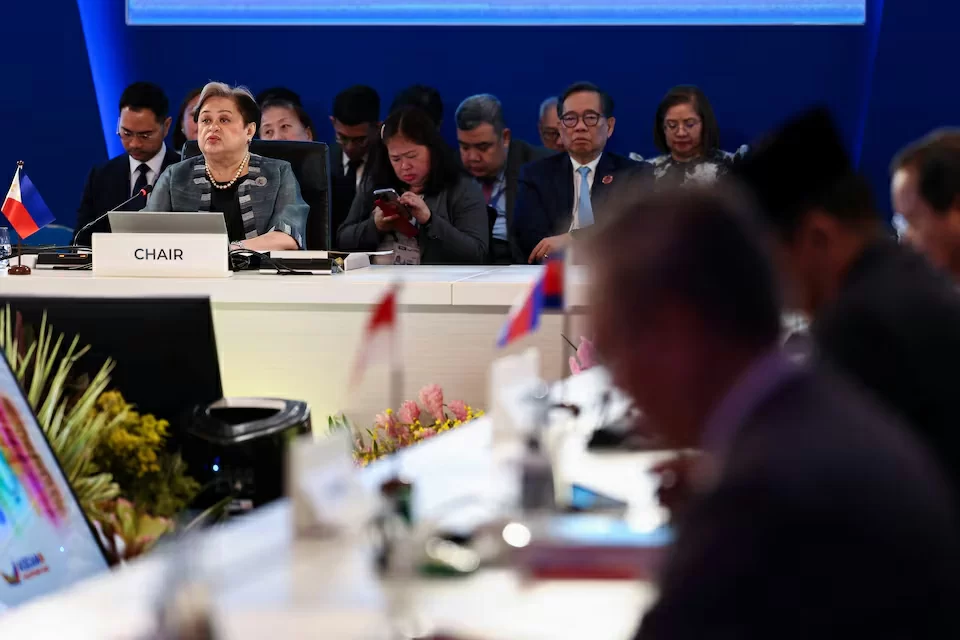
Southeast Asian bloc ASEAN centered its urgent discussions on two pressing crises on Thursday: the unfolding Middle East conflict that has disrupted global energy flows via the blockaded Strait of Hormuz, and long-simmering regional disputes that threaten bloc cohesion, during pre-summit ministerial meetings held in Cebu City, the Philippines.
Hosted by the Philippines, this year’s ASEAN chair, the gathering brought together foreign and economic ministers from the bloc’s 11 member states, home to nearly 700 million people, almost all of which rely heavily on imported energy to power their fast-growing economies. The session opened with remarks from Philippine Foreign Secretary and current ASEAN Chair Ma. Theresa Lazaro, who opened by highlighting how events outside the Southeast Asian region can send immediate, profound shocks to ASEAN economies and communities.
“The ongoing crisis in the Middle East makes clear that developments far beyond our borders carry direct and deep-seated impacts for every ASEAN member,” Lazaro told attendees, stressing that strengthened crisis coordination and institutional preparedness are non-negotiable for the bloc right now.
The Straits of Hormuz, a chokepoint that carries roughly one-fifth of the world’s daily oil and gas supplies, has become a flashpoint amid escalating Middle East tensions, with blockades disrupting global energy trade. For energy-import dependent ASEAN economies, this disruption has already driven up fuel costs and created significant downside risks to regional economic growth, prompting ministers to push for a coordinated regional response.
The Philippine chair has prioritized rapid adoption of a regional oil exchange agreement, a framework designed to spread supply risk across the bloc by creating a reserve sharing mechanism on a voluntary, commercial basis. Economic ministers also put forward two additional key proposals: developing alternative energy supply routes to reduce reliance on the strait, and upgrading cross-border communication protocols to respond faster to future supply disruptions.
Beyond energy security, the meeting also tackled multiple simmering regional conflicts. On the sidelines of the official gathering, the Philippines facilitated a rare three-way meeting between Philippine President Ferdinand Marcos Jr., Thai Prime Minister Anutin Charnvirakul, and Cambodian Prime Minister Hun Manet, aimed at de-escalating a long-running border dispute between the two neighboring Southeast Asian states. The conflict, which erupted into heavy armed clashes and airstrikes last year, has left a fragile ceasefire in place that remains vulnerable to collapse.
Anutin noted ahead of the meeting that the primary goal of the discussion was to rebuild bilateral trust, and that no final binding agreement was expected to emerge from Thursday’s talks. The delicate situation adds an extra challenge to the Philippines’ ASEAN chairmanship, which must balance competing priorities across the bloc’s 2025 agenda.
Myanmar’s political crisis, one of the most divisive ongoing issues for ASEAN, also featured heavily in closed-door discussions. Since the 2021 military coup, the country has remained deeply split, and the new military-backed civilian government installed earlier this year has been pushing for re-engagement with ASEAN. To date, the bloc has withheld recognition of the new administration, citing a lack of meaningful progress on peace negotiations with opposition groups.
The Philippines, as chair, has called for the Myanmar military government to grant ASEAN’s special envoy access to detained Nobel Peace Prize laureate Aung San Suu Kyi, as a concrete confidence-building measure to prove the junta’s commitment to the bloc’s five-point peace plan agreed after the 2021 coup.
Going into Friday’s official 48th ASEAN Summit and related leaders’ meetings, a draft consensus statement obtained by Reuters shows bloc leaders are set to formally call for immediate de-escalation of tensions between the United States and Iran, an immediate end to hostilities in the Middle East, full compliance with international maritime law, and the immediate reopening of the Strait of Hormuz to global commercial traffic. The statement will also repeat the bloc’s call for rapid ratification of the regional oil exchange agreement to strengthen regional energy security.
For decades, ASEAN has faced longstanding criticism for its consensus-based approach that often produces statements of intent rather than binding, enforceable action. But current leaders and analysts note that the severity of the current energy crisis has created new urgency that is pushing member states to move past procedural delays toward tangible, coordinated policy action.