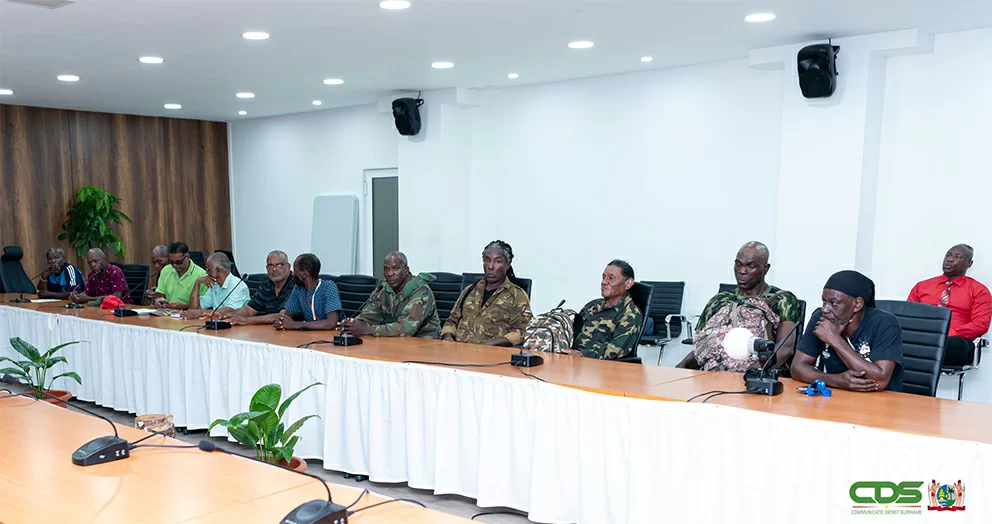
A delegation representing Suriname’s former military personnel has once again brought a raft of unaddressed grievances to the President’s Cabinet, seeking urgent government action to resolve long-running hardships facing the veteran community. The delegation, representing the Association of Surinamese Veterans and Ex-Military Personnel (VSVEM), was received by senior cabinet officials Melvin Linscheer, Rudie Roeplal and Bidjai Lalbiharie on behalf of President Jennifer Simons on May 5, 2026.
The issues put forward by VSVEM mirror concerns the group first formally raised in writing with government authorities back in 2025, none of which have seen meaningful resolution to date. According to VSVEM chairman Waldo Jameson, the most pressing concerns include inadequate resettlement and disability allowances, unaffordable out-of-pocket medical costs, exclusion from the Ministry of Defense’s official burial fund, and continued stagnation of a collective land application first submitted in 2021.
Jameson explained that ex-military personnel are currently locked out of the defense ministry’s burial fund due to a regulatory requirement that applicants have formal documented income — a barrier that disproportionately affects most former service members, who often lack stable formal employment. This rule, he emphasized, requires urgent amendment to correct a fundamental injustice.
On top of exclusion from the burial fund, the monthly resettlement and disability stipends currently provided to ex-military personnel are far too low to cover basic living costs, Jameson said. With national budget negotiations still ongoing, there is no clear timeline for a much-needed increase to these critical support payments.
While former service members do hold government-issued BaZo medical care cards, they are still required to cover a wide range of additional out-of-pocket medical expenses that place unsustainable financial strain on many households, many of which already operate on very limited incomes.
The group’s collective application for agricultural land, first submitted back in 2021, has also failed to move forward through the approval process. The proposed land parcel was intended to support collective agricultural activities and launch a member training enterprise that would provide on-the-job skills development to help former service members reintegrate into civilian workforces and build stable livelihoods.
Beyond resolving existing grievances, Jameson also highlighted that the ex-military community is eager to contribute to the country’s upcoming national housing construction program, leveraging the technical construction skills many members gained during their period of military service to help expand access to affordable housing across Suriname.
Further talks between the VSVEM delegation and presidential cabinet officials are scheduled to resume on May 13, 2026. The upcoming discussions will also explore new policy pathways to support greater reintegration of former military personnel into the civilian labor market.