A major rift has emerged between Suriname’s national police leadership and the Suriname Police Union, after the union launched a forceful protest over the sudden termination of a high-stakes negotiating session between the two parties last Wednesday.
The breakdown of talks, held on May 6, centered on a disagreement over the participation of one union board member who has been temporarily suspended from active police duty pending an ongoing internal investigation. Police leadership took the firm position that the suspended member was not eligible to join the consultation as a representative of the union. When no compromise could be reached on the issue, senior police leaders exited the meeting room early, bringing the entire session to an unplanned close.
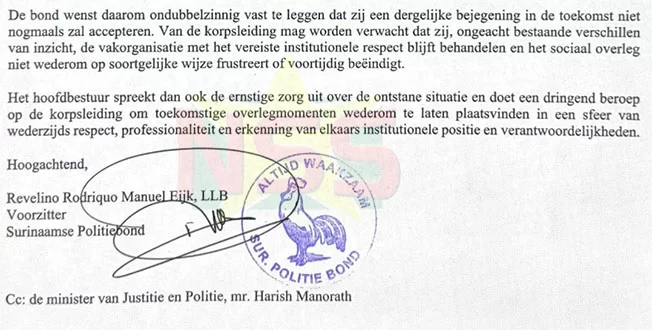
In an official protest letter addressed to National Police Chief Melvin Pinas, union chairman Revelino Eijk has labeled the incident a “serious incident” that inflicts lasting damage on the institutional relationship between police command and the country’s police labor organization. Eijk emphasized that the abrupt end to talks has put the entire framework of social negotiation between the two sides under severe strain, leaving a slate of critical issues related to the welfare of rank-and-file officers and organizational development completely unaddressed.
The union has pushed back firmly against police leadership’s stance, noting that the suspended board member attended the meeting in their capacity as a democratically elected representative of the labor union, not as an active duty police officer. The union maintains that the authority to decide the composition of its own negotiating delegation rests exclusively with the union itself, not with police management.
To back its position, the organization cites Article 4 of Suriname’s 2016 Law on Trade Union Freedom, adopted on December 15 that year. The legislation explicitly prohibits employers from implementing discriminatory measures against trade union board members or representatives. The union argues that police leadership’s actions create the clear impression that the board member is being treated unequally and subjected to restricted treatment solely because of their role in the union.
Eijk stressed that walking away from the table does nothing to foster a mature, constructive working relationship between the two sides. Differences of opinion could have been worked through through open dialogue, the union says, without shutting down the entire consultation process entirely. The incident represents a serious disruption to social dialogue that undermines healthy labor relations, mutual institutional respect, and productive collaborative work, the union added.
This is not the first time the union has raised concerns about the dynamic between the two organizations: Eijk noted that the union has previously reminded police leadership of the critical importance of mutual respect, open communication, and respectful institutional engagement in the partnership between the two groups. The union is now calling for future negotiating sessions to be held in an environment rooted in professionalism, mutual respect, and open, constructive dialogue. A copy of the protest letter has also been sent to Harish Monorath, Suriname’s Minister of Justice and Police, for further review.