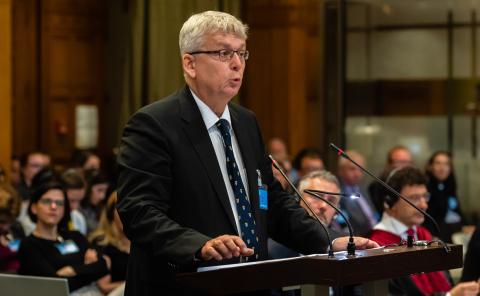
On Monday, May 2026, Venezuela presented new archival evidence to the United Nations’ highest judicial body, the International Court of Justice (ICJ), as part of its ongoing argument that the 1966 Geneva Agreement remains the sole valid framework for bilateral negotiation of its long-running border dispute with Guyana over the resource-rich Essequibo region.
Leading Venezuela’s presentation of this evidence, international law professor Andreas Zimmermann told the court that Guyana itself had twice, across different ruling administrations, floated proposals to cede partial control of disputed Essequibo territory to Venezuela during past bilateral talks.
The first documented proposal emerged in 1977, when Guyana was governed by the People’s National Congress (PNC) under Prime Minister Forbes Burnham. During closed-door bilateral negotiations held under the Port of Spain Protocol, a subsidiary agreement to the 1966 Geneva framework, Guyana’s foreign minister tabled a formal proposal to adjust the existing border at Punta Playa, Zimmermann told the court. The proposed change would shift the current border’s orientation from the northwest to the northeast, effectively transferring the affected territory to Venezuelan control.
“This development confirms that, during bilateral talks conducted under both the Port of Spain Protocol and the Geneva Agreement, Guyana was willing to pursue creative, mutually acceptable solutions and relinquish de facto control over territory that the 1899 Arbitral Award had supposedly assigned to British Guiana,” Zimmermann told the ICJ.
Decades later, during the 1990s when Guyana was led by the People’s Progressive Party Civic (PPPC) administration, further talks explored even more flexible frameworks for resolving the dispute, the professor added. In 1995, joint discussions between the two countries included serious consideration of returning partial control of the disputed territory to Venezuela, as well as an innovative proposal for a reverse lease arrangement that would have Venezuela hold sovereignty over some areas while Guyana retained day-to-day operational control.
Zimmermann also cited a 1998 letter written by then-Guyanese President Janet Jagan that reaffirmed the core purpose of the UN Secretary-General’s Good Officer mediation process – a process established under the Geneva Agreement – which Jagan explicitly noted was to “explore all avenues that would lead to the settlement of the border controversy” rather than simply debating the legal validity of the 1899 award.
The professor added that high-level talks exploring practical solutions date back even further: between 1970 and 1975, Venezuelan President Carlos Andrés Pérez and Prime Minister Burnham held extensive, detailed discussions on the border dispute and mapped out multiple potential pathways to a compromise. Those talks culminated in a 1976 proposal from Burnham himself to resolve the long-running disagreement through expanded cross-border economic cooperation, with Burnham quoted as saying: “I would propose that there should be signed an accord which would lay at rest the border question.”
Based on this long paper trail of past negotiations and proposals, Zimmermann argued, Guyana has long implicitly recognized that the Geneva Agreement is the proper instrument to resolve the substantive border dispute between the two nations, rather than treating the 1899 Arbitral Award as a final, unchallengeable settlement. The core mandate of Article 4 of the Geneva Agreement, he reminded the court, requires parties to pursue a practical, mutually acceptable solution to the full dispute, which aligns directly with the past actions of successive Guyanese governments.
The ICJ is currently holding hearings this week and next to consider the merits of the case, which centers on the legal validity of the 1899 Arbitral Award. Guyana has long maintained that the 1899 award represents a full, final and binding settlement of the border with Venezuela, and is expected to deliver its rebuttal to Venezuela’s latest arguments in the coming days.