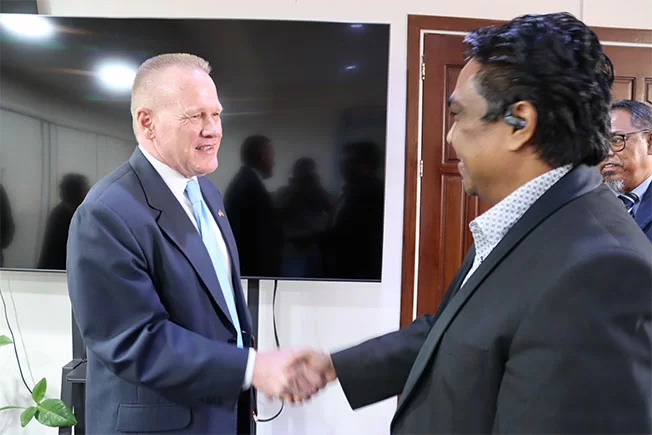
Following a high-level meeting between U.S. Chargé d’Affaires Paul Watzlavick and Suriname’s Minister of Agriculture, Animal Husbandry and Fisheries Mike Noersalim, the two countries have locked in a series of concrete collaborative agreements focused on expanding bilateral engagement in Suriname’s agriculture and fisheries sectors.
In the near term, the two partners will conduct joint field visits across Suriname, with a particular focus on assessing existing infrastructure and opportunities in the country’s fisheries industry. Beyond the initial site assessments, a dedicated U.S. agricultural mission is scheduled to travel to Suriname to conduct in-depth explorations of untapped potential across the broader agri-food value chain.
Minister Noersalim emphasized that Suriname maintains an open, welcoming policy toward foreign investors that are committed to partnering with local stakeholders to drive inclusive national development. “We are actively seeking investors that are ready to contribute to every stage of our domestic value chain, from raw material extraction through to finished end products,” Noersalim stated in comments following the meeting.
Technological innovation in agriculture emerged as a core topic during the bilateral discussions. Watzlavick highlighted how leading U.S. agricultural operations have boosted productivity through advanced mechanization and digital technology, allowing for higher output with optimized staffing levels. The two sides have agreed to pilot these technology-driven agricultural models in Suriname, a move that Noersalim stressed requires sustained openness to foreign investment to succeed.
Multiple U.S. companies have already expressed formal interest in investing in Suriname’s agricultural sector and establishing demonstration farms to showcase modern production practices, according to Noersalim. Under the framework of these planned investments, the majority of the workforce for any new projects will be hired locally, with joint ventures between U.S. and Surinamese firms positioned as a key structure for collaboration. Local job creation remains a central priority for all planned initiatives, the minister confirmed.
To prepare for this incoming investment and technological transition, Noersalim noted that Suriname must prioritize investments in skills training and workforce development to equip local workers for roles in modernized agricultural operations. Details of these training programs will be finalized and rolled out in the coming months as collaboration progresses.
A long-term policy goal underpinning this collaboration is addressing Suriname’s current trade imbalance, where the country imports more agricultural and food products than it exports. Noersalim acknowledged that reversing this trend will not happen overnight, but emphasized that the government is already working to lay the necessary foundational reforms. These steps include strengthening key public institutions, improving internal governance structures within the Ministry of Agriculture, and rebuilding the skilled technical workforce that has been depleted in recent years. “We are already moving forward on these reforms, and we remain optimistic that every challenge can be addressed with targeted solutions,” Noersalim added.