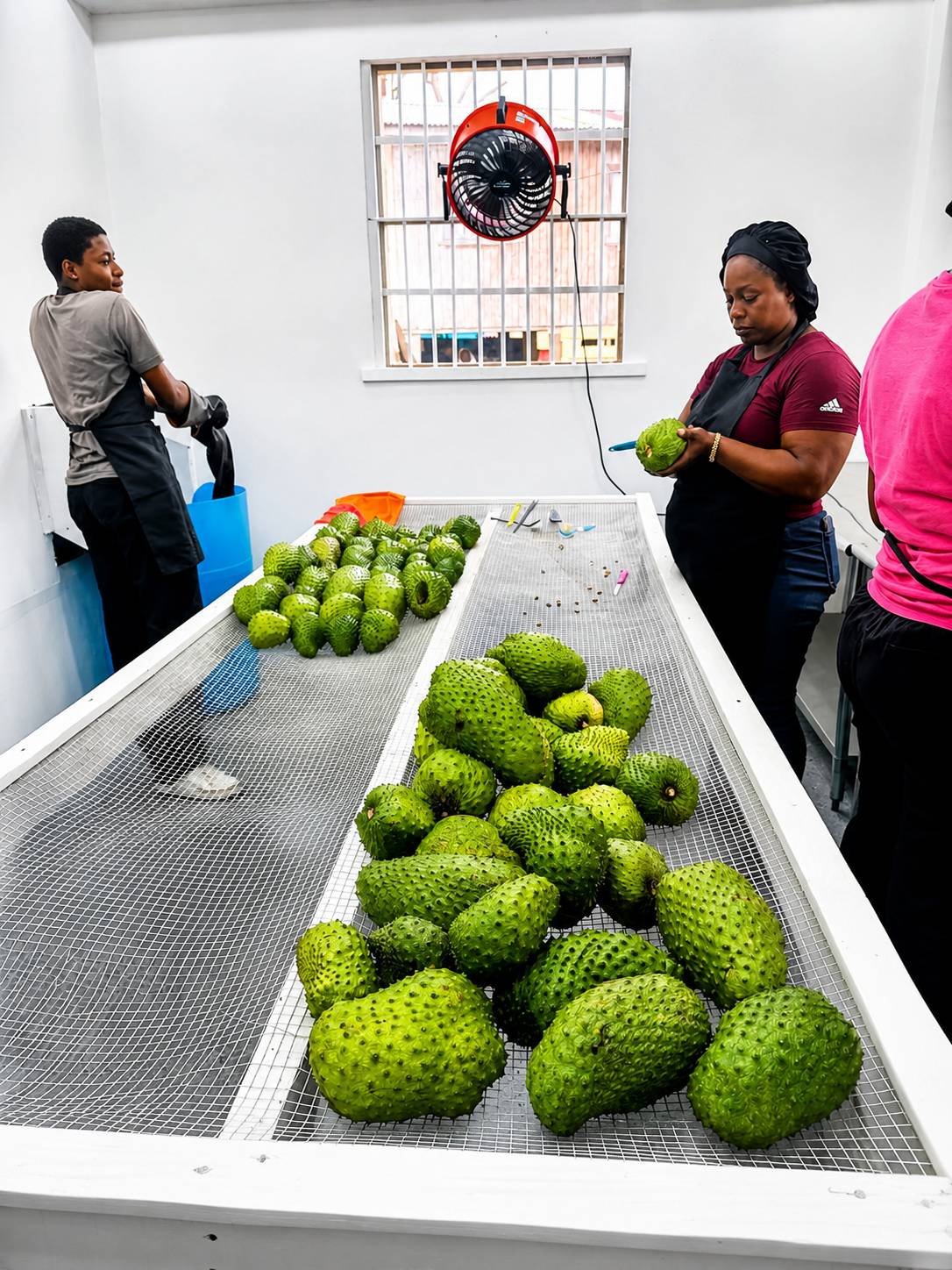
Against a backdrop of ongoing efforts to strengthen the complete soursop value chain in the Caribbean island nation of Grenada, a new targeted certification initiative has been launched to bring local producers in line with global food safety benchmarks and prepare them for entry into high-demand international markets. The pilot project is led by the United Nations Food and Agriculture Organisation (FAO), in close partnership with Grenada’s Ministry of Agriculture, Lands and Forestry, and the Geneva-based Standards and Trade Development Facility (STDF).
This certification pilot forms the next phase of the broader project *Enhancing Sanitary and Phytosanitary (SPS) Capacity and Market Access for Grenadian Soursop Exports*, marking a key strategic transition from earlier foundational infrastructure and capacity building work to a market-focused approach centered on formal compliance and third-party certification. Under the pilot, two carefully selected local packhouses and 10 connected smallholder and commercial soursop farmers will receive targeted support to work toward full GLOBALG.A.P. certification, with additional alignment to U.S. Food and Drug Administration (FDA) rules.
GLOBALG.A.P. is a globally trusted voluntary farm assurance standard that verifies agricultural production meets strict criteria for safety, sustainability, and ethical practice. The framework covers core priorities including end-to-end food safety, protection of local ecosystems, fair treatment and welfare of farm workers, and full product traceability from the field to retail shelves. Widely described as a “market access passport” for small-scale producers in developing economies, the certification strengthens systemic risk management through structured food safety controls, and builds greater buyer confidence in the consistency and safety of exported produce. When paired with requirements from the U.S. Food Safety Modernisation Act (FSMA), the certification ensures producers align with the latest U.S. import regulations, helping them keep pace with evolving global food safety standards.
The pilot was formally launched at a national stakeholder training workshop hosted at the Grenada National Stadium on April 21, 2026. The opening session centered on implementation guidance for GLOBALG.A.P.’s Integrated Farm Assurance Fruit and Vegetables GFS v6 standard, alongside the required FSMA add-on modules. These audit-based voluntary modules are designed to verify that farms and processing facilities meet FDA rules for preventive controls, produce safety, and import protocols.
The workshop drew 31 participants representing a broad cross-section of public and private sector stakeholders, including officials from Grenada’s Ministry of Agriculture, the Grenada Bureau of Standards, the Caribbean Agricultural Research and Development Institute (CARDI), the Inter-American Institute for Cooperation on Agriculture (IICA), participating farmers, export firms, and other private sector representatives. Organizers noted that turnout far exceeded initial projections, reflecting widespread industry recognition of the pilot’s potential to unlock new export opportunities for Grenada’s soursop sector.
In the first week following the official launch, participating packhouses and farms completed on-site preliminary assessments to map their current level of compliance with GLOBALG.A.P. and FSMA requirements. Drawing on these assessment findings, development teams will draft customized corrective action plans for each operation, outlining specific, practical improvements needed to reach full certification on target. All training and technical assistance for the pilot is being led by the FAO in collaboration with Grenada’s Ministry of Agriculture, Lands and Forestry, with specialized technical support from Inversiones Riel S. de R.L., a Honduras-based consulting firm with deep expertise in SPS system development and international agricultural certification processes.
Acting Chief Agriculture Officer Thaddeus Peters emphasized the strategic importance of the initiative for Grenada’s agricultural export sector. “We are pleased to support the launch of this pilot initiative to advance GLOBALG.A.P. certification within Grenada’s soursop value chain. This effort represents an important step in strengthening food safety, improving production standards, and expanding market access for our stakeholders. By aligning with internationally recognised certification systems, we are positioning our exports to compete more effectively,” Peters said.
Ricardo Pineda, Lead Consultant at Inversiones Riel S. de R.L., noted that the successful completion of the first phase of the project – which included the selection of the two participating packhouses – has laid a solid foundation for the certification process. “This milestone lays a strong foundation for certification under GLOBALG.A.P. IFA v6 with the FSMA add-on by November 2026, opening new opportunities for Grenada’s soursop in high-value international markets,” Pineda said.
Marlon St Louis, General Manager of Simply Pure Agroprocessing, one of the participating packhouses, said the process is already driving positive operational change for his team. “This process is pushing us to tighten our operations and be more consistent across the board; it will be challenging, but it’s exactly what we need to grow and compete in more demanding markets,” St Louis said.
Anne Desrochers, FAO Plant Production and Protection Specialist, cautioned that successful certification requires sustained commitment from participating producers. “While this pilot presents a valuable opportunity to advance GLOBALG.A.P. certification, it is not a passive process. Selected farmers and packhouses must commit time, resources, and consistent effort to implement the required improvements, an essential step toward achieving certification and accessing higher-value export markets,” Desrochers said.
Looking ahead, the next phase of the pilot will focus on delivering intensive, hands-on training and targeted technical support across core certification priority areas, including good agricultural practices, standardized record-keeping, full product traceability, improved post-harvest handling, and preparation for third-party certification audits.