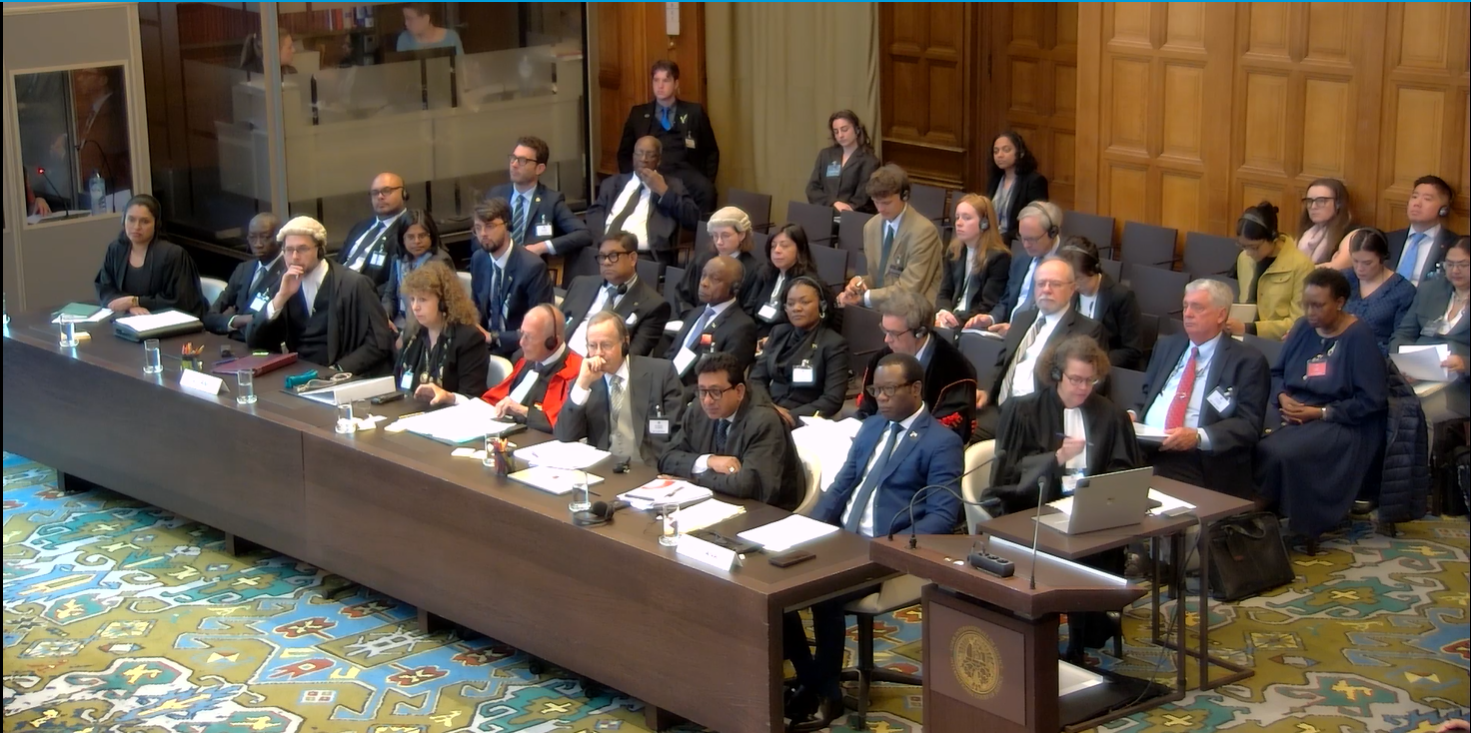
On Monday, 4 May 2026, oral proceedings on the merits of the long-running Guyana-Venezuela border dispute kicked off at the International Court of Justice (ICJ), with Guyana formally dismissing decades of Venezuelan claims alleging procedural irregularity and foul play in the 1899 territorial settlement that granted Guyana control over the resource-rich Essequibo Region.
Venezuela’s core challenges to the dispute’s legal framework center on two key documents: the 1897 Treaty of Arbitration between Caracas and the United Kingdom, which established the process to resolve the boundary conflict, and the 1899 Arbitral Tribunal Award that allocated the Essequibo territory to what would later become Guyana. Caracas claims the 1897 deal was negotiated without its full consent, included coercive pressure, and contained procedural flaws that ultimately led to an unjust 1899 ruling that stripped Venezuela of the territory.
Appearing before the ICJ panel of judges on Guyana’s behalf, lead counsel Paul Reichler systematically refuted every one of Venezuela’s allegations, backing his arguments with declassified contemporary correspondence between Venezuela, the United Kingdom and the United States. Reichler emphasized that Venezuela has no legitimate legal or factual basis to invalidate either the 1897 Treaty or the 1899 arbitral award.
Reichler also outlined the long history of the dispute, noting that Venezuela publicly accepted, respected and abided by the 1899 award for more than 60 years before formally challenging its validity in a 1962 letter to the United Nations Secretary-General. Crucially, Reichler added, even when Venezuela reversed its position on the 1899 award, it continued to recognize the 1897 Treaty as a binding legal agreement in subsequent UN submissions – a contradiction that undermines its current challenge to the treaty’s validity.
Reichler dismissed Venezuelan claims that the United States colluded with the United Kingdom to advance British interests at Venezuela’s expense. He pointed to surviving contemporary documentary evidence that directly contradicts allegations that the 1897 treaty was negotiated behind Venezuela’s back, without input from Venezuelan representatives, or that it ignored Caracas’ core interests. He confirmed that the final text of the 1897 Treaty fully incorporated Venezuela’s position on both the legal principle of prescription and the continuing validity of the 1850 bilateral agreement, and that contemporary records show Venezuela explicitly agreed that the United States had properly protected its interests during negotiations.
Another key Venezuelan claim is that the 1897 Treaty was reached without its full consent and barred it from appointing its own arbitrator to the tribunal. Reichler labeled this argument as entirely groundless, citing archival records showing the draft treaty shared with Caracas in November 1896 explicitly addressed arbitrator appointments. Under Article Two of the final treaty, the five-member tribunal would have two members nominated by the U.S. Supreme Court, two by the British High Court of Justice, and a fifth appointed by the four nominees. The structure left open the explicit possibility that U.S. justices would nominate a Venezuelan candidate – a provision that British negotiators openly opposed, Reichler confirmed.
On Venezuela’s argument that the 1897 Treaty was signed under coercion, a violation of Article 52 of the 1969 Vienna Convention on the Law of Treaties, Reichler noted that the convention’s provisions do not apply retroactively to agreements concluded decades before the treaty entered into force. He also rejected Venezuela’s claims that the alleged Anglo-American conspiracy amounts to fraud under Article 49 of the convention, as well as claims that Venezuela ratified the 1897 Treaty under a mistake of fact, as defined in Article 48, after being told the agreement protected its interests only to see those interests sidelined during the 1899 arbitration.
Reichler confirmed that while the 1897 arbitration agreement was primarily negotiated directly by then-British Ambassador to the U.S. Lord Pauncefote and U.S. Secretary of State Richard Olney on Venezuela’s behalf, Caracas raised no objections to the negotiation process at the time.
Guyana’s full delegation to the ICJ hearing includes Foreign Minister Hugh Todd, Attorney General Anil Nandlall, Guyana’s Agent to the ICJ Carl Greenidge, and Donnette Streete, Director of Frontiers at the Guyanese Ministry of Foreign Affairs. The ICJ’s merits hearing will now proceed, with Venezuela expected to present its own arguments in the coming days, as the court works to resolve a territorial conflict that has lingered for more than a century.