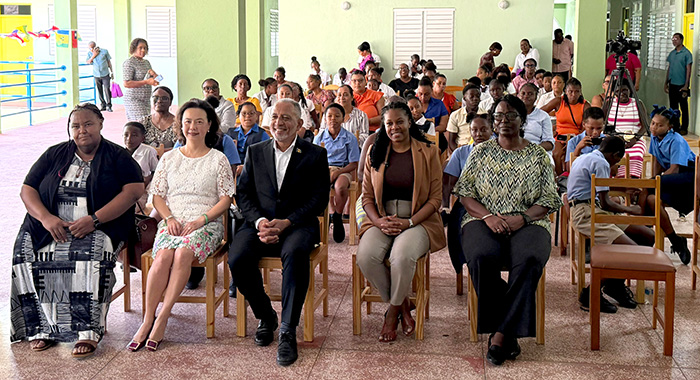
At a celebratory presentation ceremony held on the island of Bequia, senior officials from St. Vincent and the Grenadines (SVG) and Taiwan marked a decades-long bilateral partnership with the disbursement of EC$320,000 in educational bursaries to 524 local students spanning every academic level.
The need-based and merit-based awards are distributed under the long-running Taiwanese Human Resource Development Programme, a sustained education-focused initiative that dates back to 1998. This year’s cohort of recipients includes students attending primary, secondary, tertiary and technical-vocational institutions across SVG, including learners from outlying islands such as Bequia, Mustique and the Southern Grenadines. Senator Lavern King, Minister of State in SVG’s Ministry of Education, broke down the distribution of awards: 244 primary school students, 190 secondary school students, and 90 tertiary or technical-level learners have been selected for this year’s support. King emphasized that the bursary funds are earmarked to reduce financial barriers for students, covering essential costs ranging from transportation, school meals and uniforms to learning supplies, so that learners can attend classes without financial anxiety. Recipients are chosen either for outstanding academic achievement or for demonstrating remarkable resilience in overcoming personal and economic hardship, with King noting that every selected student has fully earned their award. She added that the SVG government’s commitment to inclusive education shapes the selection process, with targeted support prioritized for students with disabilities and learners from low-income, marginalized backgrounds, in line with the policy goal of leaving no student behind.
speaking at the ceremony, Taiwan’s ambassador to SVG Fiona Huei-Chun Fan outlined the enduring impact of the program, noting that more than 12,500 Vincentian students have benefited from the initiative over its 28-year run. The program aligns with Taiwan’s broader priority of investing in youth development and skills training, she explained, noting that “young people are not only vital to our present but also the bridge to our future.” Beyond the local bursary program, Fan added, Taiwan runs a suite of additional academic opportunities for Vincentian students, including youth employment and skills training schemes as well as full-degree Taiwan Scholarships. To date, 321 SVG students have completed bachelor’s, master’s or doctoral degrees in Taiwan, studying high-demand fields ranging from agriculture and healthcare to culinary arts and technology. Fan encouraged this year’s bursary recipients to pursue future study opportunities in Taiwan, highlighting the island’s global leadership in advanced technology manufacturing to motivate learners. She noted that Taiwan ranks as the world’s 22nd largest economy and sixth in global competitiveness, producing 13% of the world’s laptops and an estimated 90% of global AI servers. Taiwan also manufactures roughly 20% of the individual components found in every iPhone, including the most critical and high-value parts: the processor that powers device performance, the modem for cellular connectivity, Wi-Fi chips, semiconductor components, and the premium camera lenses that serve as the phone’s “eye,” all designed or produced in Taiwan.
SVG Prime Minister Godwin Friday, who also serves as Member of Parliament for the Northern Grenadines constituency that includes Bequia, framed the educational partnership as far more than a formal government-to-government agreement. He emphasized that the program builds people-to-people ties that deepen bilateral cultural connections and outlast changes in political leadership. “It is a partnership between peoples,” he said. “When relations transcend governments and leaders and get down into the people… most importantly through education… that is a cultural deepening and a relationship that transcends just the level of government.”
Friday described investment in education as the most critical offering that the state and society can make to young people, noting that developed knowledge and personal ability, built on natural talent, are the most valuable assets any person can hold. He called on local educators to embrace their role as a vocation, pointing out that teaching shapes lives permanently: negative classroom experiences, thoughtless comments or dismissive treatment can leave lifelong scars on young learners, while supportive, engaged mentorship leaves a lasting positive impact. “What you do stays with them for life,” he said, urging teachers to approach their work with the seriousness and respect it deserves. He also offered guidance to parents, encouraging them to prioritize engaging with their children’s schoolwork, even when busy: if caregivers show disinterest in a child’s work, he noted, that child is likely to lose interest in their own learning.
Friday stressed that the partnership with Taiwan holds particular strategic value for SVG, which lacks large natural resource reserves such as oil, gold and minerals. For SVG, human capital is the nation’s most valuable core resource, he said, and long-term support from Taiwan has been critical to developing that asset. “We don’t have gold and silver, we don’t have oil, we don’t have any of those natural resources,” he said. “But we have the best, the most important one — the intelligence, the good health of our people, the goodwill of friends who would help us, like Taiwan, to achieve what we want to do in education.”
Friday expressed SVG’s deep gratitude for Taiwan’s 28 years of continuous educational commitment, which comes alongside 45 years of formal diplomatic ties between the two sides. He called for the partnership to continue for decades more, noting that the program builds the foundational human capital that SVG’s national development depends on.