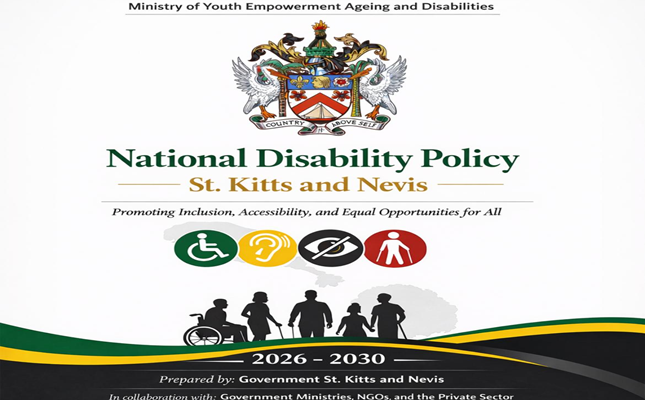
Basseterre, Saint Kitts — In a landmark step toward building a more equitable, inclusive nation, the Government of Saint Kitts and Nevis has introduced its first ever national framework to advance the rights and quality of life for people living with disabilities across the federation.
On April 30, 2026, Senator the Honourable Isalean Phillip, Minister of State with oversight for ageing and disability affairs, formally tabled the 2026–2030 National Disability Policy in the country’s Federal Parliament. The policy is a core component of the nation’s broader Sustainable Island State Agenda and aligns directly with priorities outlined in the National Development Planning Framework, rolling out a structured blueprint of guiding principles and actionable strategies to embed full inclusion for disabled people into every sector of national life.
The new policy is anchored in 10 key imperatives that address longstanding gaps and systemic barriers facing disabled residents:
1. **Removal of Environmental Barriers**: Mandates equal access to public spaces, transportation systems, information resources, and necessary assistive devices for all disabled people.
2. **Education, Training and Lifelong Learning**: Guarantees equal access to educational opportunities and certification pathways for disabled students and adult learners.
3. **Economic Inclusion and Financial Security**: Upholds the fundamental right of disabled people to secure employment, earn a living wage, and build long-term financial stability.
4. **Public Awareness and the Attitudinal Barrier**: Integrates disability rights education into national school curricula and paves the way for a nationwide public awareness campaign to shift harmful societal attitudes.
5. **Health and Wellness**: Builds a disability-inclusive health sector, ensuring equitable access to high-quality physical and mental healthcare services.
6. **Inclusive Housing and Liveable Communities**: Establishes quotas for accessible public housing, introduces a home retrofit grant program, and requires accessibility upgrades for shared public spaces including emergency shelters, sports facilities, and community centers.
7. **Social, Cultural and Public Participation**: Protects the right of disabled people to participate in cultural life, sports, civic processes including voting, and decision-making that impacts their communities and families.
8. **Legal Capacity, Protection and Access to Justice**: Mandates a review of existing legislation and procedures to eliminate intentional and unintentional discrimination against disabled people, and creates a formal Disability Commission to receive and investigate reports of rights violations.
9. **Disability Data and Research for Planning**: Implements structured collection and analysis of disaggregated disability data to enable ongoing monitoring and evaluation of policy outcomes.
10. **Accountability Implementation and Governance**: Establishes a fully staffed National Disability Council with a dedicated secretariat to coordinate cross-sector policy rollout and enforce accountability for outcomes.
In remarks following the tabling, Senator Phillip emphasized that the policy represents a clear, tangible demonstration of the federal government’s commitment to building a society that values every member, regardless of ability, and works actively to include all residents in national progress. For years, disability rights advocates in Saint Kitts and Nevis have pushed for a formal national strategy to address systemic exclusion, making this policy a long-awaited victory for inclusive governance in the small island nation.