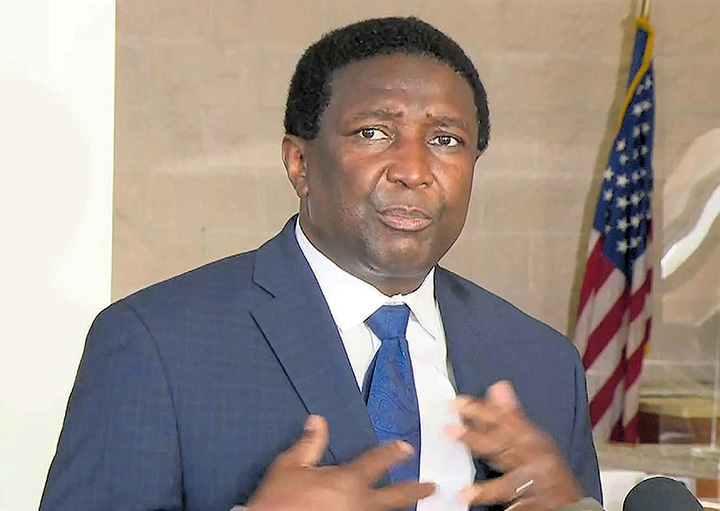
NEW YORK — For Jamaican-American politician Dale Holness, a third shot at Florida’s 20th Congressional District seat comes with a dramatically altered playing field: his two-time rival is mired in scandal, a partisan redistricting fight is roiling the state, and Holness enters the race with a clear fundraising advantage that has bolstered his long-held political ambition.
Holness, a former Broward County mayor and county commissioner who first entered politics after migrating from Jamaica as a 17-year-old, has fallen short of winning the Democratic nomination for the solidly blue district twice before. In his first 2021 special election bid, he lost to Haitian-American candidate Sheila Cherfilus-McCormick by just five votes — a margin so narrow it defied most political expectations. A rematch in 2022 ended the same way, even with the backing of the district’s roughly 25,000 Jamaican residents, a key voting bloc that has long supported Holness.
This cycle, however, the political landscape has shifted dramatically. Cherfilus-McCormick, who held the seat since 2022, resigned from Congress at the end of last month, mere minutes before the House Ethics Committee was set to vote on recommending her expulsion. The congresswoman faces felony fraud and ethics violations, centered on allegations that she diverted $5 million in erroneous COVID-19 relief grants awarded to her family’s health care company by the Federal Emergency Management Agency to fund her first successful congressional campaign. She has repeatedly denied all wrongdoing, but the scandal has gutted her political and financial standing.
Even though Cherfilus-McCormick has signaled she plans to run for re-election, her campaign is crippled by debt and a lack of funds. She drained nearly all her campaign reserves to pay criminal defense legal fees, leaving just $11,000 on hand — an amount widely considered negligible for a competitive congressional race. Her campaign committee also owes six-figure sums to multiple outside law firms, and her total fundraising haul this cycle is the lowest of the five candidates competing in the August Democratic primary.
With his longtime rival severely weakened, Holness now faces a new, more formidable challenge: a Republican-led redistricting effort that redraws the boundaries of Florida’s 20th Congressional District. The Florida state legislature approved the new map last Wednesday, which cuts Palm Beach County out of the district and adds the more Republican-leaning communities of Coral Springs, Margate, and Coconut Creek. Republican leaders hope the redistricting will flip the historically Democratic seat to their column, part of a broader national push by the party to gain multiple congressional seats across the country ahead of the November general election.
The redistricting plan is already on track to face legal pushback, however. Florida’s 2010 “Fair Districts” amendment to the state constitution prohibits partisan gerrymandering — the practice of drawing district lines to intentionally benefit one political party or weaken minority voting power. The fight in Florida is part of a larger national redistricting battle that has erupted this cycle: Republicans in Texas led a similar redraw backed by former President Donald Trump to pick up five additional seats, while Democrats have successfully pushed through redistricting reforms in California and Virginia that could net the party nine additional seats combined. A recent U.S. Supreme Court ruling that weakened a key provision of the 1965 Voting Rights Act, which was designed to protect minority congressional representation, has also favored Republican map-drawing efforts in states like Louisiana.
Despite the uncertainty of the new district lines, Holness remains optimistic about his chances. He told reporters that 70 percent of the original 20th District’s territory remains intact under the new map, and the areas that remain are ones he has represented and worked in for decades. “These are areas that I know quite well, areas where I have worked with the people over many years and to whom I have been able to bring a better way of life as commissioner and mayor,” he said.
Holness also holds a substantial fundraising lead over all other primary candidates. His campaign reported raising more than $92,500 in the most recent quarter, leaving him with $312,672 in cash on hand after just $8,000 in expenditures. He credits his fundraising success to his long record of public service and his refusal to accept donations from political action committees, noting that most contributions come from ordinary working constituents in the district. Despite his strong position, he says he is not taking victory for granted, drawing on lessons from his two narrow past losses. “While I will acknowledge that I am in a fairly strong position, I also know that there is a lot more to be done,” he said. “I learned from past elections. I’m not hiring a whole bunch of high-paying consultants. I’ve been on the phone. Most of that money that I raised is from phone calls. I’m not spending money to make money.”
Still, headwinds remain. It is unclear how large the Jamaican-American voter base will be in the reconfigured district, and campaign organizers face the challenge of mobilizing voters to turn out for the August 18 primary, an election that many constituents may overlook ahead of the November general election.
Holness is building his campaign around core kitchen-table issues that resonate with working district residents, focused heavily on economic affordability. He has highlighted the soaring cost of living that has left many residents working two or three jobs just to make ends meet, criticized Florida’s decision not to expand Affordable Care Act Medicare subsidies that would lower health care costs for vulnerable residents, and pledged to address barriers to homeownership for young people and expand access to affordable childcare. “These are the issues to which I will devote my service if elected,” he said.
A seasoned public servant, Holness was born in Hanover, Jamaica in 1957 and migrated to the United States at 17. He attended Broward Community College and Nova Southeastern University, and has worked as a real estate broker for decades, leading the local firm All Broward Realty. He began his political career on the Lauderhill City Commission from 2004 to 2010, won a seat on the Broward County Commission in 2010 where he served until 2022, and made history as the first Jamaican-American to serve as mayor of Broward County from 2019 to 2020, leading the county through the chaotic initial days of the COVID-19 pandemic. In 2021, the Jamaican government honored him with the title of Commander of the Order of Distinction for his outstanding service to the Jamaican diaspora.
Alongside Holness and the scandal-plagued Cherfilus-McCormick, three other Democratic candidates are competing for the party’s nomination: Luther Campbell, Elijah Manley, and Rudolph.