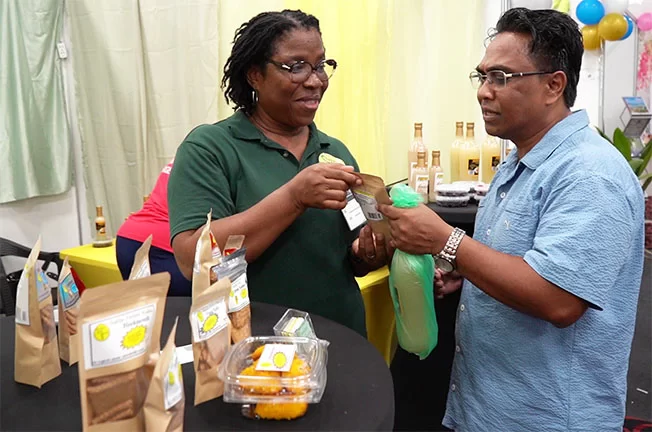
As Suriname’s three-day national Agricultural Trade Show prepared to wrap up its 2026 edition on May 3, local producers, government officials and industry innovators gathered at the KKF venue to showcase the country’s growing push toward agricultural self-reliance and global competitiveness. Organized by the country’s Ministry of Agriculture, Livestock and Fisheries (LVV), this year’s event broke new ground by prioritizing technological innovation to rejuvenate an aging sector, drawing more than 200 participating exhibitors across agricultural, livestock and fishing value chains.
For small local producers like Golden Honey Bee, the trade show offers a critical platform to highlight the quality of homegrown Surinamese goods. The family-owned beekeeping operation, led by beekeeper Shivangi Vermeijs-Mahabali, showcased its full line of artisanal, locally made products: raw honey with and without honeycomb, cold-pressed honey, cold-pressed coconut oil, and beeswax balm. This year, the brand expanded its portfolio with a new offering: 100% bean-to-bar single-origin Surinamese chocolate, which has already proven a hit with visitors. “Agriculture truly needs to become a core pillar of Suriname’s economy, so we don’t have to rely so heavily on imports,” Vermeijs-Mahabali explained during a tour of the booth attended by Agriculture Minister Mike Noersalim. “Our Surinamese products are top quality, and we’re proud to deliver a meaningful contribution to the sector.”
What sets this year’s edition apart from previous trade shows is its intentional focus on attracting young people back to agriculture through cutting-edge tools and innovation, according to event coordinator Shantie Shiamrai. “We’ve noticed the sector is facing rapid aging, so we want to make agriculture more appealing by integrating new technologies that make work faster and more efficient,” she noted. To that end, the LVV has spotlighted several modern solutions that are accessible for Surinamese producers, including drone technology that can automate core farm tasks from fertilizing and seeding to irrigating and spraying crops.
Shiamrai explained that drones cut down work time from days to just a few hours, and the innovation has already drawn intense interest from attendees across both crop and livestock operations. Also on display was vertical farming using modular tower systems, a sustainable innovation that cuts water use and allows year-round crop production in limited spaces. Beyond production technology, the trade show also highlights major progress in local food processing. Many participating companies have upgraded their packaging and labeling to meet international standards, with finished products that match the quality of imported goods, Shiamrai said. “Right now we still import far too much, but we need to capitalize on what we already produce here and start exporting more of our own goods,” she added.
The country’s fishing sector, which already has a well-established export focus, used the event to showcase updates that help it meet increasingly strict requirements from key international markets including the European Union and the United States. Thomas Willems, research and statistics coordinator for the Directorate of Fisheries, explained that ongoing research and adoption of sustainable fishing practices are critical to keeping the sector competitive and compliant with global market standards. At his team’s booth, Willems showcased modified fishing gear designed to reduce bycatch of protected species, including Turtle Excluder Devices that prevent sea turtles from becoming trapped in nets, and Dolphin Pinger acoustic deterrents that keep dolphins away from fishing gear.
Following the opening of the event last Friday, President Jennifer Simons toured dozens of exhibition stands to meet producers and innovators, underscoring the government’s commitment to growing the domestic agricultural sector. As the event closed on the evening of May 3, organizers said the 2026 edition marked a key milestone in Suriname’s transition toward greater food self-sufficiency, sustainable production and expanded global market access for local goods.