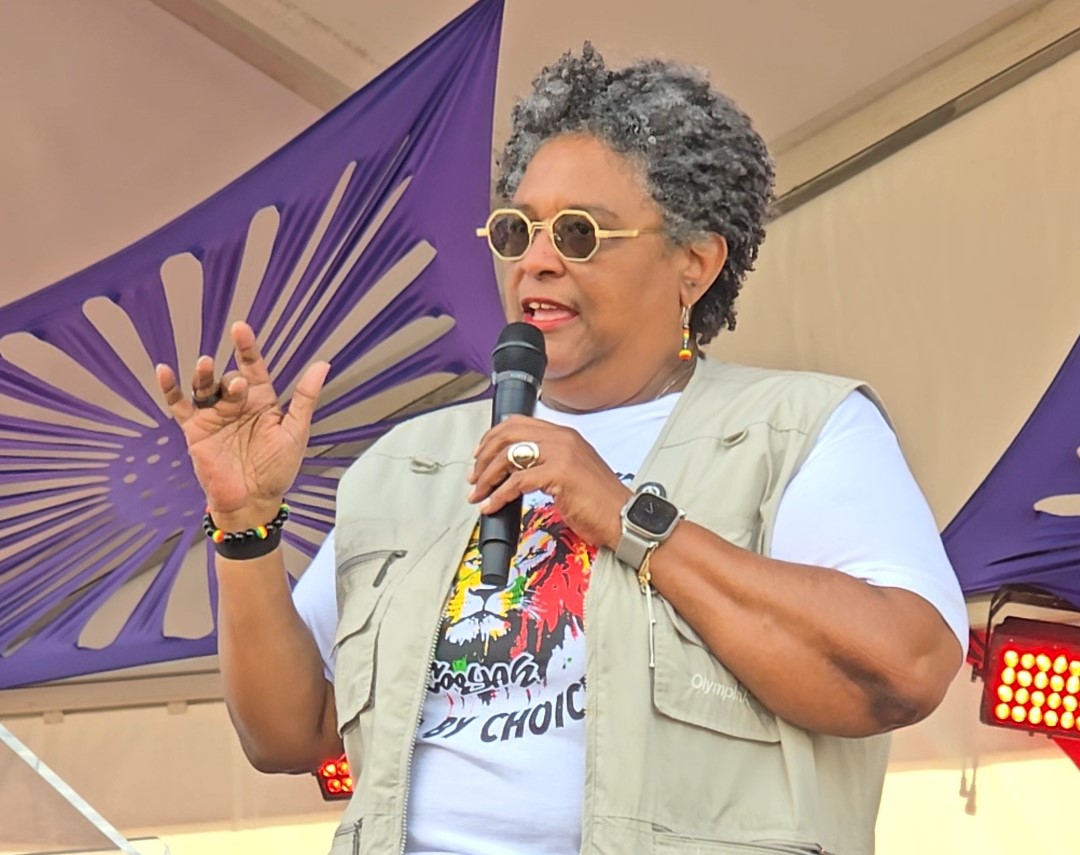
In a public address delivered Friday at the Barbados Workers’ Union Family and Picnic Affair held at the Bridgetown Botanical Gardens, Prime Minister Mia Mottley has laid out two landmark policy initiatives that will shape the island nation’s governance and economic trajectory over the coming years. The first, a long-awaited public sector job regrading initiative, is set to launch in the coming weeks, with multi-year wage negotiations for public employees to commence immediately after the regrading process concludes.
Mottley emphasized that the regrading exercise is designed to bring long-overdue organizational clarity and collective consensus across the entirety of Barbados’s public sector, standardizing role expectations and compensation frameworks to reduce disparities and improve service delivery. Beyond administrative restructuring, however, the Prime Minister used the gathering as a platform to unveil a paradigm shift in the country’s economic policy: a new framework focused on expanding asset ownership and accessible investment opportunities for ordinary working Barbadians, known locally as Bajans.
For the current administration, Mottley argued, governance goes far beyond incremental wage increases for workers. “This term must be about making Bajans owners,” she told the assembled crowd, framing the policy as a fundamental reorientation of how the government approaches shared national prosperity. While acknowledging that steady wage growth remains a core priority for her administration, she noted that the government is actively building new pathways to allow everyday workers to take stakes in large-scale national development projects spanning critical infrastructure sectors.
Key sectors identified for broad public participation include mass transit, potable water systems, utility-scale renewable energy projects, and national digital data infrastructure. Mottley pointed out that the total capital required for this pipeline of projects exceeds one billion U.S. dollars — an investment scale too large for the government to fund independently. Rather than turning exclusively to foreign investors or large domestic institutions, the government aims to open these projects to individual workers, creating structured participation frameworks to demystify the investment process for those who may feel inexperienced in large-scale asset ownership.
“Each of the individual workers may feel intimidated in understanding this can work or this ain’t gonna work, we can create systems to help show that nobody should put all their eggs in one basket,” Mottley explained. The core goal of the initiative, she stressed, is to expand wealth creation beyond monthly paychecks, encouraging Bajans to build long-term wealth through diversified participatory investment instead of relying exclusively on low-yield traditional savings accounts.
She highlighted the growing erosion of purchasing power for savers holding money in domestic bank savings products, noting that current savings accounts yield only 0.1 percent annual interest, while national inflation hit 1 percent this year. If inflation rises to 2 or 3 percent, the gap between earnings and rising prices will widen dramatically, leaving passive savers vulnerable to losing purchasing power over time. “For you not to be a victim of that, the process of enfranchisement and ownership of shares matters,” she added.
Mottley was careful to clarify that the government is not mandating individual investment choices for workers. Instead, the administration will build the regulatory and structural frameworks to enable broad participation, leaning on public-private collaboration between domestic financial institutions including pension funds, credit unions, and insurance companies to bring the initiative to fruition. This partnership model, she said, will align private institutional capacity with national development goals, opening the benefits of large-scale infrastructure growth to all segments of Barbadian society rather than a small group of wealthy or institutional investors.