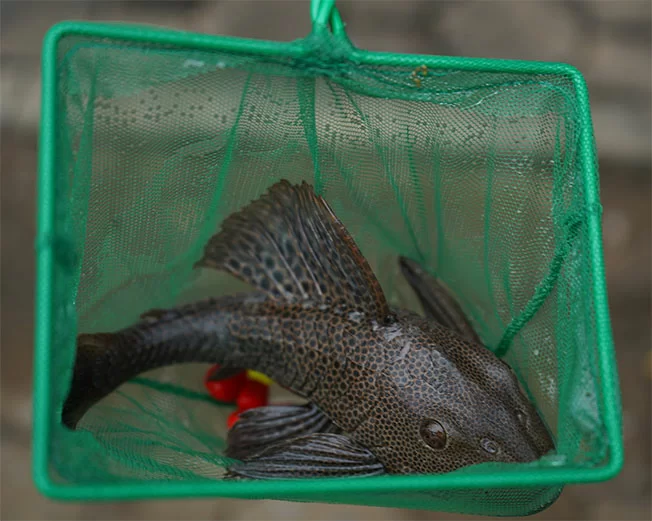
Suriname’s annual Agricultural Trade Fair, organized by the country’s Ministry of Agriculture, Livestock and Fisheries (LVV), opened its doors to visitors on Friday, running through Sunday May 3, with a standout innovative exhibit that is turning heads and challenging long-held local beliefs about a native aquatic species. At the heart of the buzz is a new smoked fish sausage product drawing crowds of attendees eager to sample the offering. When asked to guess what type of fish the sausage is made from, most visitors stammer out guesses ranging from kandratiki to bang bang and tukunari, none coming close to the actual ingredient: the liba kwie, a fish long viewed by local communities as a destructive pest. The surprise reveal always draws gasps from the crowd, as few have previously considered the invasive-feeling species as a viable food source.
Developed through a collaborative public-private partnership between the LVV and local food entrepreneurs, the liba kwie sausage has proven to be a hit with fairgoers, sparking widespread public interest in the novel product. LVV Minister Mike Noersalim explained in an interview that this initiative serves a dual purpose: adding economic and culinary value to a fish that has long been maligned for the damage it causes by burrowing holes in critical dam infrastructure across the country. Minister Noersalim noted that his team has worked closely with counterparts from the Ministry of Public Works and Spatial Planning to identify long-term solutions to reduce the species’ negative environmental and infrastructure impacts, and turning it into a popular food source emerged as a win-win outcome.
Testing and product development confirmed that liba kwie is not only safe and palatable for human consumption, but also versatile enough to be processed into a range of popular products, from fish balls to the smoked sausage that is wowing fair attendees. Compounding this benefit is the fact that liba kwie populations are abundant across Suriname’s waterways. Turning the species into a mass-market food product delivers three interconnected advantages: it reduces the pressure of overpopulation that causes damage to dam walls, expands local food output, and strengthens the nation’s core goal of food security.
Food security and expanded domestic food production are the central themes of this year’s Agricultural Trade Fair, a focus echoed by Suriname’s President Jennifer Simons during her opening address to attendees and sector stakeholders. President Simons acknowledged that efforts to grow and modernize the country’s agricultural sector have faced setbacks and inconsistent progress in past years. To address these challenges, she emphasized that greater investment and attention must be directed to pre-production planning, targeted research, and every link along the entire agricultural production chain. She stressed that transforming the sector is not a one-year project, but a gradual, step-by-step process that can eventually grow agriculture into one of Suriname’s strongest core economic sectors.
“ We truly have all the potential we need to feed ourselves, ” President Simons told the crowd. She pointed not only to future export opportunities for Surinamese agricultural products, but centered her remarks on the urgent priority of national food sovereignty. According to President Simons, Suriname must ramp up production of its own food to reduce reliance on imported goods. “ We need to be absolutely certain that if supply ships don’t arrive, Surinamese people will still have enough to eat, ” she said, underscoring the critical importance of expanding local production.
President Simons called on all agricultural sector stakeholders – from smallholder farmers to large producers, private businesses, and government agencies – to commit their full efforts to lifting the sector to a new level of productivity over the next 12 to 24 months. Once Suriname achieves full domestic food sovereignty and works out the early growing pains in production and processing infrastructure, she explained, the country will be ready to make the strategic shift to expanding agricultural exports to global markets.
For the LVV, public-private partnership is far more than a policy buzzword: it is a concrete, practical tool to strengthen the country’s entire agricultural production sector. Minister Noersalim added that the national government is also working to strengthen cross-ministerial collaboration to speed up sector development, breaking down bureaucratic silos that have slowed progress in past years. “ By giving entrepreneurs space to showcase their innovations and new products to both investors and the general public, we are building up the economic backbone of Suriname together, ” Noersalim said. “ This trade fair is proof that we achieve more when we work together. Our goal is clear: Suriname will build a modern, productive, and competitive agricultural economy that works for all of our citizens. ”