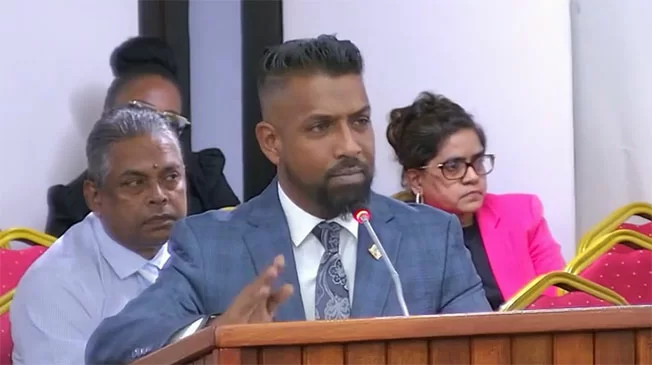
A major political firestorm has erupted in Suriname after Justice and Police Minister Harish Monorath confirmed controversial entrepreneur Jean ‘Saya’ Mixon would serve as one of his four official policy advisers – drawing sharp criticism from both ruling coalition and opposition lawmakers in the National Assembly on Thursday. The controversy has ignited fierce debate over government integrity, transparency, and the authority of Suriname’s law enforcement leadership, with senior ruling party officials publicly distancing themselves from the minister’s remarks.
The scrutiny of Monorath’s announcement gained additional urgency due to Mixon’s well-documented public history of legal trouble. The entrepreneur was previously at the center of a high-profile national criminal case involving charges of money laundering, forgery, and fraud. While a Surinamese court acquitted Mixon of money laundering charges in November 2024, prosecutors were ruled inadmissible on the remaining counts. Following the verdict, Mixon publicly stated he would remain a supporter of the ruling VHP party.
Coalition lawmaker Raymond Sapoen of the NDP, one of the ruling coalition partners, openly expressed “deep concern and disappointment” over Monorath’s public confirmation of Mixon’s role as policy adviser. Sapoen emphasized that the minister’s unvetted announcement has severely eroded public trust in the Ministry of Justice and Police.
VHP party legislator Krishna Mathoera also issued a clear rebuke of the situation, noting that a minister leading the country’s justice and policing portfolio has a special obligation to exercise extreme care when making public statements. Mathoera argued that demonstrating true leadership would require Monorath to simply admit he made a misstep, and pressed the minister to clarify whether Mixon has been granted access to classified information or any special privileges within the ministry.
Opposition NPS lawmaker Poetini Atompai pushed back aggressively against attempts to frame the relationship as a casual informal information-sharing arrangement. “When we are talking about sensitive intelligence, nobody talks about it publicly,” Atompai stated, arguing that officials cannot hide behind informal relationship excuses after publicly naming Mixon as an official adviser. He warned that Suriname could suffer lasting international reputational damage from this kind of unregulated appointment, particularly at the ministry responsible for upholding the rule of law.
NPS parliamentary leader Jerrel Pawiroredjo echoed the call for clarity, demanding a straightforward answer from the minister. “Parliament only wants one clear answer: Is he your adviser, yes or no?” Pawiroredjo said, rejecting attempts to muddy the issue with semantic debates or technical fine print.
Only ABOP lawmaker Edgar Sampie came to Monorath’s defense, arguing that it is common practice for ministers to seek informal input from private citizens, business owners, and subject-matter experts without formal government appointments. Sampie claimed the entire controversy has been unnecessarily blown out of proportion, noting that Mixon’s campaign propaganda work for the VHP during recent elections did not raise objections at the time.
After facing sustained criticism from assembly members and an initial round of unsatisfactory answers from Monorath, Interior Minister Marinus Bee – speaking after consultations with Vice President Gregory Rusland – requested a parliamentary recess to resolve the confusion. Bee publicly corrected Monorath’s earlier remarks, stating that Mixon has never received an official appointment as an adviser, no official executive order was ever issued, and no formal appointment process was completed.
Following the recess, Monorath walked back his original statement, acknowledging that Mixon “is not an adviser under the formal definition of the law.” The minister clarified that he regularly consults with a wide range of private citizens and receives input from across Surinamese society, but Mixon has never been given a formal paid position or access to government facilities for an advisory role.
Despite the minister’s attempts to clarify and defuse the situation, the heated parliamentary debate made clear that public and cross-party trust in Monorath has already sustained significant damage. The most notable development of the confrontation was that sharp criticism and public distancing came not only from opposition lawmakers, but from senior members of the ruling coalition itself.