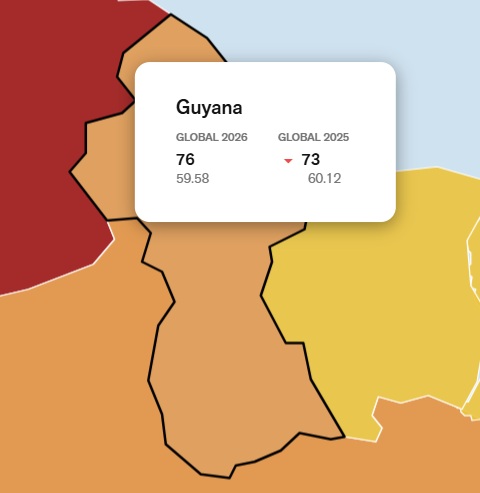
On 30 April 2026, global press freedom advocacy group Reporters Without Borders (RSF) released its annual World Press Freedom Index, marking a historic low for open journalism worldwide and recording a slight but concerning decline for Guyana’s press freedom standing.
In this year’s evaluation of 180 countries and territories, Guyana fell three spots to 76th place, down from 73rd in the 2025 ranking. Its overall press freedom score also dipped from 60.12 out of 100 last year to 59.58 this year, placing the South American nation firmly in RSF’s “problematic” press freedom category.
While RSF acknowledged that Guyana’s legal framework formally protects free speech and the public’s right to information, the organization outlined a series of growing barriers to independent journalism in the country. The report noted that media outlets critical of the ruling administration face routine targeted intimidation, and the financial sustainability of independent outlets is undermined by the deliberate withdrawal of state advertising for political reasons. Presidential press conferences are extremely rare and heavily curated, and early this year, Guyana’s National Assembly implemented controversial new access restrictions that ban news cameras from the chamber, limiting press coverage of legislative proceedings.
Notably, the RSF report omitted several key concerns repeatedly raised by the Guyana Press Association (GPA), the country’s leading representative body for journalists. These gaps include a near-total shutdown of routine public information access: only one ministerial press conference has been held in 2026 to date, convened solely by the Home Affairs Minister to address a gas station bombing. Requests for information from the Office of the Commissioner of Information are almost universally denied, and the Guyana Police Force consistently fails to respond to basic media queries, a issue that top government officials including the president, home affairs minister and attorney general have been aware of for months. In place of open press engagements, the president and a small circle of senior ministers now rely exclusively on one-way information dissemination via social media, eliminating the longstanding practice of answering journalist questions on behalf of the public. The RSF report also made no mention of the fact that parliamentary committees, which are meant to provide transparent oversight of government action, have yet to convene public sessions accessible to media and citizens.
RSF’s assessment included the contradictory observation that Guyanese journalists are generally permitted to work freely and independently, despite widespread documentation of harm. Local journalists have repeatedly documented verbal harassment and aggressive intimidation from sitting politicians — including the president and vice president — and their political supporters. The organization also confirmed structural threats to media independence: all members of Guyana’s media regulatory body are directly appointed by the president, giving the executive branch unilateral power to revoke operating licenses for critical outlets, creating a chilling effect on independent reporting.
On the safety front, RSF found that physical violence against journalists remains rare in Guyana, but media professionals face growing non-physical threats: routine online harassment from political actors and anonymous accounts, legal intimidation, and arbitrary temporary suspensions of press access. To date, no perpetrators have been prosecuted for these online and off-line attacks on journalists, creating a culture of impunity.
Beyond Guyana’s specific situation, the 2026 World Press Freedom Index delivered a grim global assessment: for the first time in the 25-year history of the ranking, more than half of all assessed countries fall into RSF’s “difficult” or “very serious” categories for press freedom. The global average press freedom score across 180 nations hit its lowest point since the index launched in 2001.
RSF attributed the steady global decline to the expansion of restrictive legal frameworks, particularly measures tied to national security policies that have steadily eroded the public’s right to information — even in longstanding democratic nations. The index’s legal freedom indicator recorded the largest single-year drop in the past year, a clear signal that journalism is increasingly being criminalized across the globe. In the Americas region specifically, the report noted significant deterioration: the United States fell seven places in the 2026 ranking, and multiple Latin American countries have continued to slide deeper into cycles of violence and political repression against independent media.