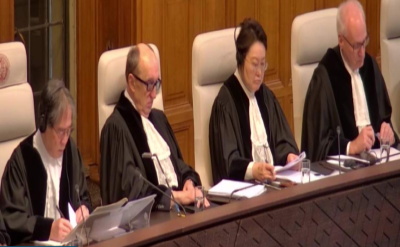
GEORGETOWN, Guyana — As the International Court of Justice (ICJ) prepares to open public oral hearings on a decades-long territorial dispute between Guyana and Venezuela, the Guyanese government has issued a clear statement of unwavering confidence in the strength of its legal case, days ahead of the proceedings scheduled to begin in The Hague on Monday.
The long-simmering border conflict traces its origins back to the 1899 Arbitral Award, which established the formal boundary between the two neighboring South American nations. That ruling stood unchallenged for more than six decades, until Caracas formally declared the award null and void in 1962 and reactivated its territorial claim to the 159,000-square-kilometer Essequibo region, a resource-rich territory that makes up roughly two-thirds of Guyana’s total land area.
In accordance with the terms of the 1966 Geneva Agreement, which lays out a framework for peaceful negotiation of the dispute, the two nations held years of bilateral talks aimed at reaching a mutually acceptable resolution. When those diplomatic efforts failed to produce a breakthrough, the United Nations Secretary-General referred the matter to the ICJ for binding adjudication. Guyana formally brought the case before the court in 2018, requesting a formal ruling confirming the full legal validity of the 1899 border award.
The ICJ has already cleared two key procedural hurdles for the case, twice upholding its jurisdiction to hear the merits of the dispute in rulings issued in December 2020 and April 2023. The court also granted two provisional measures orders at Guyana’s request, requiring Venezuela to refrain from interfering in Guyana’s lawful governance and administration of the disputed territory while proceedings remain ongoing.
Oral hearings on the core legal merits of the case are scheduled to run from May 4 to May 8, with a possible extension into the following week, according to Guyana’s Attorney General and Minister of Legal Affairs Mohabir Anil Nandlall. Both sides will present their full legal arguments before the court during these proceedings.
In its official statement released Friday, the Guyanese government reaffirmed its optimistic stance ahead of the hearings. “Guyana approaches these hearings with full confidence in the strength of its case, which is supported by the historical record and the applicable legal principles relating to the binding nature of arbitral awards, the sanctity of treaties, the respect for the rule of law and the stability of boundaries,” the Ministry of Foreign Affairs and International Cooperation said.
The long-running dispute has spilled into public diplomacy in recent weeks, sparked by a small but symbolic controversy surrounding a brooch worn by Venezuela’s Acting President Delcy Rodriguez during talks with the heads of government of Barbados and Grenada earlier this month. The brooch featured a map of Venezuela that explicitly included the Essequibo region as part of Venezuelan territory.
Guyanese President Dr. Irfaan Ali publicly expressed “grave concern” over the display, and the 15-member Caribbean Community (Caricom), a regional bloc that has repeatedly backed Guyana’s position, also noted its objection to the public presentation of material asserting Venezuela’s territorial claim during an official regional engagement.
Rodriguez dismissed the concerns during an anti-sanctions rally held at the Municipal Theatre of Valencia in Venezuela’s Carabobo state, insisting that Caracas would not back down from its long-held claim. She framed the criticism as an overreaction, saying, “You know that the president of Guyana is now causing a scandal because I always wear the pin with the map of Venezuela. The only map I have ever known. Now they are even bothered by how I dress.”
Moving forward, Rodriguez said Venezuela would use its time before the ICJ to reaffirm its longstanding position, which she framed as aligned with international law and the terms of the 1966 Geneva Agreement. “We will soon be at the International Court of Justice (ICJ) in the coming days to reaffirm our historic position, which is international law and respect for the Geneva Agreement. It is outrageous when Venezuela is attacked, and that is why we are undertaking this entire process of spiritual revitalisation for the good of our nation,” she added.