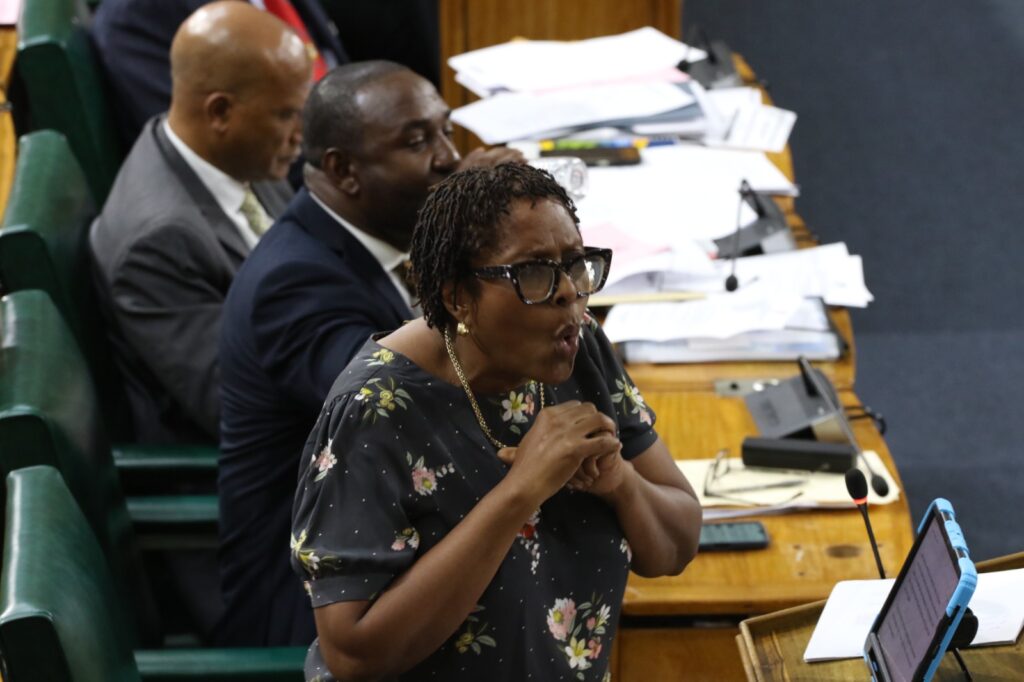
A dramatic confrontation in Jamaica’s Parliament has drawn widespread attention after opposition lawmaker Dr. Angela Brown Burke, representative for St Andrew South Western, grabbed the ceremonial mace mid-debate on a major infrastructure bill, resulting in her immediate suspension and formal naming by parliamentary leadership. Days after the incident, Brown Burke has publicly acknowledged her behavior violated established parliamentary rules, while continuing to defend the urgency of the concerns that prompted her extraordinary protest.
The chaos unfolded during an overnight, marathon committee-stage debate on the National Reconstruction and Resilience Authority (NaRRA) Bill, which stretched into the early hours of Wednesday. The legislation, drafted in response to the widespread devastation left by Hurricane Melissa, aims to create a new central body tasked with coordinating post-disaster reconstruction and long-term climate resilience projects. After more than 20 amendments were approved by lawmakers, the bill was ultimately passed in the early hours of the sitting.
From the start of clause-by-clause review, opposition lawmakers raised fierce objections to key provisions of the proposal. The core of their criticism centered on clauses that grant the new authority sweeping, unchecked powers to fast-track project approvals, issue binding directives to government regulatory agencies, and advance large-scale strategic investment projects. Opposition legislators have repeatedly flagged gaps in transparency, weak accountability mechanisms, and concerns over whether the vast spending authorized by the bill—amounting to trillions in public debt that will fall on current and future generations—lacks sufficient oversight safeguards.
Video footage published after the incident shows Brown Burke leaving her seat, approaching the mace— a centuries-old symbol of parliamentary authority and the Speaker’s power to govern proceedings—lifting it from its ceremonial position, and returning to her seat while some fellow opposition lawmakers reacted with laughter. Immediately after the act, House Speaker Juliet Holness ordered Brown Burke removed from the chamber, forcing a temporary halt to all proceedings. When the sitting resumed, the Speaker issued a firm warning to all legislators, making clear that interference with the mace would never be tolerated, regardless of the intensity of policy disagreements. “Not even in jest, Member, and not in protest either,” Holness emphasized.
Prime Minister Dr. Andrew Holness also stepped in to call for order, urging members to uphold the dignity of Parliament even amid heated policy debate. “I think what we are witnessing now is a display which when we reflect on this in years to come it will not be amongst our best, and I think the order of the house and dignity of the house must be preserved,” the prime minister stated during the disruption. A motion to suspend Brown Burke for the remainder of the sitting was subsequently brought under parliamentary standing orders, and passed with support from government members, removing her from the chamber for the rest of the debate.
In her first public comments since the incident, released in a video statement to media on Thursday, Brown Burke conceded that her actions fell outside acceptable parliamentary norms. “I start by accepting that my actions on Tuesday did not accord with acceptable parliamentary procedure. I also acknowledge under the circumstances that the decision of the House [to name me] is in keeping with the Standing Orders,” she said.
Despite accepting the punishment, Brown Burke pushed back against attempts to dismiss the broader policy objections that led to the confrontation, arguing the important concerns raised by the opposition should not be overshadowed by the dramatic scenes in the chamber. She emphasized that context is critical to understanding the incident, noting that opposition lawmakers had been unable to get their concerns about unaccountable power and excessive public debt addressed through regular procedural channels.
“I think context matters while we uphold the rules of the House, [and] at the same time I would not want that to distract unduly from the important points that we were making about the lack of transparency and accountability, the kind of unfettered powers that we saw with NaRRA because, you know, it’s trillions of dollars we’re talking about that is a debt to be borne by us and our children and our children and we want to make sure that we are doing it right and that we’re putting in the safeguards that are required,” she explained.