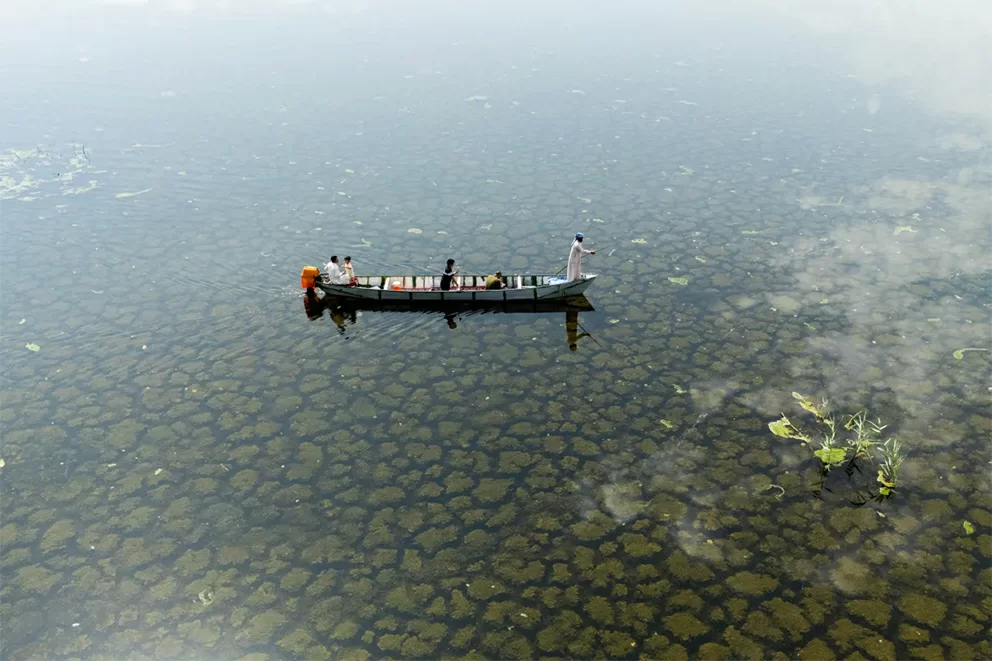
Tucked between the Tigris and Euphrates rivers in southern Iraq, the millennia-old Hawizeh Marshes — a unique wetland ecosystem long linked to the biblical Garden of Eden — is stirring back to life. This spring, after years of relentless drought that turned most of its landscape into cracked, barren earth, welcome winter rainfall has flooded vast stretches of the wetland, bringing renewed hope to local communities and conservationists alike.
Today, gliding across the marsh’s calm, sun-dappled waters in a wooden fishing boat reveals a landscape transformed. Lush green vegetation pokes through the spreading surface; water buffalo wallow in shallow pools or graze slowly on nearby thick, rich grass. Flocks of native and migratory bird species dart above the water, their silhouettes reflected clearly on the still surface, a quiet reminder of the biodiversity that this UNESCO-recognized ecosystem supports.
For decades, the marshes have faced existential threat. Years of accelerating climate change have shrunk rainfall across the region, while upstream dam construction in neighboring Turkey, Syria and Iran cut off critical water flow that once fed the Tigris and Euphrates. By the last decade, more than 90% of the marshland had dried up, destroying fishing livelihoods, displacing thousands of Indigenous Marsh Arab communities, and driving countless native plant and animal species toward local extinction. Even the Hawizeh Marshes, the wettest and most resilient section of the greater Mesopotamian wetland system, had been reduced to a parched shadow of its former self by repeated dry seasons.
But this year’s unusually heavy winter rainfall shifted the tide. Iraq’s Ministry of Water Resources reports that Tigris River reservoirs are now nearly full, and water levels on the Euphrates are expected to rise further in the coming days if neighboring Syria releases stored water from its upstream dams. Local environmental activist Ahmed Saleh Neema told reporters that the Hawizeh Marshes have not held this much water in more than a decade: approximately 85% of the protected wetland is now covered in water. While depths are still lower than historical averages, Neema notes that this level of water is already enough to guarantee the marsh will not dry out this summer, when regional temperatures regularly climb above 50 degrees Celsius — a threat that has doomed recovery efforts in past wet years.
For local fishermen like Kazem Kasid, who has spent his life casting nets in the marsh, the return of water is more than an environmental win — it is the restoration of his community’s identity and future. Dressed in a traditional white abaya and keffiyeh as he navigates his wooden boat through newly flooded channels, Kasam told AFP, “Life will come back, along with the fish and the livestock, and people will feel that their homeland and their future have been restored.”
The Mesopotamian Marshes hold enormous cultural, historical, and ecological value. As one of the largest wetland systems in the Middle East, it supports hundreds of species of fish, migratory birds, and megafauna that cannot survive anywhere else in the arid region. For centuries, Indigenous Marsh Arab communities have built their lives and culture around the marsh’s water and wildlife. While the current rebound is still fragile, and long-term threats from upstream development and climate change remain unresolved, the return of water to Hawizeh has given stakeholders a rare chance to protect and restore one of the world’s most unique cultural and natural landscapes.