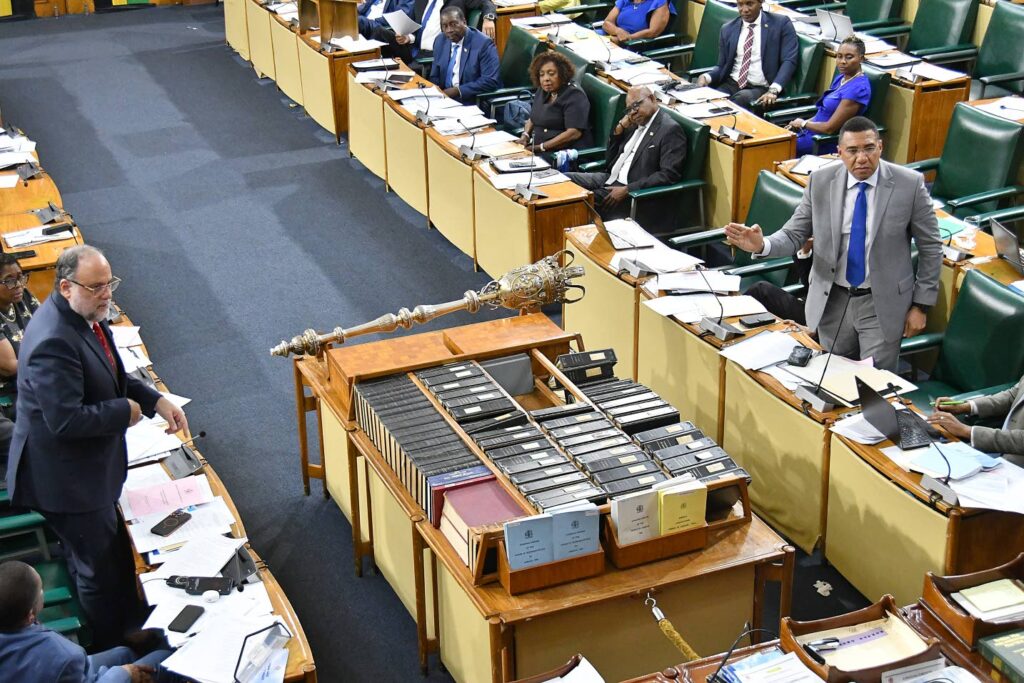
After a marathon legislative sitting that extended into the early hours of Wednesday, Jamaica’s House of Representatives passed 20 amendments to the National Reconstruction and Resilience Authority (NaRRA) Bill, a landmark piece of legislation created to guide recovery from Hurricane Melissa — the most powerful storm to make landfall in the country’s recorded history. The bill formalizes NaRRA as a centralized coordinating body for post-disaster reconstruction and long-term climate resilience projects, with a core mandate to speed up public and private investment critical to reversing the hurricane’s economic damage and strengthening the nation’s ability to withstand future extreme weather events.
The most high-profile of the approved amendments updates consultation requirements for communities impacted by reconstruction projects. The change came in direct response to sustained concerns raised by civil society organizations and opposition lawmakers, who criticized the original bill for failing to explicitly outline NaRRA’s obligation to engage affected populations. Under the revised Clause 17, NaRRA is now legally required to hold consultations with any people who are currently, or may in the future be, impacted by projects the authority oversees.
However, the final approved version was significantly narrowed from an earlier draft that won cross-stakeholder support. That initial iteration explicitly named vulnerable groups — including women, people with disabilities, the elderly, children, youth, local communities, and non-governmental organizations — that must be included in consultations, and required mandatory feedback meetings every six months. Opposition Leader Mark Golding slammed the truncated final language, arguing that the removal of specific group protections leaves the rule vague and toothless.
“The original draft outlined a far more comprehensive obligation. This shortened version only says the authority must hold consultations during project development and monitoring, but it gives no detail on which stakeholders must be included,” Golding told parliament during debate.
Government leaders pushed back against the criticism, defending the broad, open wording as a deliberate choice to avoid limiting participation rather than an effort to weaken accountability. Leader of Government Business Floyd Green argued that explicitly listing specific demographic or organizational groups would inadvertently narrow the scope of eligible stakeholders and create unnecessary bureaucratic delays that would slow reconstruction.
“This wording gives NaRRA far broader flexibility for consultation, because it includes every potential affected group without requiring an explicit, limited list. This is a far better approach that allows for wider engagement under the new framework,” Green explained. Prime Minister Dr. Andrew Holness echoed this position, emphasizing that the administration’s policy has always centered on inclusive community engagement, and the generalized wording actually creates a wider scope for participation than a rigid list of categories that could miss marginalized groups.
While the government made concessions on consultation and reporting rules, it rejected all opposition attempts to revise the bill’s most controversial governance provisions. The biggest point of contention centered on Clause 7, which the legislature left unchanged despite opposition calls to create an independent governing board to oversee NaRRA and hold its chief executive officer (CEO) accountable for operational and financial decisions. Golding argued that given NaRRA will manage billions of dollars in public spending, much of it borrowed from international creditors with interest, an independent oversight board is non-negotiable, especially in Jamaica’s current environment of low public trust in government institutions.
The government rejected the proposal, noting that NaRRA was intentionally structured as a streamlined executive agency focused on rapid reconstruction, rather than a traditional board-governed public body. Holness argued that adding a board would introduce unnecessary layers of bureaucracy that would slow critical decision-making during an urgent national recovery effort. “This entity has a very specific, time-bound task to execute. A board would bring discretionary policy interpretation and day-to-day management debates that are unnecessary here — our mandate is clear, we just need to deliver results quickly,” the prime minister said.
Several other contentious clauses also remained unamended after debate. Clause 5, which grants the prime minister sole power to appoint NaRRA’s CEO via written instrument, stayed intact despite opposition concerns over excessive concentration of executive power. Clause 6, which allows the authority and its CEO to delegate functions to “any person” with only ministerial approval, also survived unchanged, even after ruling party MP Marlene Malahoo Forte (St James West Central) raised concerns that the open wording lacked safeguards for competence and transparency.
“All I am saying is that the phrase ‘any person’ needs a qualifier. These are technical, specialized functions, so we need to ensure the person given authority is duly competent to carry them out,” Malahoo Forte noted during committee discussions. The government also retained the bill’s broad powers to expedite project approvals: Clauses 21 through 24, which let NaRRA issue directives to approval agencies and allow the responsible minister to issue “step-in orders” that override bureaucratic delays, went untouched. Clause 25, which empowers Cabinet to label projects worth $15 million USD or more as “strategic investment projects” across sectors from tourism and agriculture to healthcare, housing, and mining, also remained unchanged.
Among the more broadly supported amendments was a revision to auditing rules. The original bill let the CEO appoint NaRRA’s auditor with only cabinet secretary approval; the revised amendment moves the appointment power fully to the cabinet secretary, subject to final sign-off by the entire Cabinet. Lawmakers also approved an amendment requiring the CEO to submit progress reports to the responsible minister every six months, with copies tabled publicly in both houses of parliament. Another update expands NaRRA’s public project register to include private-sector strategic investment projects alongside government-led reconstruction efforts, and requires the register to name each project’s promoter, increasing public transparency over who is leading development work under the law. A final new amendment exempts approved projects from certain public investment management requirements under Jamaica’s Financial Administration and Audit Act, a change expected to cut red tape and speed up the approval process for critical recovery work.