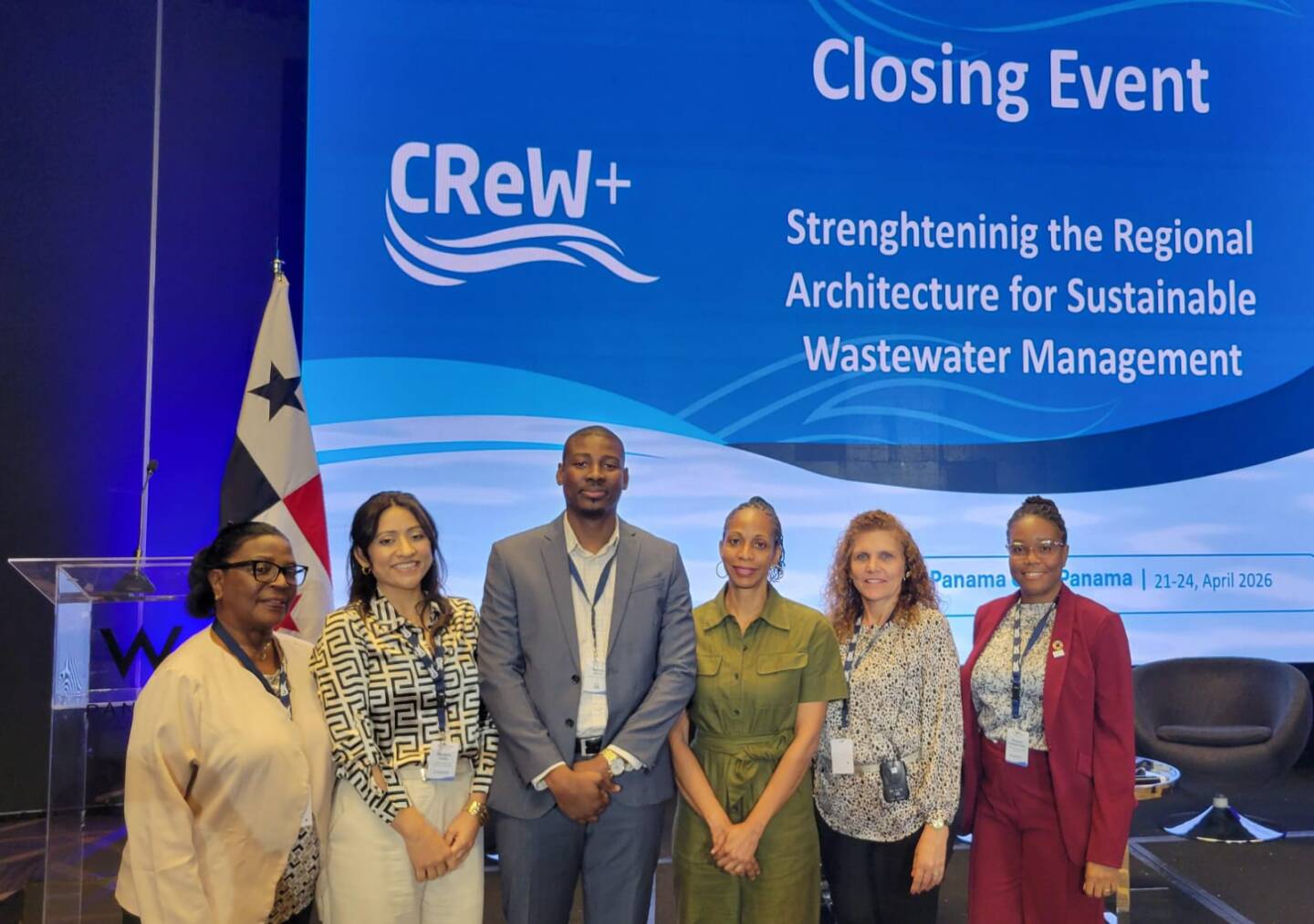
From April 21 to 24, 2026, the closing event for the GEF CReW+ project took place in Panama City, drawing stakeholders from across the Caribbean, Latin America and beyond to assess years of collective work on sustainable wastewater management and map the path forward. At the event, Dr. Roxanne Graham-Victor, Regional Coordinator for the Global Water Partnership-Caribbean (GWP-C), took the stage during a session focused on strengthening regional frameworks for sustainable wastewater management, moderated by Leverne Walker, Programme Management Officer for Marine Pollution at the Cartagena Convention Secretariat. During her presentation, she detailed the organization’s multifaceted contributions to advancing Integrated Water and Wastewater Management (IWWM) across the Caribbean and expanding into broader Latin American regions.
Dr. Graham-Victor emphasized that progress in wastewater management extends far beyond constructing physical infrastructure. Under the GEF CReW+ initiative, GWP-C’s work has centered on three core pillars: capacity-building and national-level support, innovation and on-the-ground project development, and public outreach and knowledge sharing. All these pillars work together to create lasting, systemic change, she explained.
On the capacity-building front, GWP-C has delivered targeted regional training and engaged directly with national stakeholders to boost local wastewater planning expertise. A standout example was a 2022 regional workshop focused on Shit Flow Diagrams (SFDs), a hands-on planning tool that visualizes the flow of wastewater and human waste through urban systems. The training gathered 28 water and sanitation practitioners from 13 Caribbean countries and territories, equipping them to develop SFDs and integrate the tool into city-wide sanitation strategies. For policymakers and local leaders, SFDs provide clear, actionable insight into where gaps exist in wastewater services, treatment and disposal, helping guide more effective resource allocation and policy design.
The second core pillar of GWP-C’s work under the initiative has been nurturing innovation and building a pipeline of implementable projects, turning abstract dialogue about water sustainability into tangible action. Key initiatives included the Young Caribbean Water Entrepreneurs Shark Tank competition, open calls for locally driven IWWM project proposals, and direct implementation support for selected grantees. To date, GWP-C has funded projects across Trinidad and Tobago, Colombia and Panama, marking the first time the partnership has supported on-the-ground water management work in Central and South America – a major milestone for expanding cross-regional impact.
Thirdly, GWP-C prioritized expanding public understanding of wastewater and sanitation challenges through targeted knowledge products and communications campaigns. Recognizing that these issues have long been confined to technical circles, the organization developed a range of accessible, audience-focused content: youth-created social media videos under the #WastewaterMatters campaign, evidence-based perspective papers, a regional video series breaking down IWWM principles, and specialized workshops for young leaders and journalists. These efforts have successfully brought wastewater and sanitation into broader public discourse, encouraging cross-stakeholder dialogue and building public support for reform.
Reflecting on the initiative’s outcomes, Dr. Graham-Victor outlined key lessons for the region going forward. The project has clearly demonstrated that cross-regional collaboration is a powerful driver of technical progress and can turn innovative ideas into implemented solutions, she noted. However, it also highlighted a critical need: to embed long-term gains in stronger national-level governance and systems, to ensure progress outlives individual, time-bound projects.
The GEF CReW+ closing event brought together national governments, regional bodies and implementing partners from across the Caribbean and Latin America to celebrate collective achievements and identify opportunities to continue advancing sustainable wastewater management in the region. For GWP-C, the event represented a valuable opportunity to share its lessons learned and reaffirm its commitment to building a stronger, more resilient regional foundation for integrated water and wastewater management. This article was distributed via NOW Grenada, which notes it is not responsible for the views expressed by contributing authors.