Five months after a historic general election shifted power in St. Vincent and the Grenadines, the country’s official government communications agency is facing growing public and political scrutiny over an embarrassing mislabeling mistake in a public press invitation.
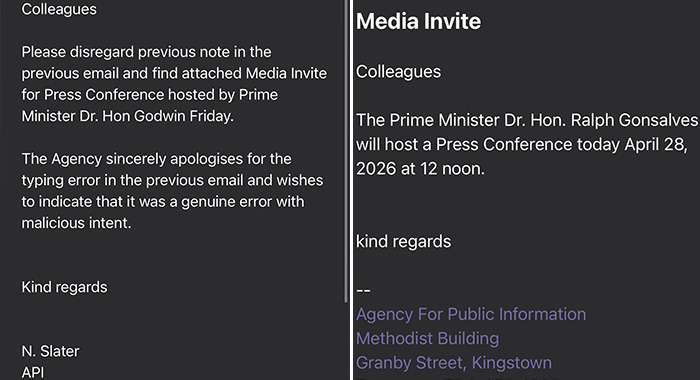
The error dates back to April 28, 2026, when the Agency for Public Information (API), the body mandated with disseminating accurate official information on behalf of the St. Vincent and the Grenadines government, distributed an unsigned media alert at 9 a.m. local time. The invitation incorrectly stated that the upcoming press conference would be hosted by Dr. Ralph Gonsalves, identifying him as the incumbent prime minister. Gonsalves, who led the Unity Labour Party (ULP) and held the prime minister’s office for 24 years starting in 2001, was removed from office following the November 27, 2025 general election, where Godwin Friday’s New Democratic Party (NDP) secured a landslide 14-1 majority over the incumbent ULP. Gonsalves was the sole ULP candidate to win his parliamentary seat, and now serves as leader of the parliamentary opposition.
Just 29 minutes after the first incorrect email was sent, acting API director Nadia Slater issued a second communication, signed with her initials, requesting that media outlets ignore the original invite. Slater corrected the host of the press conference to incumbent Prime Minister Dr. Hon. Godwin Friday, and issued an initial apology for the mistake. However, this correction contained a second, even more controversial error: the apology stated the mix-up was “a genuine error with malicious intent.”
Only three minutes after the second email was distributed, Slater issued a third correction, which attached the correct official press invitation and retracted the typo-ridden wording from the previous apology. In the final correction, Slater clarified that the original mislabeling was “a genuine error WITHOUT malicious intent.”
The blunder has drawn unwanted attention to the API, which is tasked with upholding the accuracy of government communications, just months after the new administration took office. The timing of the mistake, coming five full months after the transfer of power, has sparked questions about how the agency could mistakenly misidentify the sitting prime minister, even as Slater has repeatedly stated that the incident was nothing more than an accidental typing error.