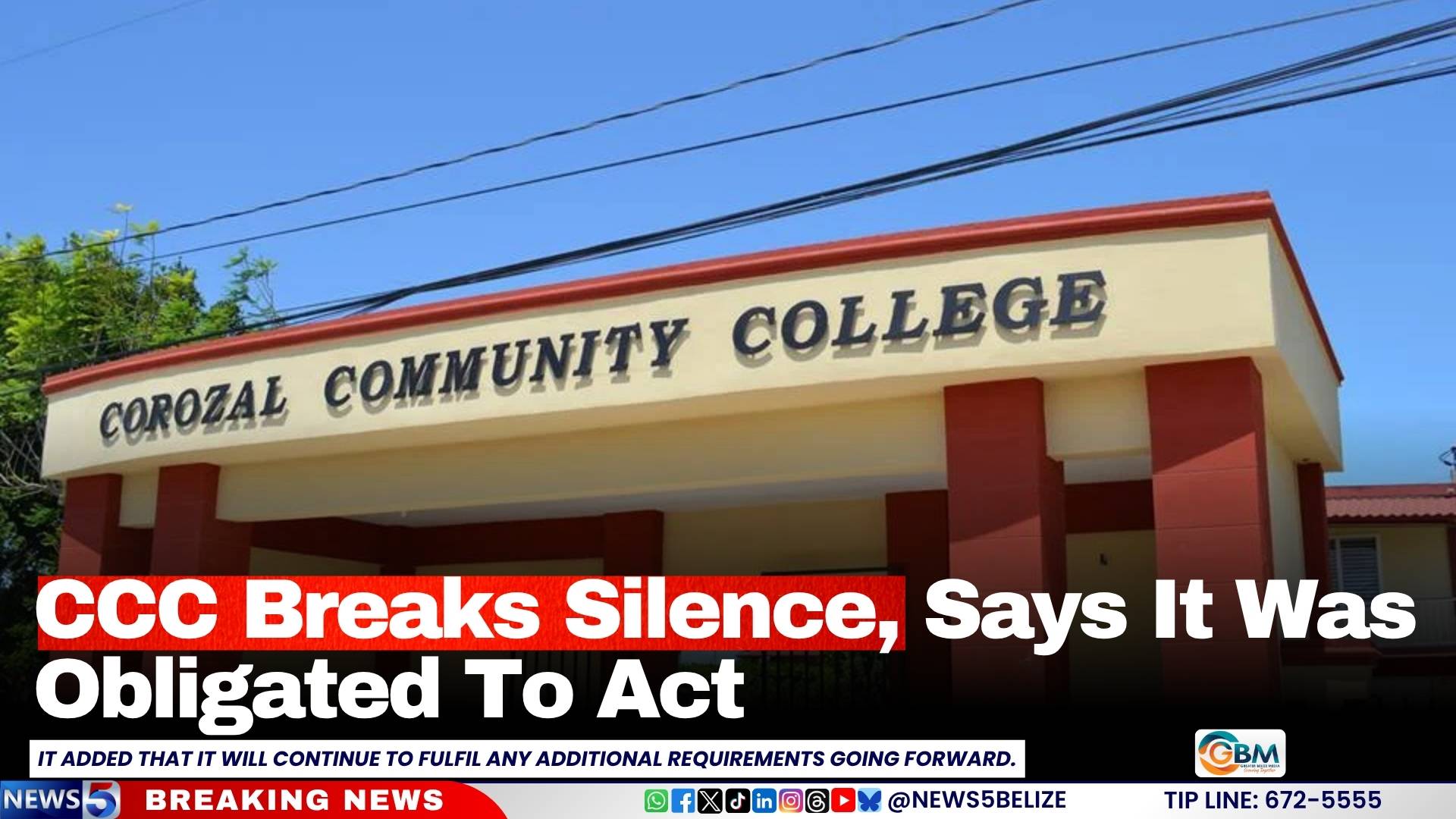
Nearly a month after the Belizean High Court dismissed its legal bid to block the reinstatement of a previously fired teacher, Corozal Community College (CCC) has broken its public silence to explain its decision to pursue the contentious case.
In an official statement released April 24, 2026, the Belizean secondary institution framed its legal challenge as a responsibility rooted in student protection, while acknowledging it has no choice but to abide by the court’s final ruling. The statement comes in response to earlier reporting on the High Court’s judgment, which marked the final chapter in a two-year-long disciplinary saga centered on allegations of misconduct involving minor students.
CCC officials noted that while they could not confirm the origin of the information in prior reporting, the institution had faced prior threats of public exposure around the case, making it necessary to lay out its position clearly for the general public and key educational stakeholders. The full text of the High Court’s ruling is currently available for public viewing on the official website of the Judiciary of Belize.
To contextualize its actions, CCC shared a full timeline of the disciplinary process, which traces back to March 2024. That month, the college launched formal disciplinary proceedings against teacher Renan Ruiz following a serious allegation of professional misconduct: inappropriate, unsuitable communication with underage students enrolled at the institution. CCC emphasized in its statement that it followed every required procedural step throughout the process to guarantee that principles of natural justice were fully upheld for all parties involved.
By September 2024, the Belize Teaching Service Commission reviewed the case and upheld the misconduct finding, approving a formal recommendation to dismiss Ruiz from his position. The commission ruled Ruiz’s behavior qualified as morally harmful to students under Rule 92A-(3)(b) of the 2012 amended Education Rules, which covers inappropriate contact and verbal harassment of students. Ruiz received formal notification of his termination shortly after the commission’s vote.
The college learned of Ruiz’s formal appeal of the dismissal ruling in January 2025. Eight months later, in September 2025, the Teaching Service Appeals Tribunal issued its own ruling: while the panel agreed Ruiz’s conduct was unacceptable and violated professional standards, it found the termination penalty excessive. The tribunal adjusted the penalty to a fine equal to one and a half months of Ruiz’s salary and required him to complete mandatory professional counselling, clearing the path for his return to the classroom.
CCC opted to challenge the tribunal’s ruling by filing an application for judicial review with the High Court. As reported in prior coverage, Justice Rajiv Goonetilleke rejected CCC’s application entirely on March 20, 2026. The justice ruled that CCC’s legal arguments had no reasonable chance of succeeding, and additionally found that as an unincorporated body without formal legal personality, the college did not have the legal standing to bring the challenge in the first place.
The court also ordered CCC to pay all legal costs incurred by Ruiz throughout the process, adding a critical warning: if the college fails to meet this financial obligation, the individual who submitted the supporting affidavit for the judicial review application could be held personally liable for the debt.
CCC confirmed in its statement that Ruiz officially returned to his position at the college on April 16, 2026, consistent with the court’s ruling. The institution noted it has already fulfilled all immediate obligations required by the judgment, and will comply with any additional requirements that arise as the case concludes.