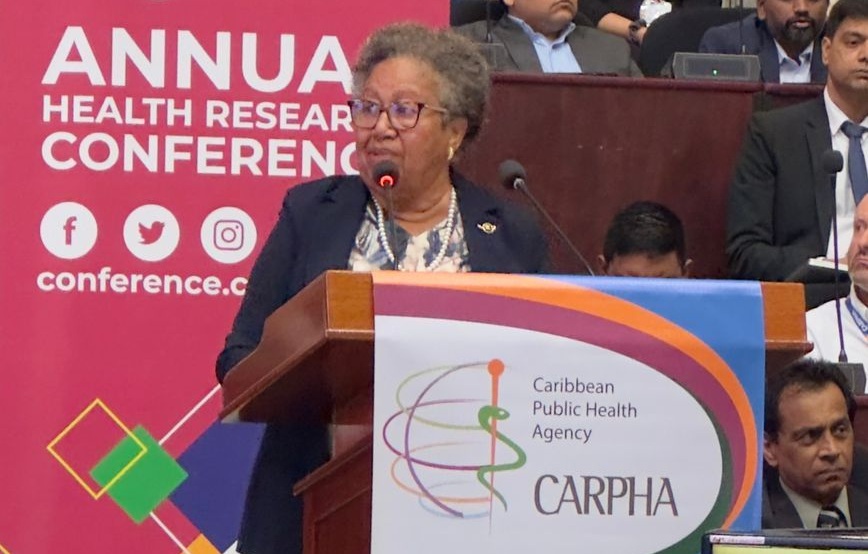
On Wednesday, April 22, 2026, top regional and national leaders opened the 70th Annual Public Health Research Conference hosted by the Caribbean Public Health Agency (CARPHA) in Georgetown, Guyana, centering discussions on redefining digital and biotech innovation in the Caribbean health sector around the core principle of local data sovereignty.
Speaking to delegates at the opening session, CARICOM Secretary-General Dr. Carla Barnett, a Belizean economist and former politician, framed the rapid emergence of transformative health technologies — including artificial intelligence, population genomics, and cloud-based digital health platforms — as a once-in-a-generation opportunity for the region. These tools, she noted, carry the potential to help Caribbean nations overcome long-standing systemic barriers to care that have persisted for decades.
Dr. Barnett highlighted the life-changing impacts these innovations could deliver for Caribbean communities: genomic sequencing could enable customized treatment for non-communicable diseases (NCDs), which disproportionately affect the region, by accounting for the unique genetic diversity of Caribbean populations, while AI-powered surveillance systems could forecast emerging pandemic outbreaks weeks earlier than traditional monitoring systems. “These are the game-changing possibilities to safeguard the health and resilience of the people of the region,” she emphasized.
But to unlock these benefits, Dr. Barnett argued, all health innovation must be rooted in the clear assertion of regional data and biological sovereignty. She argued that the current model of external research and data extraction leaves Caribbean people as nothing more than raw data points for foreign institutions, rather than the primary beneficiaries of scientific breakthroughs. Instead, she called for the development of regionally governed biobanks that protect local biological assets while still contributing meaningfully to global scientific progress.
To operationalize this new sovereignty-centered model, Dr. Barnett called for expanded investment in upskilling Caribbean public health professionals, equipping them with modern skills in data analytics, ethical governance, and cross-sector policy design. She added that community trust must be the foundation of any paradigm shift, noting that research must prioritize the needs of marginalized populations as much as it serves laboratory-based science. “If our people do not trust innovation, they will not adopt it,” she said. “Our research must stay relevant, speak to the needs of the mothers in a rural or remote village as clearly as it does to a scientist in a laboratory.”
Guyana’s Health Minister Dr. Frank Anthony, a trained medical doctor and public health specialist, echoed these remarks, framing CARPHA’s annual conference as a critical space for regional collaboration to strengthen Caribbean-led public health science. He stressed that self-determination in health begins with controlling the region’s own health data: “if the region did not generate its own data, others will define our realities for us; if we do not publish our findings, our stories remain untold.”
Dr. Anthony added that research only delivers full public value when it is translated from conference presentations and laboratory notes into actionable outcomes, including peer-reviewed publications, evidence-based policy briefs, and updated clinical practice frameworks that improve patient care. He also called for expanded mentorship programs to train the next generation of Caribbean researchers to lead projects, publish work, and shape global health discourse. “It places Caribbean knowledge on the world stage and it allows our voices and our evidence to shape the international discourse,” he explained. He also urged the region to prioritize widespread adoption of modern health tools including telemedicine and integrated digital health systems.
In his opening address to delegates, Guyanese President Irfaan Ali laid out an ambitious challenge for attendees: craft a actionable policy framework for CARICOM leaders outlining the critical gaps that must be closed to unlock the Caribbean’s unique research potential. Dr. Ali, an urban planner, pointed out that the Caribbean’s combined population size and extreme ethnic diversity give it a natural advantage as a global test bed for new medical technologies, public health interventions, and research and development projects. Currently, however, the region lacks the critical infrastructure, updated legal frameworks, and regulatory systems needed to host large-scale pilot research. “We have an ethnic mix that is essential for pilots yet how many pilots are conducted in this region?” he asked.
To advance regional access to modern digital health, President Ali offered Guyana’s existing telemedicine infrastructure to serve as a regional hub for the entire CARICOM area, open for use in clinical care delivery, cross-institutional research, and public health workforce education.