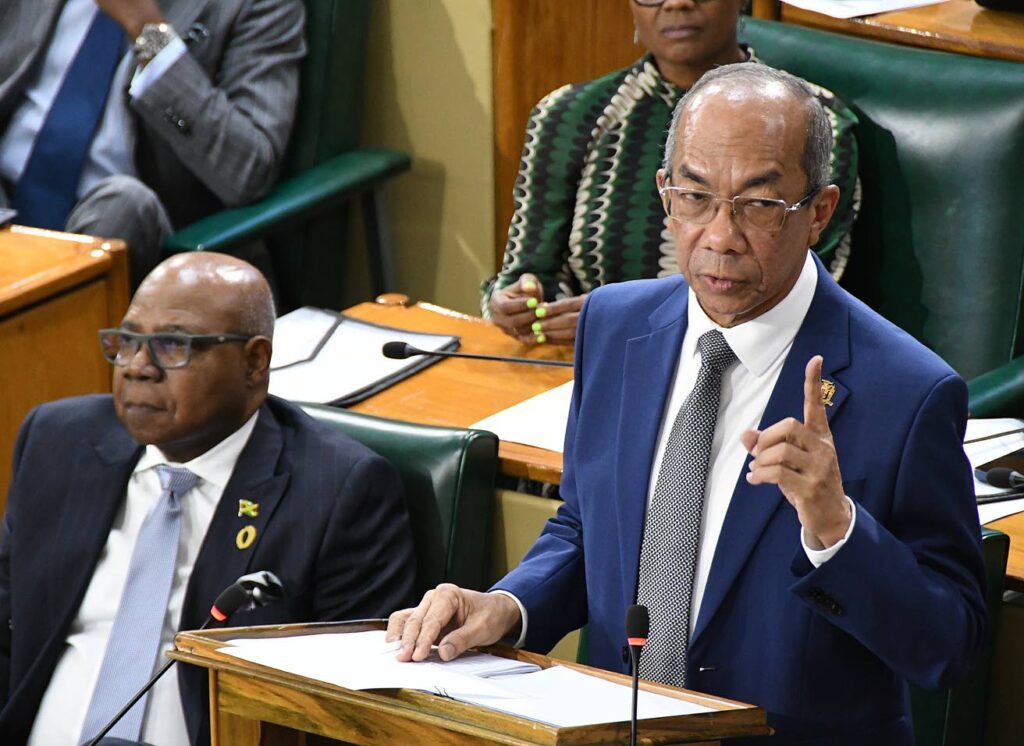
Delivering the opening address for the 2026/27 Sectoral Debate in Jamaica’s House of Representatives on Tuesday, Minister of National Security and Peace Dr. Horace Chang announced a landmark milestone in the country’s decades-long fight against violent crime, crediting targeted, sustained government investment in law enforcement for the transformative results.
Central to Chang’s presentation was a striking improvement in arrest rates relative to homicides: the ratio of arrests per 100 murders has climbed dramatically from just 44 in 2012 to 99 in 2025, a near one-to-one ratio of arrests to lives lost to violent crime. ‘This is the essence of deterrence,’ Chang explained, noting that the growing certainty of capture and incapacitation sends an unmissable warning to individuals who turn to criminal activity.
Over the past years, the Jamaican government has prioritized upgrading the Jamaica Constabulary Force (JCF), pouring resources into expanded personnel, new and renovated infrastructure, modernized patrol vehicles, and enhanced intelligence-gathering infrastructure. Chang emphasized that these investments have driven a fundamental shift in public safety outcomes that has not been seen in over 15 years.
The most tangible indicator of progress is the national murder rate: in 2025, Jamaica recorded 674 homicides, marking the first time in 32 years that the annual total fell below the 700 threshold. The downward trend has accelerated into 2026, with first-quarter murder rates dropping 29% compared to the same period last year. Chang added that the final quarter of 2025 (with 153 murders) and first quarter of 2026 (with 134 murders) are the two lowest quarterly homicide counts recorded since the JCF began collecting structured, disaggregated crime data 25 years ago.
Between 2017 and 2025, the cumulative impact of these security interventions has saved thousands of lives, Chang said: over that period, roughly 3,000 homicides occurred, compared to the higher baseline that preceded the government’s reforms. ‘That represents an average of 374 Jamaicans each year who are alive today because of these interventions,’ he stated.
Beyond homicides, other categories of violent crime, including non-fatal shootings, have followed the same downward trajectory. Chang extended the Jamaican government’s sincere gratitude to both the rank-and-file of the JCF and the country’s international security partners, whose human and technical support have been critical to the progress. ‘Without these actions and investments Jamaica would have continued on a trajectory that could have made us one of the most unsafe places to live in the world,’ he noted. ‘We changed that path.’
Chang attributed the breakthrough to disciplined, consistent execution of long-term reform, which has now pushed the country to a tipping point of accelerated public safety gains. The progress is rooted in two key improvements: stronger intelligence-led policing and more rigorous case investigation. Another landmark achievement is record-high firearm seizure rates: in 2025 alone, Jamaican law enforcement recovered 1,076 illegal weapons, most of which were pistols—the weapon most frequently used in homicides.
The ratio of firearm seizures to murders has also improved dramatically, outpacing the rate of violent crime. Back in 2011, Jamaican authorities seized an average of 44 firearms for every 100 murders, a 4:10 ratio. By 2024, that ratio climbed to 73 seizures per 100 murders, or 7:10. In 2025, the ratio hit 15:10, meaning authorities now recover an average of three illegal firearms for every two murders committed.
‘This shows clear evidence that enforcement is now getting ahead of violent crime,’ Chang said. He framed the current performance as a major national breakthrough, enabled by better intelligence, inter-agency coordination, and a more cohesive national response to organized crime.
Through the transformed JCF and deepened collaboration with other key security agencies including the Major Organised Crime & Anti-Corruption Agency (MOCA), Passport, Immigration and Citizenship Agency (PICA), and Jamaica Customs Agency, law enforcement is systematically disrupting transnational and local criminal networks and eroding their ability to operate. ‘In Jamaica, there is no hiding place for criminals. We will find them! We will incapacitate them! We will arrest and prosecute them!’ Chang declared. ‘Critically, our intelligence is now outpacing the criminals — and we will continue to strengthen it.’