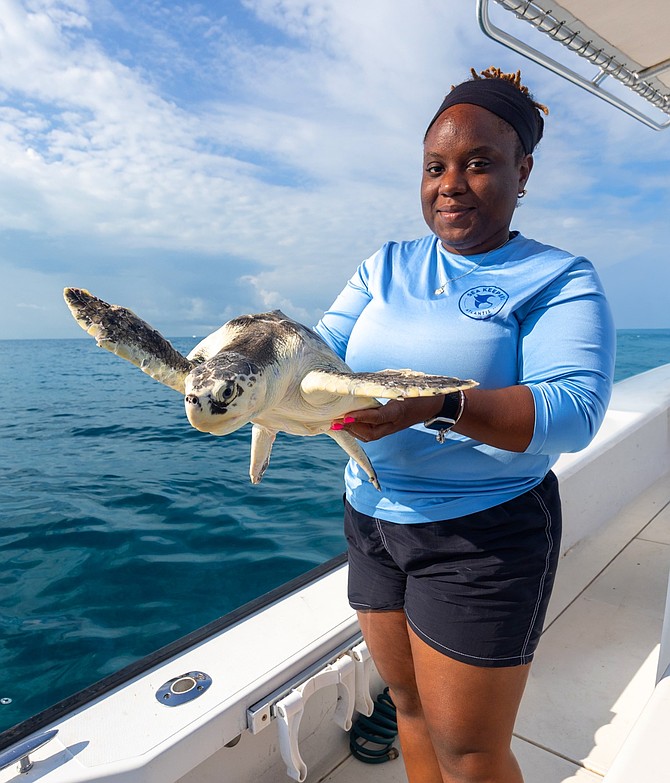
Against all odds, a tiny, critically endangered Kemp’s ridley sea turtle named Lucky has completed an extraordinary 2,700-mile cross-border journey from an icy Canadian shore to the warm tropical waters of The Bahamas, a groundbreaking conservation success story that arrives just as the world marks Earth Day.
Lucky’s story began in late autumn last year, when volunteers with the Canadian Sea Turtle Network, who conduct routine cold-weather coastal patrols, stumbled upon the weak, unresponsive juvenile along the rocky outer shores of Halifax, Nova Scotia. The young turtle had wandered far north of his species’ native warm Gulf of Mexico habitat, and plummeting ocean temperatures left him suffering from “cold stunning” — a life-threatening condition that leaves sea turtles immobilized and unable to forage or escape dangerous conditions. Prior to this rescue, no cold-stunned Kemp’s ridley sea turtle had ever been found alive and successfully rehabilitated in Canadian history; survival of such an event in Halifax’s frigid waters was widely considered almost impossible.
After the turtle was pulled from the shore, he received weeks of specialized veterinary care in Canada, slowly regaining enough strength to move to the next phase of his rehabilitation. Conservation teams began searching for a suitable facility with a natural warm marine environment and experienced veterinary staff to continue preparing Lucky for his eventual release back into the wild. That search ultimately led to Atlantis Paradise Island, a resort in The Bahamas with a dedicated Fish and Turtle Hospital and a long-running marine conservation program.
The journey south was almost derailed before it even began. Teams were set to depart Halifax on February 24, when a massive winter storm slammed into the region, dumping nearly 12 inches of snow and bringing wind gusts reaching 60 miles per hour. But as his name suggests, fortune favored the young turtle. After rerouting through Toronto, the rescue team and their precious passenger completed the multi-leg trip and touched down in The Bahamas, where Atlantis staff were waiting at the airport to receive him.
Lucky was immediately transported via the organization’s SeaKeepers rescue vehicle to the Atlantis facility, where he entered a quarantine period to acclimate to his new surroundings. A full health intake was conducted the following day, with Atlantis’s veterinary and aquarist teams completing detailed measurements, a full physical examination, and diagnostic blood work to confirm his stability.
After six weeks of continuous observation, targeted care, and rehabilitation that allowed Lucky to redevelop natural foraging behaviors and rebuild his strength, he passed a final health assessment led by Atlantis veterinarian Deandra Delancey-Milfort on April 8. Later that day, the Atlantis SeaKeeper team carried Lucky offshore and released him into the clear waters just off Paradise Island, marking the successful end of a months-long collaborative effort that crossed international borders, connected multiple conservation organizations, and united volunteers and experts across two vastly different climates.
Kemp’s ridley sea turtles, first formally identified in 1906 by Florida fisherman Richard M. Kemp after whom the species is named, are the smallest and most critically endangered of all sea turtle species. Juveniles typically hatch along Gulf of Mexico nesting beaches, then seek shelter in floating sargassum patches to feed and grow before moving to coastal habitats. However, young, inexperienced turtles often get pushed far off course by strong winds and shifting tides, stranding them in far northern waters as autumn transitions to winter, when dropping temperatures lead to life-threatening cold stunning.
Ahead of this year’s Earth Day, Lucky’s survival and release offers a powerful reminder of the fragility of marine ecosystems and the impact of cross-border collaborative conservation. What began as a near-fatal wrong turn for a tiny juvenile turtle has become a powerful example of what collective action for the natural world can achieve. Even for the smallest, most vulnerable creatures, conservationists note, cross-border cooperation can deliver second chances that make every mile of effort worth it.