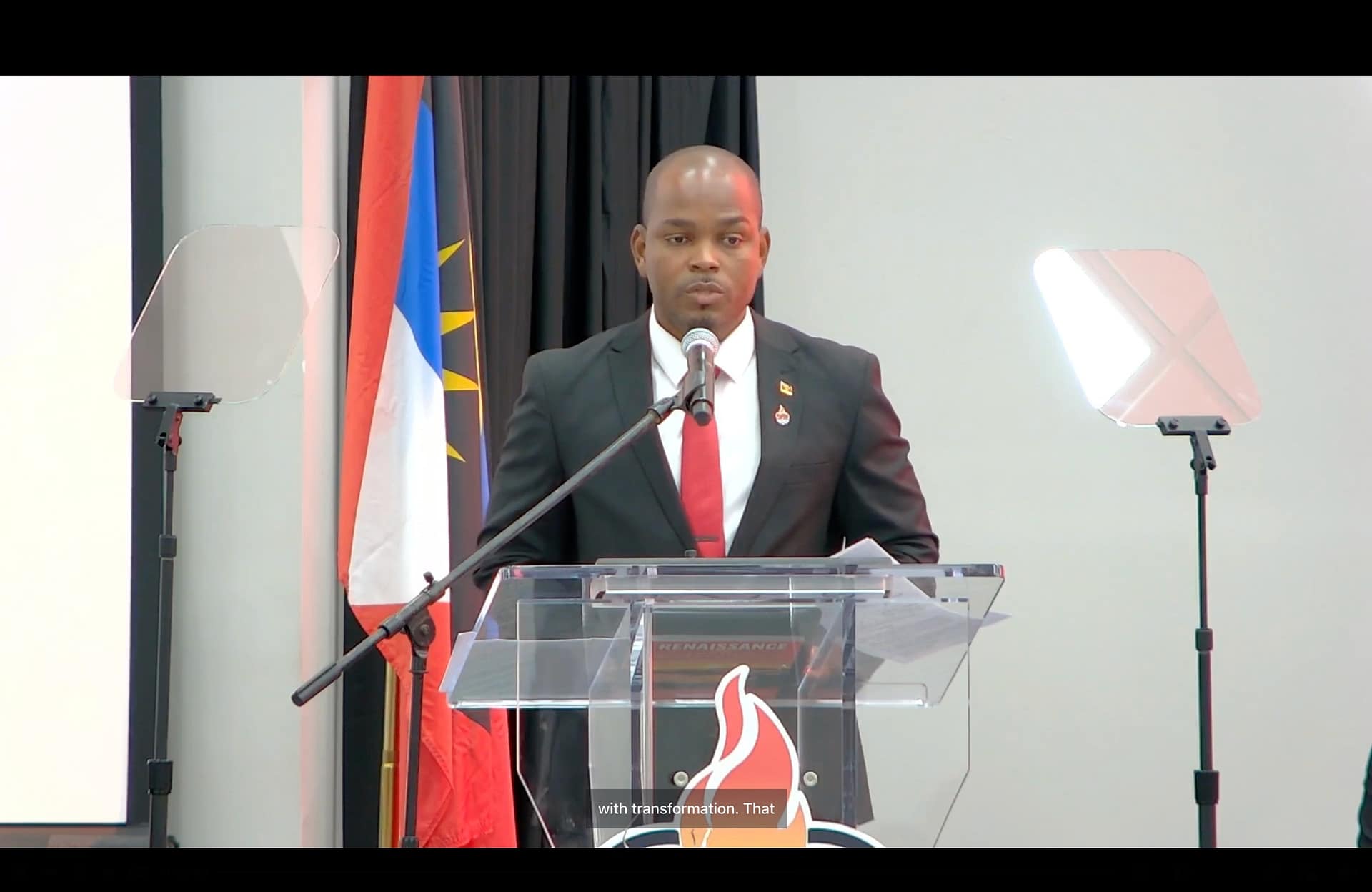
At the official launch of the Antigua and Barbuda Labour Party (ABLP)’s flagship “Renaissance” policy manifesto, held at the American University of Antigua Conference Centre, St. John’s Rural West candidate and sitting Minister of State in the Ministry of Health, Wellness and the Environment Michael Joseph delivered a keynote address centered on three core pillars of the administration’s agenda: intergenerational governance renewal, transformative healthcare reform, and urgent climate action.
Opening his remarks to a crowd of party supporters, Joseph pushed back against implicit questions over his appointment to public office as a young leader, framing his inclusion in the cabinet as a deliberate, values-driven choice by the ABLP administration. “Why Michael Joseph? Why a young minister? The answer is simple — because our government understands something fundamental: the future cannot be built without the youth of this nation at the table,” he stated. Positioning his tenure as an example of the party’s commitment to balanced leadership, Joseph noted that the ABLP’s approach intentionally blends decades of institutional experience with fresh perspectives and innovative thinking from emerging generations. “We believe in leadership that reflects the people… leadership that combines experience with innovation and tradition with transformation,” he explained. “I stand here as part of a generation that is not waiting for change — we are participating in it.”
Turning to his portfolio priorities, Joseph outlined a fundamental shift in the island nation’s healthcare strategy, moving beyond a system focused solely on treating existing illness to one that prioritizes preventive care, universal access, and systemic resilience. The administration, he said, is actively strengthening primary care infrastructure to eliminate gaps in access that leave rural and low-income residents behind. “In health, we are not simply managing illness — we are transforming it,” Joseph said. “We are strengthening primary healthcare so that no citizen is left behind because of geography or circumstance.”
He added that ongoing upgrades to hospital and clinic services are designed to equip the system to handle both routine patient needs and unexpected public health crises, while expanding focus on long-unaddressed priorities including non-communicable disease management and mental health support. Rejecting the framing of healthcare as a limited privilege, Joseph emphasized that the ABLP enshrines universal access to care as a non-negotiable fundamental right for all Antigua and Barbuda citizens. “A healthy nation is not built on hospitals alone. It is built in our homes, in our schools and in our communities,” he said. “This government believes that healthcare is not a privilege for a few, but a right for every citizen.”
Addressing environmental policy, Joseph framed climate change as an immediate, lived reality for the small island nation, rather than an abstract debate. Antigua and Barbuda already faces growing threats from rising sea levels, shifting rainfall patterns, and increased frequency of extreme weather events that disproportionately endanger low-lying coastal communities. Unlike many global powers that delay action, Joseph said, the ABLP administration has moved forward with a practical, action-oriented climate agenda focused on boosting national climate resilience, protecting the island’s critical marine ecosystems — a core pillar of its tourism and fishing economies — and upgrading national waste management infrastructure. “We do not debate whether climate change is real. We live its reality,” he said. “We are building not just infrastructure, but resilient infrastructure… not just policies, but sustainable progress.” Even as a small island developing state, Joseph emphasized, Antigua and Barbuda is not waiting for global powers to act: the nation is taking proactive steps to cut its own emissions and build resilience, and is leading by example in regional climate advocacy. “We are not waiting on the world — we are doing our part and we are leading where we can,” he said.
Wrapping up his address, Joseph tied these three policy priorities — youth empowerment, healthcare transformation, and climate action — together into the ABLP’s overarching “Renaissance” vision for sustained national progress. He argued that the three pillars are interconnected: investing in public health reflects a commitment to valuing every citizen’s life, protecting the environment demonstrates responsibility to coming generations, and elevating young leaders ensures long-term continuity, stability, and adaptive renewal for the nation. Joseph urged party supporters to take pride in the progress the country has made under the ABLP, while remaining focused on the work ahead to deliver shared prosperity. Positioning the newly launched manifesto as a clear roadmap for the next term of government, Joseph called on all citizens to move beyond passive observation and play an active role in building the nation’s future. “Do not underestimate what a united people, guided by purpose and driven by vision, can achieve,” he said. “Dreams are not fulfilled by spectators — they are fulfilled by believers, by builders, by those willing to serve. The path forward leads to a new era of progress and prosperity for all Antigua and Barbuda.”