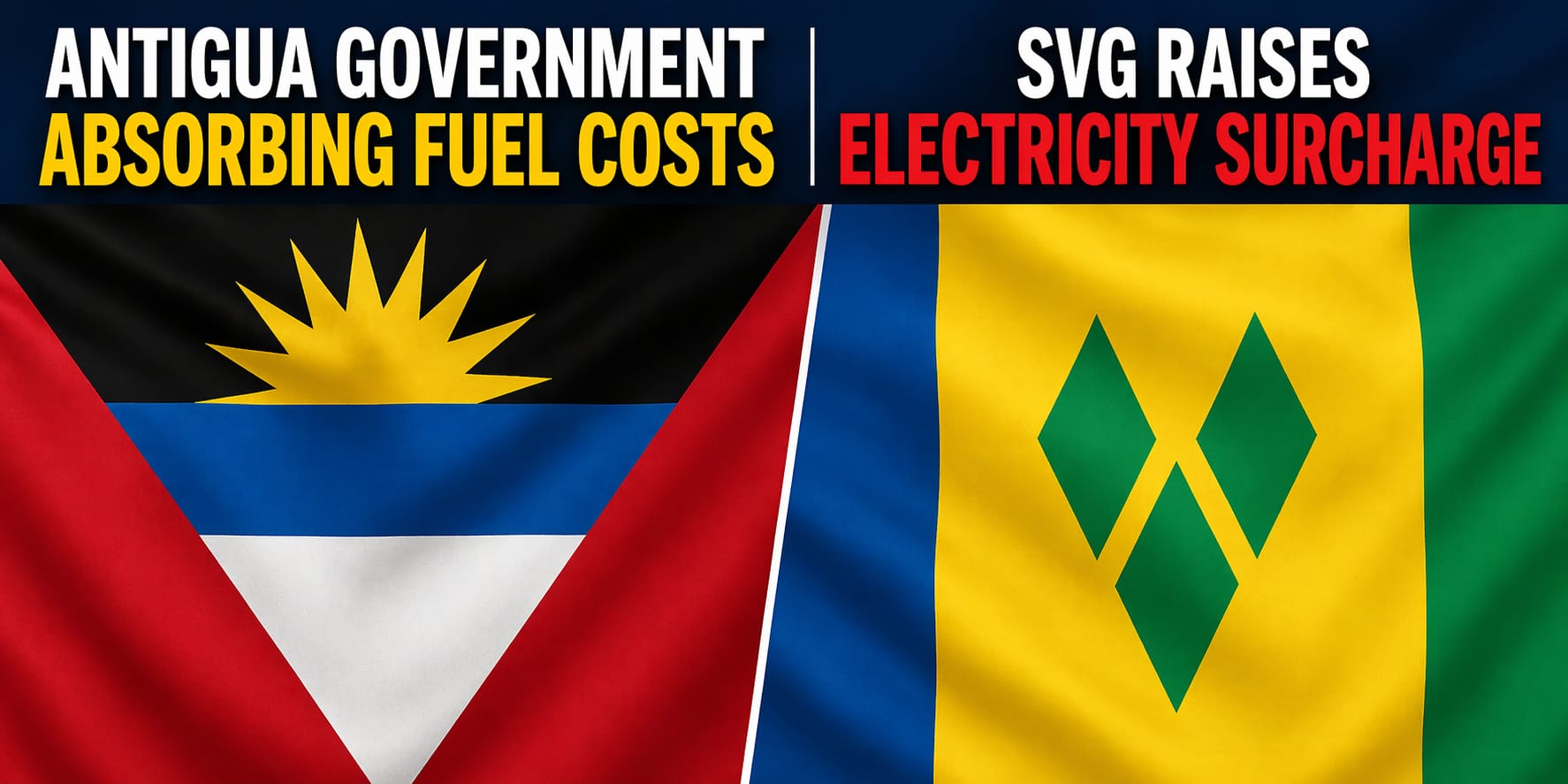
Against a backdrop of soaring global fuel prices driven by Middle Eastern geopolitical conflict, tight supply chains, and ongoing market volatility, two Eastern Caribbean nations have adopted starkly different policy approaches to protect their populations from rising cost-of-living pressures. Antigua and Barbuda’s government has committed to shouldering the burden of spiking international fuel costs through targeted subsidies and consumption tax cuts, aiming to insulate domestic households from steep increases in both electricity tariffs and transportation expenses. In sharp contrast, neighboring St. Vincent and the Grenadines (SVG) has opted to pass nearly all additional fuel costs directly to end users via a raised electricity surcharge, a decision that has already drawn attention to the trade-offs small island developing states face amid global economic uncertainty.
Under Antigua and Barbuda’s current cost stabilization strategy rolled out by Prime Minister Gaston Browne, the state provides a $1.67 per gallon subsidy for all fuel, including the petroleum products used to power the country’s electricity generation infrastructure. On top of this direct subsidy, the government has also cut the consumption tax applied to retail fuel to keep pump prices consistent for motorists and commercial transport operators. This dual policy intervention has succeeded in keeping domestic fuel and energy prices relatively stable even as global benchmark prices continue to climb, according to local government reports.
Despite these near-term wins for consumers, Antiguan officials have openly acknowledged the significant fiscal strain this policy places on public budgets. If international fuel prices continue their upward trajectory in the coming months, the current subsidy regime will not be financially sustainable indefinitely, Browne confirmed in public comments. Prime Minister Browne has also noted that sustained global market volatility could force the government to revisit the policy even amid its commitment to keeping household costs manageable.
Meanwhile over in SVG, the state-owned national utility St. Vincent Electricity Services Limited (VINLEC) has implemented a measurable increase to its monthly fuel surcharge, effective April 2026. The surcharge will climb from $0.5490 per kilowatt-hour to $0.6650 per kilowatt-hour, representing a $0.116 per kWh jump that will be reflected directly on residential and commercial customer bills. VINLEC officials framed the adjustment as an unavoidable response to two overlapping pressures: rising global fuel costs, driven largely by ongoing conflict in the Middle East, and reduced output from the country’s renewable energy generation facilities. The utility emphasized that the fuel surcharge is a pass-through mechanism designed exclusively to recoup actual fuel expenses, and does not generate any additional profit for the state-owned enterprise. VINLEC has also urged domestic customers to prioritize energy conservation where possible to reduce the overall impact of the higher surcharge on their monthly bills.
The contrasting policy choices highlight a growing dilemma for governments across the Caribbean region, where nearly all small island economies rely heavily on imported fossil fuels to meet their energy and transportation needs. While consumer-facing subsidies deliver immediate relief and help prevent broader inflation across the domestic economy, economists widely note that these measures carry significant long-term fiscal risks, particularly for nations with limited public revenue streams. Subsidies can strain national budgets, crowd out funding for other critical public services like healthcare and education, and create market distortions that slow the transition to domestic renewable energy generation. Passing costs to consumers, on the other hand, eases immediate fiscal pressure but drives up cost-of-living burdens for working-class and vulnerable households, potentially increasing economic hardship in the short term. For Caribbean leaders navigating global economic forces outside of their control, there remains no universally popular or risk-free solution to the ongoing challenge of volatile global fuel prices.