KINGSTON, Jamaica — A landmark initiative to boost technical and vocational training in clean energy is moving forward at St Andrew Technical High School (STATHS), as procurement begins for a purpose-built renewable energy laboratory on the institution’s campus. Jamaica’s Minister of Education, Skills, Youth and Information, Senator Dana Morris Dixon, announced the timeline for the project during an official alumni engagement visit this Tuesday, held to mark the school’s 65th anniversary under the celebratory theme “Inspiring Change: Reshape, Realign, Refocus”.
According to Minister Dixon, construction of the cutting-edge lab is scheduled to take place entirely over the upcoming summer holiday break, with a grand opening planned for the start of the new academic semester in September. The facility is designed to give hands-on technical training to students across a range of fast-growing renewable energy sectors. “Students will gain practical knowledge of solar technology, complete training for solar panel installation, and learn the ins and outs of energy storage batteries. They will also study core concepts of wind power generation,” Dixon explained during her address. “In the lab, they will master every step of working with renewable energy systems: how to install them, how to continuously monitor their performance, how to carry out repairs and maintenance, and they will even get to explore other clean energy solutions beyond solar and wind,” she added.
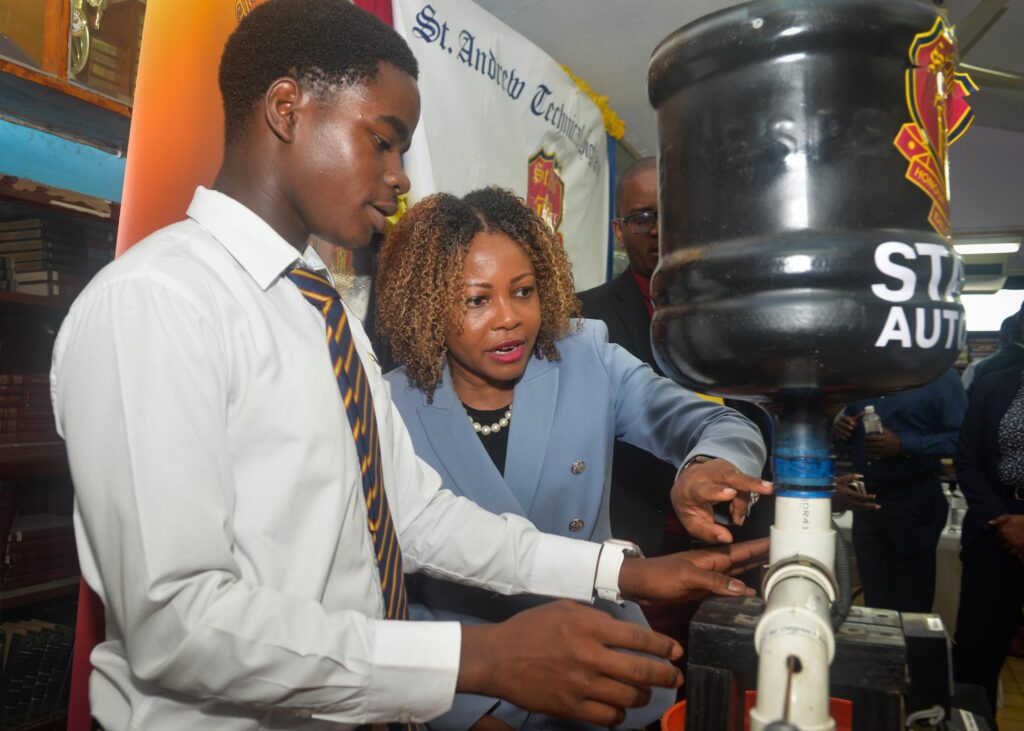
During her visit, the minister also conducted a tour of STATHS’ existing Technical and Vocational Education and Training (TVET) facilities, where she got a first-hand look at the innovative work already being carried out by the school’s student body. Two 11th-grade students, Nathaniel Hurge and Cameron Pinnock, took the opportunity to present STATHS Autopeck, an automated chicken feeder the pair developed alongside two other classmates, to address a common challenge for small-scale poultry raisers.
Nathaniel explained that the idea grew out of a widespread inconvenience: many small poultry keepers and agricultural teachers struggle to monitor chick feeding overnight, creating an unnecessary daily hassle. To solve this problem, the team designed and built their low-cost automated solution from readily available materials over just two weeks of work. The device operates using two reduction motors for power, paired with three 3D-printed spiral screws arranged in clockwise, counter-clockwise, and central positions to guide feed smoothly downward into feeding basins. A programmable timer module lets users set custom feeding durations and intervals to match the needs of their flock, while an integrated weighted sensor automatically shuts the machine off if too much feed accumulates in the basins, preventing harmful overfeeding.
While the device is not the first automated chicken feeder on the market, Nathaniel noted that it features a custom, low-cost design tailored to small-scale use, and the team already has big plans for future upgrades. “Down the line, we want to add a connected app that will let users monitor the feeder remotely from any location,” he said. Cameron added that the project required cross-disciplinary collaboration across multiple technical fields, pulling in skills from electrical engineering, building construction, plumbing, and even visual arts to bring the idea to life. Built with affordable off-the-shelf components including reduction motors, a DC power outlet, a repurposed five-gallon plastic bottle, plumbing pipes, and a control switch, the project pushed the students to problem-solve through unexpected challenges. “It was a demanding task, but we pushed through and got it done,” Cameron said. “Our next upgrade will be adding an integrated solar power system to cut the device’s reliance on continuous grid electricity, making it even more sustainable for off-grid use.”