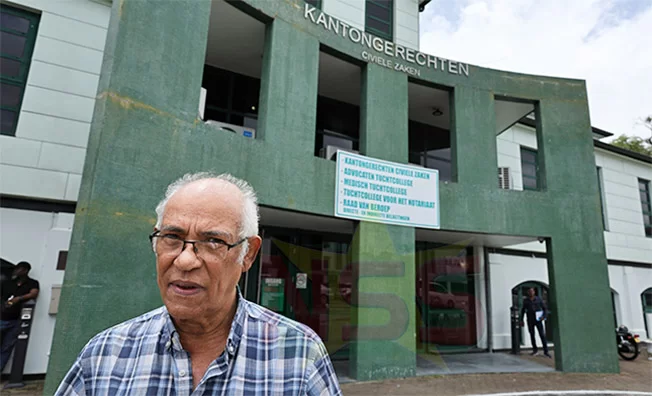
A landmark full civil procedure case against the state of Suriname, filed by 10 family groups of victims of the infamous December 8 murders, officially got underway in court this Tuesday. After a brief opening presentation of the case before the judge, legal representatives for both sides exited the courtroom, with lead counsel for the victims’ surviving relatives Hugo Essed stopping to speak with reporters to outline the details of the historic proceeding.
Essed emphasized that this is not a fast-track summary proceeding, but a full substantive civil trial that will examine the core merits of the families’ claims. Against expectations for a years-long delay, he noted that the case launched with far greater speed than anticipated, and projects that a final court ruling could be delivered within roughly 12 months.
In total, 60 family members of the 10 slain victims – including prominent public figures John Baboeram, Cyril Daal, Edmund Hoost, Rudie Kamperveen, Harrie Oemrawsingh, Leslie Rahman, Cornelis Riedewald, Jiwansing Sheombar, Jozef Slagveer and Somradj Sohansingh – have joined the collective lawsuit against the Suriname state. The claimants are demanding three core outcomes: official public rehabilitation of the victims’ reputations, a formal public apology from the Suriname government, and financial compensation for the harm they have suffered. Per participating family, the claims total 500,000 euros for material damages and an additional 750,000 euros for non-material harm stemming from the killings.
Beyond compensatory damages, the families are also seeking 250,000 Surinamese dollars per family to cover court and legal representation fees. To enforce any potential ruling in their favor, they have additionally requested a daily penalty payment of 500,000 Surinamese dollars per family for every day the state fails to comply with the court’s final judgment.
A notable detail emerging from the opening day is that five additional families of victims connected to the 1982 massacre have opted not to join the legal action. Essed told reporters that he has no insight into what led these families to decline participation, noting that all surviving heirs were extended a formal invitation to join the claim. “All heirs were given the opportunity to participate in this action. I cannot say why some chose not to take part; as counsel for the participating families, I have had no contact with the unrepresented families,” Essed explained.
He added that outreach to all surviving relatives was coordinated through the Organization for Justice and Peace (OGV), which first shared detailed information about the planned legal proceeding with families more than a year ago. Collecting the required legal documentation, including proof of inheritance and formal power of attorney from all claimants, took longer than initially projected to complete, contributing to the gap between initial planning and the launch of the trial.
Essed also laid out the legal foundation for holding the Suriname state directly liable for the killings. “The murders were carried out by individuals acting in their capacity as state officials and government functionaries, using state-owned resources and infrastructure, including weapons and military facilities belonging to the National Army of Suriname. That direct connection makes the state co-liable for the killings,” he argued.
Under Suriname’s legal framework, if the court finds the state liable for damages, the government would then have the right to pursue separate claims to recover those funds from the perpetrators of the massacre or their heirs. Essed, however, cautioned that this path would be largely unworkable in practice, as most of the individuals directly involved in the killings are not believed to hold significant personal assets that could be seized to cover the damage awards.