With just 28 days remaining until the Bahamas’ critical general election, the Free National Movement (FNM) held its first major campaign rally on New Providence, where party leader Michael Pintard launched a fiery defense of his controversial proposed national lottery, directly pushing back against scathing criticism from sitting Prime Minister Philip Brave Davis.
Held at Golden Gates Park under the campaign theme “Fire Forward,” the event drew an energized crowd of FNM supporters, who packed the venue dressed in official party gear, waving party flags, chanting and dancing as the slate of party candidates took the stage. Signature FNM anthems, from “Simply the Best” to “Keep the Fire Burning,” played throughout the night, building a festive, high-stakes campaign atmosphere. The rally wrapped with a traditional Junkanoo rush-out after a closing prayer, leaving attendees buzzing with momentum ahead of the upcoming vote.
In his keynote address – delivered after a dramatic torch-lit procession entrance accompanied by police escort – Pintard pushed back hard against Davis’ recent dismissal of the lottery plan as a cynical “gimmick” rooted in electoral desperation. The FNM leader accused the prime minister of outright hypocrisy, arguing that Davis’ label is far more fitting for the incumbent administration’s own policy practices.
Pintard hit out at the government’s handling of public funds, declaring, “The prime minister [is] the chief architect of gimmicks. They started talking about slash funds and if you look in the dictionary next to slash funds, you will see the picture of the prime minister.”
Outlining the core guardrails of his proposal, Pintard emphasized that the FNM’s national lottery would operate under strict regulatory oversight from an independent governing board, designed to explicitly insulate revenue from political misallocation and interference. He noted that unregulated gambling is already widespread across the Bahamas, arguing that formalizing the sector would allow the government to redirect currently untapped funds toward tangible public benefits for Bahamian citizens.
To back the plan, Pintard pointed to existing national lottery models in countries including the Dominican Republic, Curaçao, St Martin and Ghana, explaining that the Bahamian framework would allow the state lottery to coexist with existing private gaming operators while directing all proceeds toward public initiatives. These would range from small business grants for aspiring entrepreneurs, to financial support for students pursuing post-secondary education both at home and abroad, to investments in cultural development and environmental protection.
Questioning the incumbent government’s opposition, Pintard noted, “it was them who gave birth to the regularizing of gaming. Why would it be a problem for them all of a sudden to have a national lottery where the bulk of those resources are being administered to the government system?”
Davis had struck back at the proposal just days earlier, questioning both its intent and the international examples Pintard cited. The prime minister called the plan a headline-grabbing stunt rooted in political desperation, arguing that the Dominican Republic’s national lottery – the example Pintard highlighted – has been marred by widespread corruption and mismanagement. Davis claimed the proposal amounted to a poorly thought out plan to create a slush fund for corrupt actors.
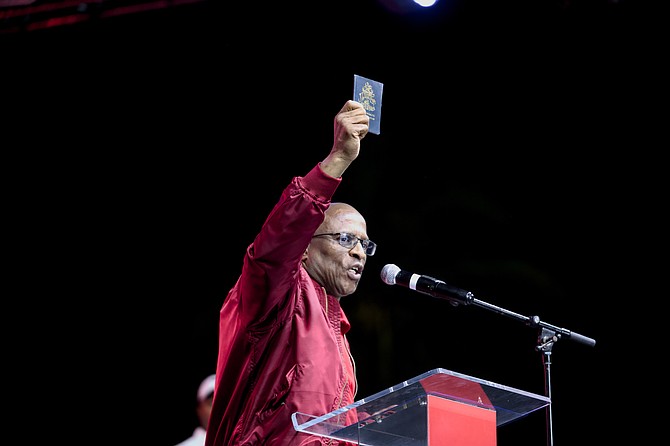
Beyond the lottery debate, Pintard used his keynote to address broader hot-button issues including national sovereignty and immigration, holding up a Bahamian passport as a core symbol of national pride and birthright. He affirmed that all individuals who obtain Bahamian documentation through legal channels – regardless of their country of origin – are welcome members of the Bahamian community, but blasted the incumbent administration for failing to crack down on rampant fraud involving identity documents like passports and voter ID cards.
Pintard accused the government of targeting critics who raise alarms about document fraud, saying, “if you’re not outraged by the frequency with which fraudulent passports, voters cards are being used in this country, if you are not angry about that, then you must be an accomplice in it happening.” He also pledged that if the FNM wins the election, a new administration would immediately launch a full audit of incumbent government finances to track public spending and root out mismanagement, declaring “we’re going to open the books.”
The rally marked the FNM’s second major campaign event, and featured remarks from the party’s full slate of New Providence candidates, including Pinewood hopeful Denari Rolle, Golden Gates candidate Michael Foulkes, Garden Hills candidate Rick Fox, Bamboo Town candidate Dr. Duane Sands, Carmichael candidate Arinthia Komolafe and South Beach candidate Darren Henfield. Each candidate used their platform to criticize the ruling Progressive Liberal Party, pointing to what they described as a lack of tangible progress across their constituencies. FNM Deputy Leader Shanendon Cartwright, who is contesting the newly created St. James constituency, introduced Pintard and offered brief remarks on immigration and public spending ahead of the keynote.