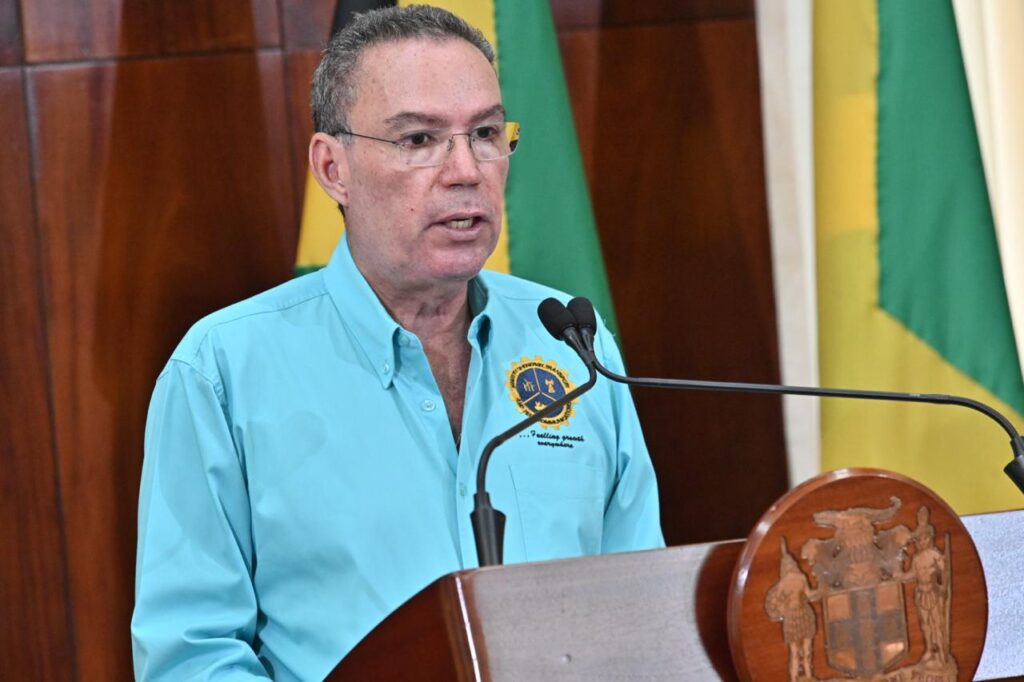
KINGSTON, Jamaica — Jamaica is grappling with a growing crisis driven by skyrocketing international oil prices spurred by ongoing Middle East geopolitical instability, and Energy Minister Daryl Vaz has issued an urgent call for collective responsibility among all Jamaicans to cut energy use, while warning that the government could soon implement targeted movement restrictions to curb fuel consumption.
Vaz outlined the government’s multi-pronged response to the economic fallout from Middle East tensions during a post-Cabinet press briefing held Wednesday morning, making clear that further price hikes are inevitable as long as the regional conflict continues.
“You’re gonna see increases as long as this conflict in the Middle East continues. We [the Government] will do what we can do, but it is important that you do what you need to do to understand that you need to conserve starting today, today, today,” the minister stressed repeatedly, emphasizing the urgency of immediate action.
Among the policy options under active consideration by the government is a return to COVID-era hybrid work-from-home arrangements, a measure that would cut down on commuting traffic and overall transportation fuel use. Vaz noted that final approval for any new conservation policies will rest with the full Cabinet, but argued that change is unavoidable given current patterns of travel.
“The Government is gonna have to look at policies to limit movements, especially transportation movements. I don’t know whether or not we go back to a COVID-hybrid version of working from home; something has to happen, because the level of traffic that I am seeing on the road doesn’t show me that anybody realises that there’s a war and the price of fuel/oil is going to go up, and up, and up,” Vaz said.
He added that while the government will finalize formal conservation plans following Cabinet deliberations, individual and community action is non-negotiable amid the unprecedented global price crunch. “it is 100 per cent the responsibility of every Jamaican to realise that we are in a major, major crisis as it relates to the price of oil internationally, and therefore, you need to take responsibility for your household, your business, [so] see what you can do,” he stated.
Even as the government confronts soaring costs, Vaz moved quickly to reassure the public that Jamaica’s energy security remains solid. Long-term finished product supply contracts and domestic refining capacity operated by state-owned oil firm Petrojam have kept supply chains stable, meaning there is no risk of fuel shortages, only elevated prices. “So, it’s not a matter of not being able to buy [oil]; it’s the price. So there’s no need to panic,” he declared.
To soften the blow of global price increases for consumers, the government has already implemented a range of mitigation measures through the Ministry of Energy, Ministry of Finance, and Petrojam, designed to avoid passing the full weight of global price hikes onto Jamaican households. Petrojam’s pricing committee also maintains continuous monitoring of global market conditions, adjusting ex-refinery prices in line with shifts.
However, Vaz revealed that this existing price-capping mechanism has come at a steep cost: Petrojam has already accumulated between $1.3 billion and $1.4 billion in unrecovered losses that have not been passed to consumers. If the current framework remains in place through June 2026, total losses would reach $11.8 billion – an amount equivalent to two-thirds of the current fiscal year’s total revenue measures, which Vaz called “unaffordable, unsustainable.”
Vaz also addressed the broader geopolitical context driving price volatility, noting that stalled talks between Iran and the United States have worsened market uncertainty. While he remains hopeful that a diplomatic resolution can be reached, he acknowledged that discussions have moved “in the wrong direction since Monday.”
To address the dual goals of fiscal stability and consumer protection, the Cabinet has approved a new tiered pricing mechanism that will replace the current flat $4.50 price cap. The new framework will bring domestic fuel prices into closer alignment with global market movements, allow for controlled, predictable weekly adjustments, protect consumers from sudden sharp shocks for smaller price increases, and give Petrojam greater flexibility to respond to large global price swings.
Vaz explained that the revised system will likely include three separate tiers of caps, adjusted weekly in response to global market changes, making it far more agile than the inflexible flat cap currently in place. “This will allow Petrojam to be more agile and respond in a more timely manner to price volatility. What does that mean? It means that the $4.50 cap cannot be sustained, and it means that we’ll have to have several different tiers of caps – probably three – that will speak to what’s happening in the market and, as I said, pricing is weekly. So it means that we can adjust on a weekly basis,” he said.
Closing his remarks, Vaz rejected any suggestion that the government can continue absorbing massive losses to keep prices artificially low, given competing pressing national priorities. “But let me be blatantly and truthfully upfront in your face; the Government of Jamaica cannot stomach an $11.8 billion [loss] with all of what we have to do and all of the contending priorities, and anybody who tell you any different… rubbish! No Government in a situation like this can sustain that,” the minister argued.