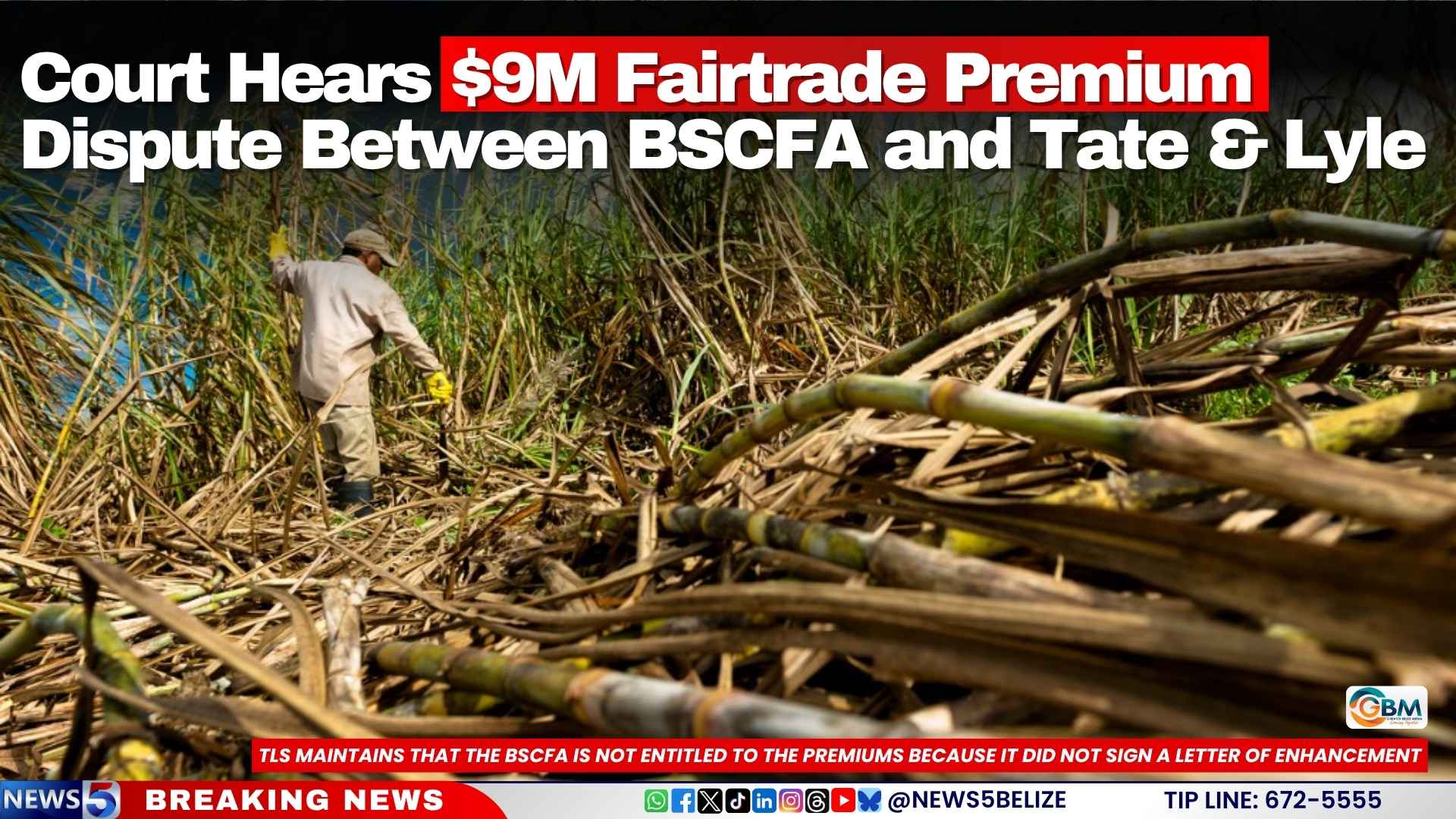
A high-stakes legal battle over $9 million in unpaid Fairtrade sugar premiums moved to the Belize Court of Appeal on April 13, 2026, pitting the Belize Sugar Cane Farmers Association (BSCFA) against global sugar processing giant Tate & Lyle Sugars Limited (TLS). The dispute, which has already stretched more than two years through lower courts, centers on conflicting claims over eligibility for premium payments for two sugar crop cycles: 2021/2022 and 2022/2023.
Tuesday’s appellate hearing stretched nearly four hours, with legal teams for both sides laying out their core arguments in front of the court. The appeal itself was filed by TLS, which is challenging a 2025 Belize High Court ruling that rejected the firm’s bid to dismiss the BSCFA’s original claim entirely. The BSCFA first launched its lawsuit in March 2024, naming both Belize Sugar Industries (BSI) — the local processor that holds a long-term contract to supply Fairtrade-certified sugar to TLS — and TLS as defendants.
Per the BSCFA’s core argument, the association’s farmer members grew and supplied fully Fairtrade-certified sugar cane throughout the two disputed crop years. Because those harvests were sold to TLS as Fairtrade-eligible product, the farmers are legally entitled to collect the corresponding Fairtrade premiums, which are added payments intended to support community development and producer welfare under Fairtrade labeling rules. The association is seeking the full $9 million in unpaid premiums, plus accumulated interest, and is also pressing claims of damages for alleged unlawful conspiracy and violation of global Fairtrade operating standards.
TLS, for its part, has pushed back on every element of the BSCFA’s claim. The company maintains that payment of Fairtrade premiums is only required when the producer association signs a formal Letter of Enhancement (LOE), a binding document that outlines the terms of premium distribution and dispute resolution. According to TLS, no valid LOE was signed by the BSCFA for the two crop years in question, disqualifying the farmers from collecting the premiums.
Additionally, TLS has argued that the 2021 LOE — which was in place for the 2020/2021 crop cycle — included a binding arbitration clause requiring all related disputes to be heard in London, not in domestic Belizean courts. The firm has repeatedly called for the dispute to be moved to international arbitration rather than adjudicated locally.
The BSCFA has directly refuted this position, countering that the 2021 LOE was explicitly written to cover only the 2020/2021 harvest, and expired fully before the start of the 2021/2022 crop cycle. With no new LOE agreed upon for the disputed period, the expired agreement’s arbitration clause cannot apply to the current conflict, the association’s legal team argues. The BSCFA further alleges that TLS and BSI intentionally withheld the new LOE for the 2021/2022 and 2022/2023 cycles specifically to cut farmers off from the millions in premium payments they were owed.
All three parties presented senior legal counsel for the appellate hearing: Magali Marin-Young and Allister Jenkins argued on behalf of the BSCFA, while Eamon Courtenay and Iliana Swift represented TLS. Though BSI is not an official party to the appeal, the court granted the firm permission to submit its own arguments, delivered by Senior Counsel Godfrey Smith, Hector Guerra, and Edgar Lord. Both TLS and BSI have denied all allegations of wrongdoing, asserting that global Fairtrade rules explicitly require a signed contractual agreement between buyers and producer associations before premium payments can be issued.
The appellate hearing marks a key turning point in a dispute that has major implications for Fairtrade labeling practices, smallholder farmer rights, and contract enforcement in global agricultural commodity supply chains, with a ruling expected to set a precedent for future premium disputes in the region.