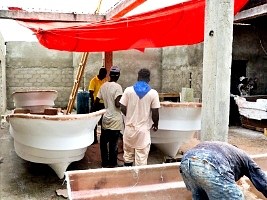
In a working visit to Haiti’s far northern regions this week, Marcelin Aubourg, the country’s Minister of Agriculture, Natural Resources and Rural Development (MARNDR), led a inter-agency delegation to assess the progress of ongoing fisheries infrastructure development projects, part of a broader national push to unlock the sector’s untapped economic potential for coastal communities.
The delegation’s first stop was Fort-Liberté, where they toured a local facility manufacturing marine engines and new fishing vessels. Bernard Chauvet, general manager of the workshop, confirmed that 20 of the 80 ordered fiberglass fishing boats will be ready for delivery by the end of May. Built at four feet wide, each vessel is outfitted with an average 15-horsepower engine, specifically engineered to withstand deep-sea fishing conditions that are common off Haiti’s northern coast.
On April 10, 2026, Aubourg convened a working meeting with representatives from local fishing associations at the North Departmental Directorate of Agriculture (DDAN). During the talks, the minister stressed that fishing has evolved into one of Haiti’s most promising high-growth sectors for rural livelihoods. He noted a striking cultural shift in the industry: unlike decades past when fishing was often viewed as an unstable, low-status occupation, today’s Haitian fishermen embrace their professional identity, as the trade now reliably generates enough income to support their households. Aubourg, who previously served as departmental director of agriculture for the South and Grand’Anse regions, urged northern fishermen to fully invest in their work, noting that expanded infrastructure and training will open pathways to long-term improvements in household income and quality of life.
The on-site inspections and community meetings are part of Haiti’s broader Program to Support Agricultural and Fisheries Productivity and Improve Rural Infrastructure for Market Access (PAPAIR), a national initiative focused specifically on boosting fisheries output and rehabilitating outdated coastal fishing infrastructure. After delivering measurable positive outcomes for small-scale fishing communities in Haiti’s southern departments, the program is now rolling out to the northern and northeastern regions.
Laurent Mérisier, an agricultural engineer and one of three national PAPAIR coordinators, shared details on the program’s early progress in the north. To date, roughly 20 local fishing associations—15 in the North department and five in the Northeast—have completed technical training as part of the initiative’s organizational capacity-building component. Each participating association will receive four of the 80 new fishing boats currently under construction. All vessels will come fully equipped with marine engines and modern fish preservation tools, a upgrade that will particularly benefit small-scale fishmongers who rely on fresh product to serve local markets.
PAPAIR is a flagship project of the Haitian government, implemented through MARNDR, with financial backing from two major international development bodies: the Inter-American Development Bank (IDB) and the Global Agriculture and Food Security Program (GAFSP).