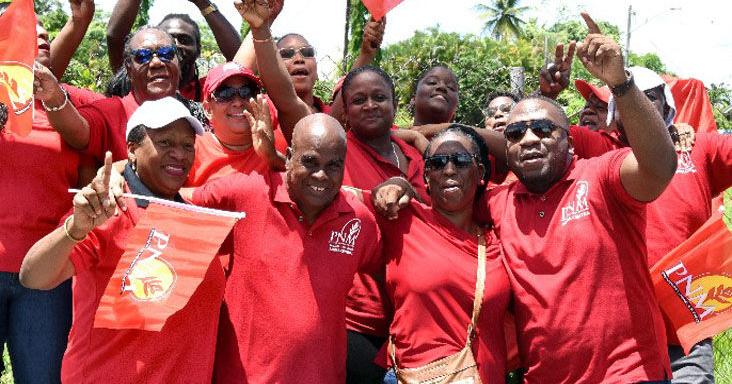
For more than 20 years, campaign finance reform has stood as a rare point of cross-party consensus in Trinidad and Tobago’s legislative landscape. Yet despite holding executive power for nearly a full decade, the former People’s National Movement (PNM) administration never managed to turn that long-held agreement into binding law — a failure that prominent political analyst Professor Hamid Ghany says was entirely avoidable.
The question of reform jumped back into public discourse earlier this year, after PNM deputy political leader Senator Sanjiv Boodhu publicly called on the current sitting government to table new campaign finance reform legislation during an April 1, 2026 press appearance outside Parliament. In a recent interview with the *Sunday Express*, Ghany pushed back on Boodhu’s call by highlighting the PNM’s own history of inaction on the file, when the party held the votes and authority to pass the reform itself.
Ghany explained that during both the 2015–2020 and 2020–2025 parliamentary terms, the PNM government tabled draft amendment legislation targeting campaign finance via changes to the long-standing 1967 Representation of the People Act. Crucially, amending this existing law only required a simple parliamentary majority — a threshold the PNM held, meaning opposition parties could not have blocked the measure even if they had united to oppose it. Despite this clear path to passage, both versions of the bill lapsed before coming to a final vote. Ghany emphasized that no external barrier stopped the legislation: “Something else stopped it.”
Beyond the PNM’s failure to advance the bill, Ghany pulled back the curtain on extra provisions tucked into the 2020 iteration of the amendment that went far beyond basic campaign finance regulation. One controversial section, 30AS, would have mandated strict new rules for pre- and post-election political coalitions: any alliance of two or more registered parties would have to file a formal, signed coalition agreement with the Elections and Boundaries Commission (EBC) at least three months before a general election for pre-election pacts, or within 21 days of signing for post-election coalitions. All member parties would also be required to maintain their separate registered status under the law.
Ghany noted that these rules directly intruded on core political decision-making for parties. If the bill, which lapsed in 2020, had been reintroduced and passed before the 2025 general election as planned, the long-standing coalition arrangement of the opposition United National Congress (UNC) would likely have violated the new requirements.
The bill also overstepped its original mandate in its regulation of media coverage during election campaigns, Ghany argued. Provisions 43A and 43B would have repositioned the EBC as a formal media regulator for both state and private outlets during election cycles. Under 43A, all registered parties and candidates would be guaranteed access to state-owned print and electronic media on terms no less favorable than those granted to any other group. Direct-access political programming would be required to air in high-visibility time slots to maximize audience reach, and state media would be legally mandated to maintain strict balance and impartiality in all political coverage. The bill classified disproportionate access to state media by one party as an illegal in-kind donation from an unauthorized source, and granted the EBC power to set binding guidelines for airtime allocation across all state outlets.
For non-state private media, 43B would have imposed similar non-discrimination rules: outlets would have to offer airtime to all parties and candidates on equal pricing terms, and the EBC would be given authority to cap the total amount of airtime any outlet could sell to a single party or candidate. This would have put the EBC in control of a core revenue stream for private media companies, for whom campaign advertising is a critical source of income during election cycles.
In his assessment, Ghany concluded that the PNM’s two failed attempts at reform ultimately failed because the party overreached, choosing to insert regulation of internal party coalition strategy and private media business into a bill that was meant only to address campaign finance. Instead of advancing the long-sought consensus on reform, the extra provisions ultimately derailed the entire legislative effort, leaving the issue unaddressed for the entirety of the PNM’s decade in power.