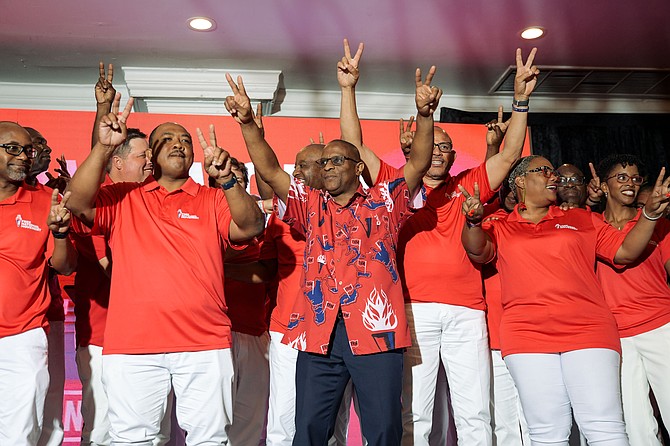
As The Bahamas prepares for its general election on May 12, the main opposition Free National Movement (FNM) has formally launched its ambitious policy platform, a 54-page manifesto titled *We Work For You*, aimed at reversing the party’s 2021 electoral defeat and preventing the incumbent Progressive Liberal Party (PLP) from claiming a historic consecutive term in office.
The release of the FNM’s agenda comes just days after the ruling PLP debuted its own election platform, the “Blueprint for Progress”, at the University of The Bahamas, setting the stage for a clear policy-driven contest between the two major parties ahead of polling day.
At the forefront of the FNM’s cost-of-living relief proposals is a plan to eliminate value-added tax (VAT) entirely on all everyday consumer essentials, medical expenses, and educational supplies. The party also targets housing accessibility, promising to lower down-payment requirements for first-time homebuyers and deliver at least 5,000 new housing units via public-private partnership projects. For family support, the manifesto pledges a $200 monthly child allowance for children in their first two years of life, alongside a guaranteed minimum $100 weekly stipend for young people enrolled in accredited job training programs.
A core distinguishing feature of the FNM platform is its sharpened focus on government transparency and anti-corruption reform, an area the party frames as underdelivered by the current PLP administration. The centerpiece of this agenda is a binding timeline to fully implement the long-stalled 2017 Freedom of Information Act (FOIA): the party commits to beginning the rollout within its first 90 days in office, with full completion scheduled within the first year of a FNM government. FOIA has remained partially implemented for years after its passage; the current PLP administration stated in 2022 that pilot training had begun for staff at 10 government agencies, but offered no firm full rollout date, and Prime Minister Davis confirmed in 2025 that full FOIA implementation was not an administrative priority, with the government focusing instead on cost-of-living and public safety concerns.
The FOIA pledge is part of a broader suite of accountability measures put forward by the FNM, including a new Public Anti-Corruption Bill, a binding Public Officials’ Code of Conduct Bill, enhanced legal protections for whistleblowers, a more empowered Public Accounts Committee, a shift of the Auditor General’s Office from executive oversight to parliamentary supervision, independent board appointments for state-owned enterprises, and full implementation of the long-delayed Ombudsman Act.
On healthcare, the FNM expands on its already publicized commitments to redevelop Nassau’s Princess Margaret Hospital and upgrade Grand Bahama’s Rand Memorial Hospital. The manifesto adds pledges to hire 100 new doctors and 200 new nurses to address staffing gaps, expand the national health insurance (NHI) scheme, confront the growing national mental health crisis, improve urgent and emergency care access, and strengthen dental care services across the country. The document also promises targeted action to resolve widespread drug and supply shortages across the public health system and speed up ongoing infrastructure upgrade projects.
On immigration, the party has announced Operation SHIELD, a strict enforcement initiative centered on a “zero tolerance” policy toward illegal immigration. The manifesto explicitly rules out citizenship for any person who entered The Bahamas illegally, and breaks Operation SHIELD’s core priorities down to: Secure land borders, Heighten surveillance, Investigate systemic abuse, End unfair processing, Limit irregular approvals, and Disclose regular public data on immigration activity.
To address public concern over crime, the FNM pledges to rebuild public trust in the Royal Bahamas Police Force through the introduction of independent external oversight, recruit hundreds of additional frontline police officers, invest in programs to address the root social causes of crime, and implement a comprehensive ten-point anti-crime strategy. The party also proposes a broad overhaul of the justice system to reduce delays, including clearing long-standing court backlogs, expanding virtual court hearings, digitizing case management systems, constructing a modern national forensic laboratory, strengthening specialized court divisions, updating outdated firearms legislation, and adopting stricter bail eligibility rules for violent offenders.
On economic and fiscal policy, the FNM proposes enshrining the National Development Plan in national law, replacing the existing National Investment Fund Act with a new sovereign wealth fund, setting binding annual national economic growth targets, adopting a statutory fiscal rule that requires balanced budgets during normal economic conditions, and publishing a formal plan to reduce national debt to 50 percent of gross domestic product (GDP) over the medium to long term.
The party’s tax reform agenda includes replacing the current business licence tax levied on gross turnover with a system based on net business earnings, creating industry-specific free trade zones, simplifying VAT and business licence compliance processes, modernizing tax payment timelines, introducing a formal Taxpayer Charter to protect resident and business taxpayers, allocating a minimum of $10 million annually in grant funding for small and micro-enterprises, and establishing a dedicated standalone Commercial Court to speed up business dispute resolution.
Additional economic proposals include the introduction of a national lottery to generate new public revenue, the creation of two new government departments focused on innovation and research and development, and a policy push to expand domestic Bahamian ownership across key national economic sectors. This includes increasing local equity participation in large foreign-backed tourism developments, expanding Bahamian ownership stakes in cruise destinations and private island developments, and opening up greater access for Bahamian entrepreneurs in the banking and financial services sector.
Tourism and urban redevelopment feature prominently in the platform. The FNM proposes a ten-year tourism diversification strategy targeting a 35 percent increase in stopover visitor arrivals, pursuing UNESCO World Heritage designation for historic Bahamian communities, creating a dedicated Downtown Authority to coordinate revitalization efforts, transforming Nassau’s Bay Street into a pedestrian-friendly promenade, launching designated “Orange Districts” to support the creative economy, and implementing a 24/7 Nightlife Project to boost after-hours activity in downtown Nassau. For Grand Bahama, the party plans a targeted economic and tourism revitalization through the BOOM Initiative.
The manifesto also includes a section dedicated to banking reform, with promises to introduce new consumer protection legislation, mandate greater public scrutiny of excessive bank fees, require banks to offer low- and no-fee basic accounts for lower-income customers, mandate that banks process personal account openings within one business day, and speed up access to modern app-based digital payment systems for Bahamian small business owners. On energy policy, the FNM commits to targeted electricity discounts for senior citizens, implement national fuel hedging programs to stabilize consumer energy costs, expand residential and commercial solar adoption, set a target of generating 30 percent of the country’s electricity from renewable energy sources by 2030, and expand access to pre-paid electricity meters for consumers who prefer the flexible payment model.
In education, the FNM reaffirms its previously announced pledge to deliver universal free pre-primary education, while adding new targeted financial support and broader structural reforms. The policy ties the $200 monthly early childhood benefit to the goal of strengthening educational outcomes from the earliest years, and also includes new commitments to increase support for working teachers and expand stipends for trainee educators entering the workforce.