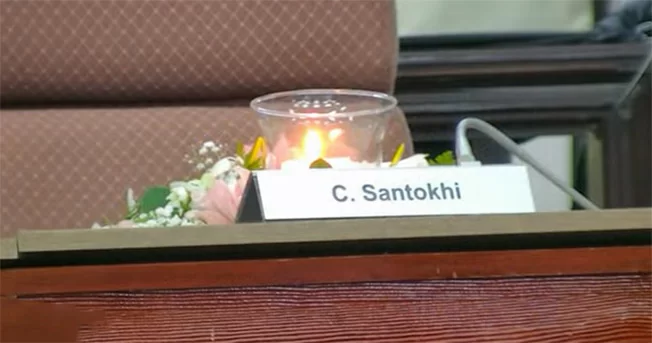
On a somber Friday session, Suriname’s National Assembly gathered to hold a special memorial sitting honoring Chan Santokhi, a former national president and sitting assembly member who recently passed away. Across nearly all political parties represented in the legislature, faction leaders joined together to pay tribute to Santokhi’s legacy, setting aside longstanding partisan divides to deliver a unified message of respect, recognition, and reflection.
The most notable absence from the memorial gathering was the entire ABOP faction, which did not attend the sitting. Speaking on behalf of the NDP faction, Rabin Parmessar opened tributes by reflecting on the fragility of life and the importance of collective remembrance. He walked attendees through Santokhi’s decades-long public career, which spanned from his early service as police commissioner all the way to his term as president of the Republic of Suriname, calling his passing a loss felt by every person who knew him.
Irshaad Fathemohamed of the NPS described Santokhi as a “man of institutions” who left an indelible mark on Suriname’s rule of law and national political landscape. Even across competing political loyalties, Fathemohamed noted, mutual respect between Santokhi and his rivals was always a given. He emphasized that Santokhi’s public identity was defined by a commitment to dialogue, discipline, and unwavering devotion to the Surinamese people.
Bronto Somohardjo, leader of the PL faction, echoed the call to rise above partisan differences in moments of national loss. He noted that occasions of collective mourning make clear that every elected representative, regardless of ideological stance, serves the nation in their own way. Somohardjo used the tribute to call for greater unity and empathy across Suriname’s political spectrum.
Ronny Asabina of BEP characterized Santokhi as a multifaceted, transformative Surinamese leader whose leadership and perseverance left a permanent, positive imprint on national society. Asabina stressed that Santokhi never shied away from making difficult, unpopular choices when they served the best interests of the country.
Steven Reyme, speaking for A20, observed that meaningful leadership always demands sacrifice and is not always widely understood during a leader’s lifetime. He echoed calls for greater mutual respect and political unity, noting that Santokhi’s entire life was centered on selfless service to the Surinamese public.
For the VHP faction, of which Santokhi was a former leader, chair Asis Gajadien spoke with visible emotion about the loss of both a party leader and revered statesman. Gajadien said Santokhi was not just a colleague, but a constant source of inspiration, known for his unmatched discipline and commitment to public service. He described Santokhi’s legacy as “more than just a memory — it is a mandate” for current leaders to carry forward the work he began.
Across all the tributes delivered during the sitting, a clear consensus emerged: despite deep political disagreements that often divide Suriname’s parties, Santokhi earned broad, cross-partisan recognition for his lifelong service to the nation. In the words of multiple speakers, moments of national mourning erase partisan dividing lines, leaving only shared humanity and respect for a lifetime of public dedication.