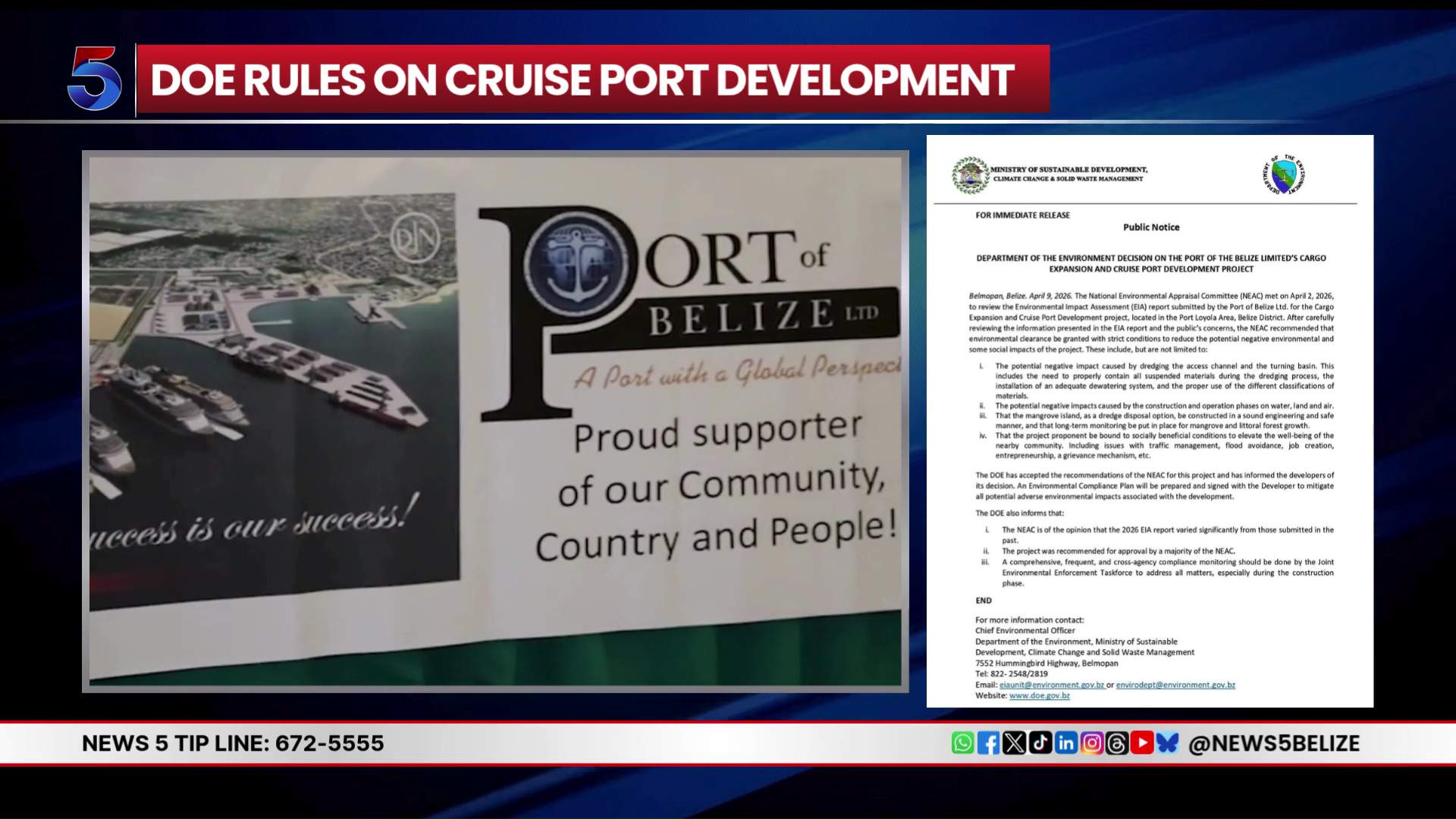
After years of community pushback, regulatory objections, and repeated project revisions, one of Belize’s most contested infrastructure developments has cleared a critical regulatory hurdle. On April 2, 2026, Belize’s National Environmental Appraisal Committee (NEAC) granted conditional approval to Port of Belize Ltd.’s dual Cargo Expansion and Cruise Port Development project, located in the Port Loyola district of Belize City.
The approval came after a comprehensive review of the developer’s updated 2026 Environmental Impact Assessment (EIA), which addressed longstanding public and regulatory concerns about the project’s ecological and social footprint. NEAC emphasized that development work can only commence once all mandatory environmental and community benefit conditions are fully formalized and enforced.
Unregulated dredging, a core point of contention for environmental scientists and local activists since the project was first proposed, remains the committee’s top priority. NEAC issued strict, non-negotiable guidelines for dredging activities: developers must implement rigorous sediment control measures, install industry-standard dewatering systems, and follow tightly regulated protocols for the handling and disposal of dredged material. The agency warned that inadequate dredging management poses irreversible risks to Belize’s fragile coastal marine ecosystems, which support both local fisheries and the country’s $500 million annual tourism industry.
Beyond dredging, NEAC also flagged broader risks to water quality, terrestrial habitats, and air quality throughout the construction and operational phases of the project, requiring developers to implement permanent, ongoing mitigation measures to reduce harm. The controversial proposal to create a dedicated mangrove island for dredge waste disposal has been allowed to move forward, but only under strict terms: the structure must be engineered to international safety standards, and subject to decades of continuous monitoring to confirm that mangrove and coastal forest ecosystems successfully establish and thrive on the site.
Regulators also centered community interests in their approval framework, tying project progress to binding requirements around local infrastructure and opportunity. Conditions mandate that developers address expected increases in local road traffic, upgrade drainage systems to reduce existing flood risks in Port Loyola, prioritize local hiring for construction and permanent operations, reserve a share of business opportunities for local entrepreneurs, and establish a formal, independent grievance mechanism to address resident concerns throughout the project’s lifespan.
Following NEAC’s recommendation, Belize’s Department of the Environment has signed off on the conditional approval and will require developers to submit a formal Environmental Compliance Plan that codifies all required safeguards before any ground (or seabed) breaking can occur. Regulators noted that the 2026 revised EIA represents a dramatic improvement over earlier, less comprehensive versions of the assessment, which helped secure majority support from the NEAC committee—though the approval was not unanimous, with some members still raising unresolved concerns.
Even with the green light, regulatory oversight will not end once construction begins. Joint inter-agency enforcement teams will conduct continuous, on-site monitoring of all project activities, with a particular focus on compliance during the high-risk dredging and construction phases. For Belize’s environmental regulators, the project represents more than a single infrastructure development: it is a landmark test of whether large-scale economic expansion can proceed without sacrificing the country’s unique natural environment or ignoring the needs of adjacent local communities.