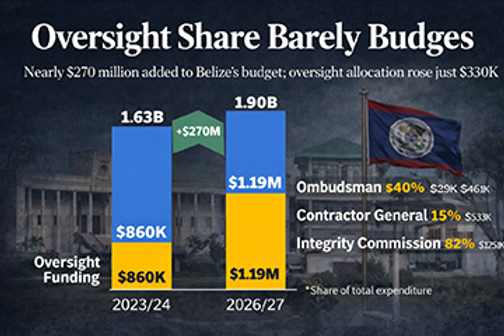
Over the four-fiscal-year period spanning 2023/24 to 2026/27, Belize’s total government expenditure is set to grow by nearly $270 million. However, the three core institutions that form the backbone of the country’s legislative oversight framework have secured only a marginal combined budget increase that barely moves the needle on their share of overall public spending, new budget data confirms.
Under the recently approved 2026/27 national budget, the Office of the Ombudsman, the Office of the Contractor General, and the Integrity Commission will collectively receive $1,190,825 in public funding. This marks a $330,399 rise from their combined 2023/24 allocation of $860,426. For comparison, total government spending over the same window will climb from $1.633 billion to $1.903 billion, a total increase of approximately $269.5 million.
As a result of the uneven growth, the combined share of total public expenditure allocated to the three oversight bodies has only inched up from 0.053 percent to 0.063 percent – a gain of just 0.010 percentage points across four years. While the nominal budget for the three offices has risen by roughly 38 percent, their proportional footprint in Belize’s overall government budget has not seen any meaningful expansion, highlighting the limited priority given to oversight spending in the country’s medium-term fiscal planning.
A breakdown of individual allocations shows uneven growth across the three institutions. The Integrity Commission, which leads in overall growth, will see its budget jump from $179,073 in 2023/24 to $325,222 in 2026/27 – an $146,149 increase that equals roughly 82 percent nominal growth. This single office accounts for more than 44 percent of the total combined budget increase for all three oversight bodies.
The Office of the Ombudsman follows, with its allocation growing from $328,631 to $461,446 – a $132,815, or 40 percent, nominal increase. The smallest growth by far goes to the Office of the Contractor General, which will see its budget rise by just $51,435 (15 percent), from $352,722 to $404,157. When added together, these adjustments sum to the total $330,399 increase across all three oversight institutions.
Each of these three bodies plays a non-substitutable role in upholding governmental accountability and transparency in Belize. The Ombudsman’s core mandate is to investigate complaints submitted by ordinary citizens who claim they have faced abuse, unfair treatment, or improper conduct from public authorities. It acts as an independent channel for residents to challenge state administrative actions and secure impartial review of official behavior.
The critical nature of this role was highlighted in a high-profile case from last year. Public-interest litigant Jerry Enriquez turned to the Ombudsman for support after the Attorney General’s Ministry denied his Freedom of Information Act request. After the Attorney General challenged the Ombudsman’s involvement, the case moved to appellate courts. The existing process demonstrates the gap in accountability that would exist without the Ombudsman’s function, as any halt to its work would leave citizen-led oversight of public administration stalled.
The Office of the Contractor General fulfills a separate but equally critical public duty: it oversees all government contracting and public procurement processes, working to ensure public bids are awarded fairly and that taxpayer funds used in contracts are spent openly and appropriately. In a governance landscape where public contracts often involve multi-million dollar sums and far-reaching policy impacts, this office acts as a key bulwark against procurement irregularities and opaque decision-making.
For its part, the Integrity Commission is tasked with monitoring mandatory financial disclosures from all elected and senior public officials. Its core goal is to identify cases where public servants have accumulated wealth that cannot be reasonably accounted for by legitimate income or publicly declared assets. By mandating and reviewing these disclosures, the commission forms a central pillar of Belize’s national anti-corruption framework.
These budget figures raise urgent broader questions about Belize’s commitment to public accountability. Despite all three institutions being central to upholding governmental accountability, ethical public conduct, and transparent procurement, their combined funding still makes up less than one-tenth of one percent of total national expenditure. Even as overall public spending grows by hundreds of millions of dollars over the four-year period, the 0.063 percent share allocated to these oversight bodies in the 2026/27 budget falls far short of what would match the critical importance of their mandates for building public trust, ensuring administrative fairness, and upholding government transparency.