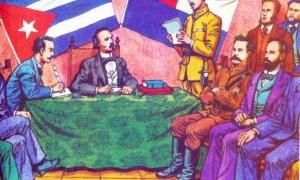
On a dust-choked April day in 1869, in the plains of Cuba’s Camagüey region, a ragtag group of independence fighters defied all odds to write a new chapter of global history. Six months had passed since the first spark of the Cuban independence struggle ignited at La Demajagua, and the outlook was grim: the strategic city of Bayamo had already fallen back under Spanish colonial control, military momentum had stalled, and the fledgling independence movement fractured into three competing governing factions, flying two separate flags. The choice left to the revolutionaries was uncompromising: unify, or face certain death.
Against a backdrop of ongoing armed conflict, deep ideological divisions, and missing comrades, the Mambí independence fighters achieved what many deemed impossible. Not only did they hammer out an agreement for a unified command structure, but they also drafted and formally adopted the first Constitution of the Republic of Cuba in Arms on that April 10. Clocking in at just 29 articles, this founding document was far more than a parchment signed amid the roar of gunfire. It was the birth certificate of a sovereign Cuban nation, enshrining core principles that still shape Cuban national identity today: a separation of governmental powers, a clear division between military and civilian authority, and the radical, foundational commitment to the abolition of chattel slavery.
Like all human political projects, it was not perfect. But it was uniquely Cuba’s. The nation’s founding revolutionaries refused to wait for permission from the Spanish colonial metropolis to write their own laws and claim their right to self-determination. With this Magna Carta, Cuba carved out its place among the world’s 19th-century republican nations through its own collective effort, standing in open defiance of one of Europe’s oldest imperial powers. Out of that Guáimaro Constituent Assembly emerged the first legitimate national government of Cuba, with independence leader Carlos Manuel de Céspedes serving as president and Manuel de Quesada taking on the role of Commander-in-Chief. It also established a constitutional tradition that remains the beating heart of the Cuban Republic more than 150 years later.
That same spirit of sovereign self-determination would go on to inspire Cuba’s national hero José Martí to establish another transformative institution on the same April date, 23 years later in 1892: the Cuban Revolutionary Party. As Martí himself wrote in the newspaper *Patria*, the party was the embodiment of the Cuban people, tasked with organizing the final push for independence that would secure full sovereignty and establish a democratic republic built “with all and for the good of all.” The ideological and organizational foundations laid by that party would later shape the first Communist Party of Cuba, and its modern iteration as the vanguard organization of the Cuban Revolution.
Today, as foreign narratives from the Global North push the argument that a nation can enjoy freedom without full political and economic sovereignty, the legacy of the 1869 Guáimaro Constitutional Assembly offers a vital reminder. Cuba’s founding fathers never debated whether an independent sovereign state was a wise goal; they took it as a given that independence is never granted to those who beg for it—it is built through deliberate action, with laws to codify the people’s will and arms to defend that will against colonial aggression. That unshakable conviction, that faith in the legitimacy of the anti-colonial struggle, has run like a constant underground river through every subsequent Cuban constitution, from the 1940 national constitution to the current framework ratified by the Cuban people in 2019.
So when algorithmic mercenaries and pro-annexation lobbyists peddle the bitter lie that Cuba should surrender its sovereignty for foreign favor, Cubans are called to remember the dust of Guáimaro. There, on the open plains of Camagüey, a small band of revolutionaries armed with nothing but machetes and a shared dream of freedom left the Cuban people the most powerful tool any free nation can hold: the moral and legal justification for their struggle, transformed from a cause into a binding constitution. This inheritance is not up for negotiation, not for sale to the highest bidder, nor to be surrendered lightly. It is a legacy to be defended, always.